ICRA — Infection Control Risk Assessment — is the structured process that governs how construction and renovation work proceeds in and adjacent to occupied healthcare facilities. It is required by the Joint Commission, adopted by Florida's AHCA (Agency for Health Care Administration) as a component of the construction review process, and embedded in standard practice at every accredited hospital in Jacksonville and across Northeast Florida. What is less well understood is that ICRA compliance does not just protect patients — it is one of the most powerful schedule protection tools available on a hospital construction project.
JK Prestige Construction has zero ICRA violations on completed healthcare projects. That record comes from a specific protocol: a preconstruction ICRA walkthrough with the clinical team, a documented barrier design approved before mobilization, and a daily barrier inspection conducted by our superintendent. Read about JK's hospital construction approach for more detail on how this works in practice.
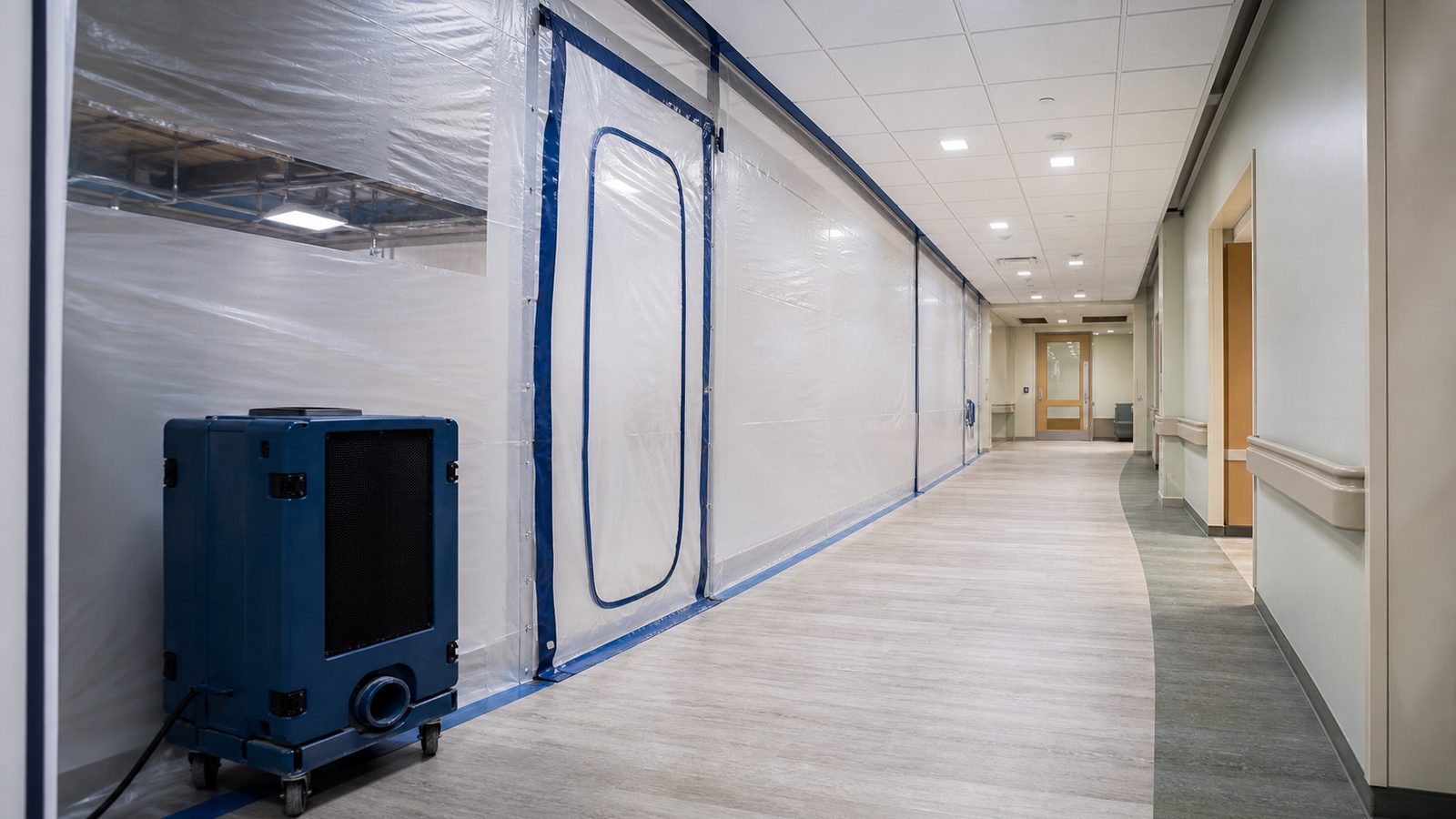
1. Prevents Airborne Pathogen Spread to Immunocompromised Patients
The primary purpose of ICRA is to prevent construction-generated particulates — dust, fungal spores, and airborne debris — from reaching patients who cannot defend against them. Aspergillus fumigatus, a fungus that lives in soil and building materials, is nearly harmless to healthy individuals but has a mortality rate above 50% in severely immunocompromised patients (bone marrow transplant recipients, patients on high-dose immunosuppression). A dust release during construction in or adjacent to a hematology-oncology unit can cause an outbreak traceable to the construction event. ICRA barriers — when correctly designed and maintained — contain that dust. The containment is not decorative: a proper negative-pressure ICRA barrier with a HEPA (High-Efficiency Particulate Air) exhaust unit creates airflow dynamics that move air from the patient areas toward the construction zone, preventing pathogen migration in either direction.
2. Defines Barrier Type Before Work Begins — No Guessing on Site
Without an ICRA document, the GC's superintendent makes real-time decisions about barrier construction that should have been made by the infection control committee weeks before mobilization. Is plastic sheeting sufficient, or does this project require a hard-wall temporary partition? Is negative pressure required? How many air changes per hour must the containment unit maintain? These decisions have cost and schedule implications — a hard-wall barrier with HEPA exhaust can add $15,000–$40,000 to a small renovation scope compared to a simple plastic dust partition. Making that decision on the fly, during construction, based on a facilities manager's best guess, is how ICRA violations happen and how budgets blow up. JK requires the ICRA barrier type to be specified in the signed ICRA document before our crew touches the first stud. In Jacksonville hospitals including Baptist and UF Health facilities, this documentation is standard — JK enforces it as a condition of mobilization.
3. Gives the Clinical Team Predictable Construction Boundaries
ICRA documentation establishes exactly where construction begins and ends — which corridors, which doors, which vertical penetrations. Clinical staff and nursing management use that information to plan patient movement, staff assignments, and visitor routing for the duration of the project. When barriers move without notice, clinical teams cannot maintain the infection control protocols they have built into their operations. That breakdown causes friction between clinical and construction teams that slows projects: nursing managers call administrators, administrators call facilities, facilities calls the GC, and work stops while everyone sorts out what happened. JK locks barrier locations in the ICRA drawings and requires written approval from the infection control practitioner (ICP) for any barrier modification, no matter how minor. That single protocol eliminates most clinical-construction conflicts on occupied hospital sites.
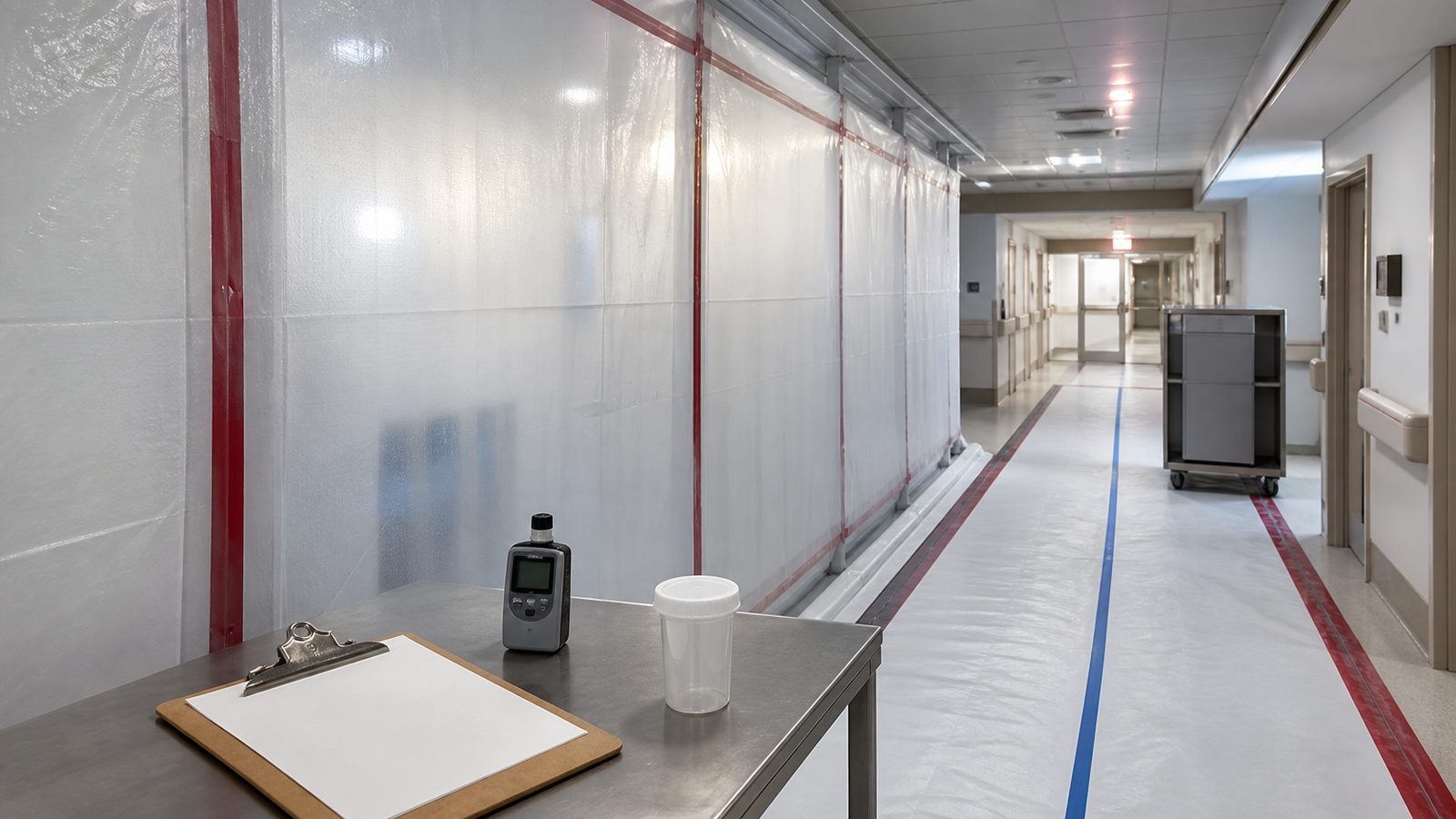
4. Reduces Emergency Work Stoppages from JCAHO Inspections
The Joint Commission (JCAHO) conducts unannounced surveys of accredited hospitals. When a survey occurs during an active construction project, surveyors will inspect the construction area for ICRA compliance: signed ICRA documents on site, barrier integrity, negative pressure verification, contractor PPE (personal protective equipment) compliance, and the infection control committee approval signatures. A project that cannot produce those documents during an unannounced survey will receive a finding — and findings during construction can escalate to a requirement that work stop until the deficiency is corrected. JK maintains a full ICRA compliance binder on every hospital project site: signed ICRA assessment, barrier design drawings with infection control committee approval, negative pressure monitoring logs, and daily barrier inspection records. That documentation is ready for a survey at any time, with no advance preparation required.
5. Protects the GC from Liability When Documented Correctly
If a patient develops a healthcare-associated infection (HAI) traceable to a construction event, and the GC cannot demonstrate that ICRA protocols were followed, the GC's liability exposure is significant. If the GC can produce a complete ICRA documentation package — signed risk assessment, barrier design approvals, daily inspection logs, negative pressure monitoring records, and superintendent sign-off on each work shift — the GC has documented evidence of due diligence. That documentation does not guarantee freedom from liability in every scenario, but it is the difference between a defensible position and an indefensible one. JK's ICRA documentation protocol exists as much for our protection as for the patient's. Every document is date-stamped, signed, and retained in the project file for the full warranty period after project completion.
6. Defines Pressure Relationships in HVAC Before Demo
One of the most technically consequential ICRA decisions is the pressure relationship between the construction zone and the adjacent patient areas. Positive-pressure rooms push air outward — appropriate for immune-protected patients who need a clean supply. Negative-pressure rooms pull air inward — appropriate for isolation patients. The construction zone itself should be negative relative to surrounding occupied spaces, meaning air flows from the clean patient areas toward the dirty construction zone, not the reverse. Establishing this pressure relationship requires HVAC coordination before demolition begins. If the existing HVAC in the construction zone is set up for positive pressure (as it might be in a former clean procedure room), it must be modified or supplemented with a temporary HEPA exhaust unit before demo. JK's preconstruction ICRA walkthrough includes an HVAC pressure relationship review with the facility's mechanical team for every occupied hospital project.
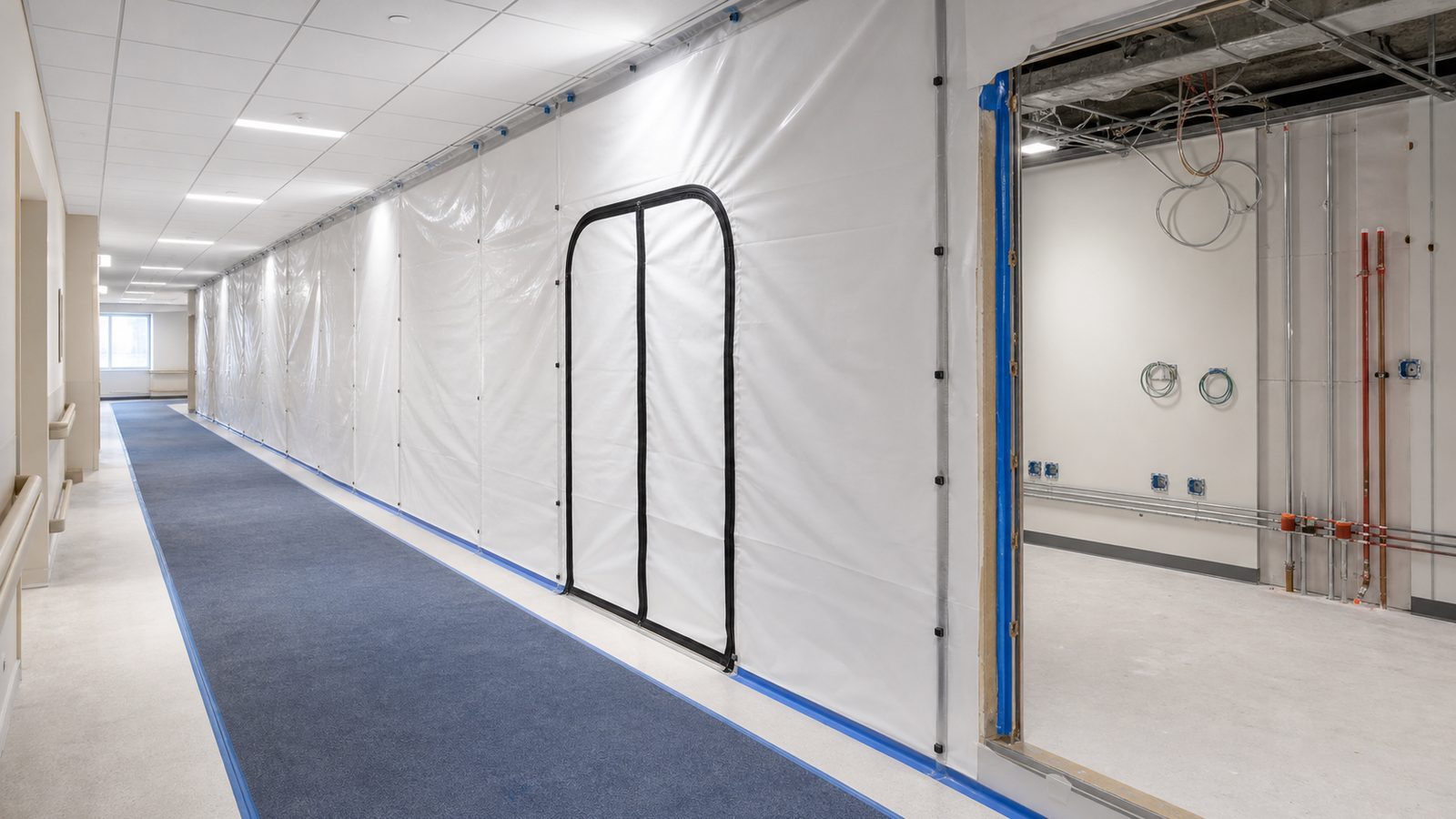
7. Enables Phased Work Planning That Minimizes Clinical Disruption
ICRA compliance forces a phasing conversation that many hospital projects defer until construction begins — and that deferral is expensive. When you know the ICRA barrier type, the pressure requirements, the adjacent patient risk group, and the MEP shutdown sequence before mobilization, you can design a phase plan that minimizes the number of days each clinical area is affected. That planning typically reveals that a project originally scoped as three phases can be executed in two by sequencing MEP work differently — saving two barrier installations, two inspections, and two moves by clinical staff. JK develops a phasing plan as part of our preconstruction ICRA process, and that plan is submitted to the clinical coordinator for approval before work begins. Contact JK to discuss phasing for your next hospital renovation.
Get a written estimate in 48 hours. Call (904) 944-0278 or request a consultation.
No call center. No coordinator. A JK principal reviews every inquiry and replies with a real number, not a range, not a follow-up form.
Request Free Estimate →