Commercial roofing in Florida is a different discipline from residential roofing. The systems are different, the failure modes are different, the regulatory framework is different, and the contractors qualified to perform the work are a smaller subset of the licensed roofing contractor pool than most building owners realize.
This guide is written for commercial building owners, developers, and property managers in Northeast Florida who need to understand commercial roofing systems well enough to write an informed specification, evaluate contractor qualifications, and make a defensible material selection for their building. The information here applies to new commercial construction, roofing replacement on existing commercial buildings, and re-roofing of industrial, healthcare, and mixed-use facilities in the Jacksonville market.
JK Prestige Construction self-performs roofing on commercial and healthcare projects throughout Duval, St. Johns, Clay, and Nassau counties. We are a GAF Master Elite certified roofing contractor. Our principal walks every commercial roofing project personally. Get an estimate at https://jkprestigeconstruction.com/#/contact.
Why Commercial Roofing Is Categorically Different From Residential
The defining difference between commercial and residential roofing is slope. Residential roofing in Florida is almost entirely pitched roofing — slopes of 2:12 or greater — where water sheds by gravity. Commercial buildings, particularly single-story retail, warehouse, and medical office buildings, typically have flat or low-slope roofs: 1/4:12 to 2:12. Water on a low-slope roof does not shed by gravity alone. It must be managed through engineered drainage systems.
This changes everything: the waterproofing requirement, the material systems that are appropriate, the inspection and maintenance protocol, and the consequence of failure. A pinhole in a residential shingle system may allow water intrusion during a heavy rain event. A 4-inch gap in a membrane seam on a 50,000 square foot low-slope roof can admit thousands of gallons of water into the building before it is discovered.
Commercial membrane roofing systems must be continuous and seamless in their waterproofing plane. Seams — where membrane sheets are joined — are the primary failure point. The quality of seam welding or bonding determines the long-term performance of the entire roof. This is a skill-intensive installation that separates experienced commercial roofers from residential contractors who occasionally attempt commercial work.
The membrane area of a large commercial building also creates a thermal mass problem. Dark-colored membranes in Florida's climate can reach surface temperatures of 160–180°F in peak summer conditions. This thermal loading accelerates membrane aging and increases cooling loads for the building. Material selection for commercial roofing in Florida is partly a durability decision and partly an energy performance decision.
Florida Climate Considerations for Commercial Roofing: UV, Heat, Wind Uplift, and Ponding Water
Four climate factors drive commercial roofing system selection in Northeast Florida.
UV degradation is the primary long-term membrane degradation mechanism in Florida's climate. Materials that perform well in northern climates — where UV exposure is moderated by cloud cover and lower sun angles — may underperform their rated service life in Florida. Membrane manufacturers' published service lives are typically rated for a national average climate; Florida performance may deviate.
Heat aging accelerates the oxidation of polymeric membrane materials. TPO and EPDM membranes both degrade under sustained high-temperature exposure, but their degradation mechanisms differ. TPO can become brittle at seams under sustained heat. EPDM can experience accelerated oxidation of the rubber compound. Both can be mitigated with reflective coatings and proper membrane thickness specification.
Wind uplift in Florida's commercial building code is governed by ASCE 7 wind load calculations and verified by FM 4470 (Factory Mutual) testing. FM 4470 classifies commercial roofing assemblies by their resistance to wind uplift pressure. Florida commercial buildings are typically required to meet FM 1-90 or FM 1-120 uplift ratings (the number indicates minimum wind uplift pressure in psf). The specified roofing assembly — membrane type, insulation attachment method, and deck attachment — must be FM-listed for the required rating. An assembly that is not FM-listed for the building's wind uplift requirement is a code non-compliance.
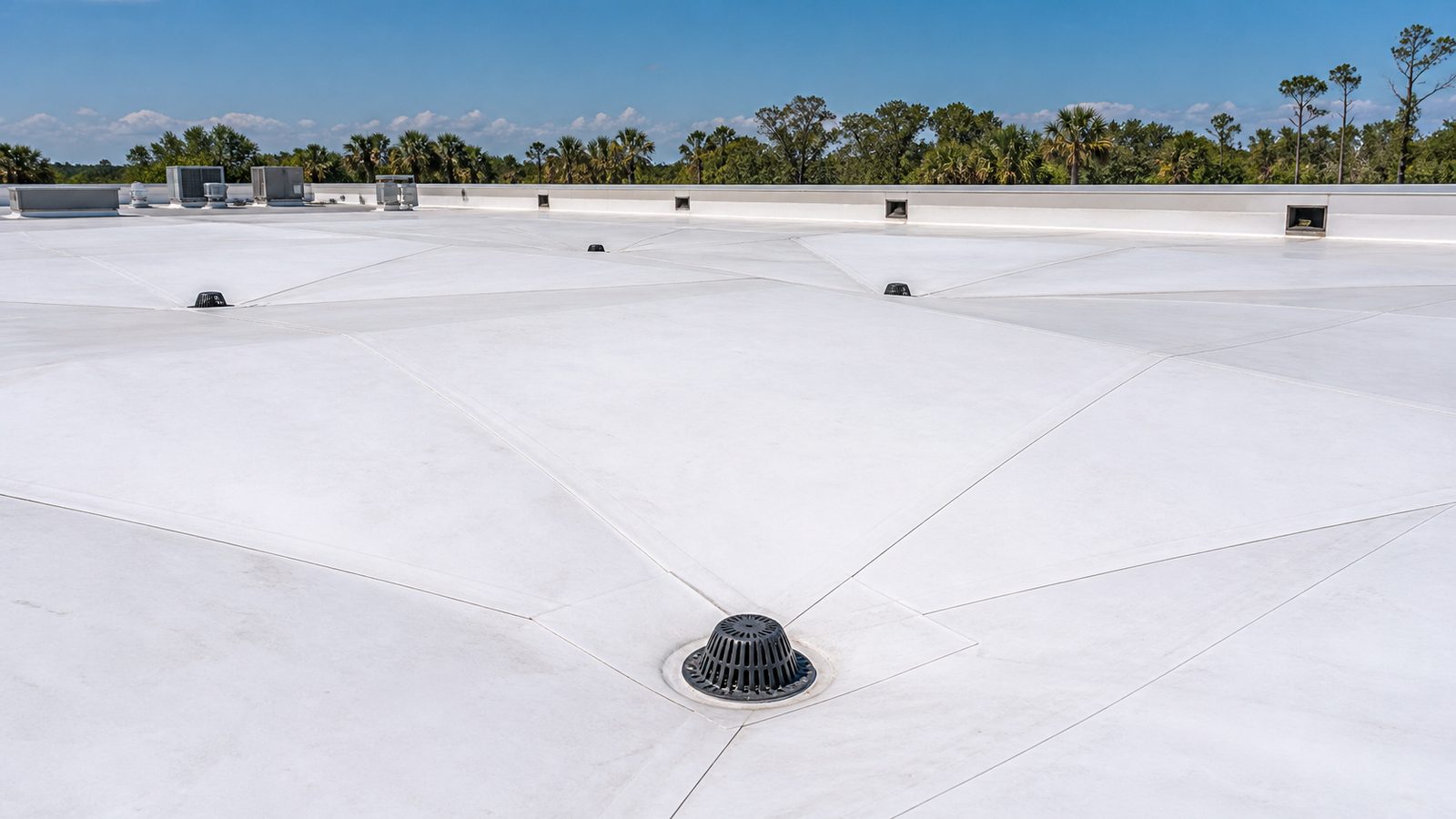
Ponding water — water that remains on a flat or low-slope roof more than 48 hours after a rain event — is both a structural and a waterproofing problem. Structurally, ponding water adds dead load to the roof deck at a rate of 5.2 psf per inch of depth. A 4-inch pond of water on a 10,000 square foot roof area adds over 208,000 pounds of unplanned dead load. From a waterproofing perspective, ponding water accelerates membrane degradation and is a specific exclusion in most commercial roofing warranties. Proper commercial roofing specification requires verified drainage design, not assumed drainage.
TPO Roofing: The Dominant Florida Commercial System
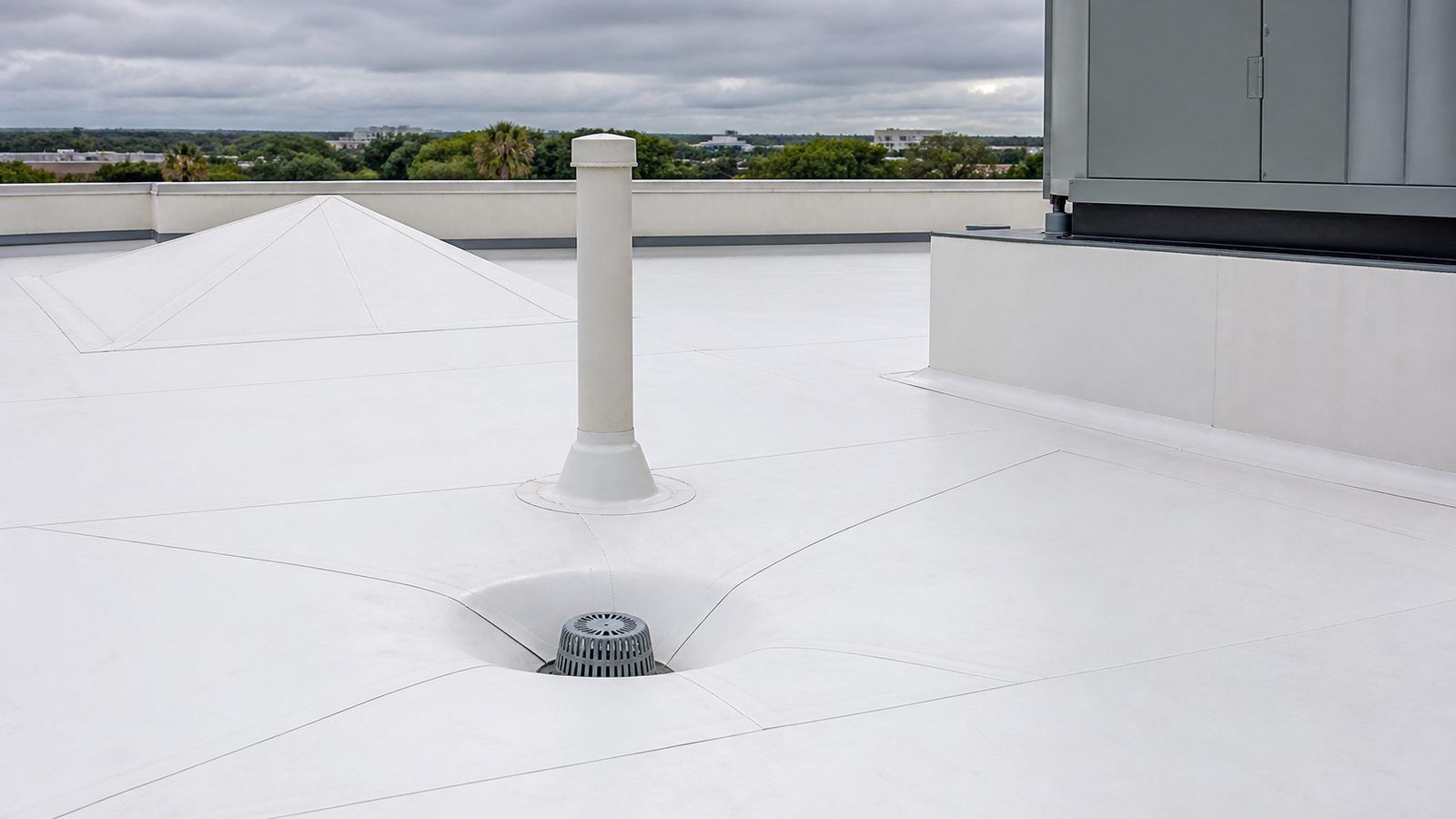
Thermoplastic Polyolefin (TPO) is the most widely installed commercial membrane roofing system in Florida. It accounts for the majority of new commercial roofing installations and re-roofing projects in the Jacksonville market.
TPO is a single-ply thermoplastic membrane available in 45-mil, 60-mil, and 80-mil thicknesses. In Florida's commercial market, 60-mil is the standard specification for most applications. Specifying 45-mil TPO to reduce cost is a false economy — the membrane's resistance to puncture, seam stress, and UV degradation is directly related to thickness.
TPO is heat-welded at seams using hot-air welding equipment. The seam weld creates a homogeneous bond between the two membrane layers that, when properly executed, is stronger than the membrane itself. Seam width is critical — the current TPO installation standards require a minimum 1.5-inch weld. Seams narrower than this minimum are prone to peel under wind uplift.
TPO is available in white, tan, and gray. White TPO has the highest solar reflectance — typically 0.75–0.80 Solar Reflectance Index (SRI) — which reduces cooling loads and qualifies for LEED and energy code credits. In Jacksonville's climate, the energy performance of white TPO is meaningful: studies document 10–15% cooling energy reductions versus dark-colored membranes in similar Florida climates.
Installed cost for 60-mil TPO in Northeast Florida in 2025: $8–$12 per square foot for a standard low-slope re-roofing project, including tear-off of one existing membrane layer, insulation inspection, and fastening. Complex roof configurations with high drain counts, penetrations, or structural work add cost.
Service life for properly specified and maintained TPO in Florida: 20–30 years for 60-mil membrane with annual maintenance. The lower end of this range reflects aggressive UV climates without reflective coating maintenance; the upper end reflects maintained systems with periodic topcoat application.
See JK Prestige's commercial roofing capabilities at https://jkprestigeconstruction.com/#/roofing.
EPDM Roofing: When It's Specified and Why
Ethylene Propylene Diene Monomer (EPDM) is the second most common commercial membrane in Florida, though its market share has declined relative to TPO over the past decade. EPDM is a synthetic rubber membrane with excellent flexibility and long-term UV resistance in certain climate profiles.
EPDM is available in 45-mil, 60-mil, 75-mil, and 90-mil thicknesses. Like TPO, the 60-mil is the standard specification for Florida commercial applications. Unlike TPO, EPDM seams are not heat-welded — they are bonded using adhesive or taped using EPDM seam tape. Adhesive-bonded seams have historically been the primary failure mode for EPDM roofing. Modern EPDM seam tapes have improved seam reliability but require more precise surface preparation than heat-welded TPO.
EPDM is typically black, which creates a significant surface temperature differential versus white TPO — EPDM surfaces can reach 180°F+ in peak Florida summer conditions. This thermal loading was historically a reason to prefer EPDM for its thermal flexibility (the rubber compound accommodates greater thermal movement than early TPO formulations), but modern TPO has closed this gap. White EPDM is available but accounts for a small fraction of installations.
EPDM is specified in Florida on applications where chemical exposure is a concern — certain industrial facilities, areas adjacent to HVAC equipment with refrigerant exposure, and facilities with specific rooftop chemical storage. EPDM has better resistance to certain chemical exposures than TPO.
Installed cost for 60-mil EPDM in Northeast Florida in 2025: $9–$14 per square foot. EPDM is typically more expensive than equivalent TPO due to higher material cost and more labor-intensive seaming.
Metal Roofing for Commercial Buildings: Systems and Florida-Approved Fastener Patterns
Commercial metal roofing divides into two primary systems: exposed-fastener panels and standing seam panels. Each has a distinct performance profile and cost structure.
Exposed-fastener metal panels use screw fasteners driven through the face of the panel into the structural support. The fastener penetrates the weather barrier. In Florida's climate, exposed fasteners are the primary leak source for aging exposed-fastener metal roofs — the rubber EPDM washer under each fastener degrades under UV and thermal cycling, eventually allowing water infiltration at every fastener point. Exposed-fastener metal is appropriate for agricultural, industrial, and low-cost commercial applications where periodic fastener replacement and maintenance are acceptable.
Standing seam metal panels connect to the structural support through concealed clips, not through the panel face. The panel surface has no penetrations. Standing seam provides significantly better wind resistance and water tightness than exposed-fastener systems. Florida-approved standing seam systems carry FM Approvals for specific wind uplift ratings. The clip pattern and substrate fastening must match the FM-listed configuration.
For commercial roofing specifications, specify the FM approval number and wind uplift rating alongside the panel profile and gauge. A standing seam panel installed with a non-approved clip spacing does not meet the FM listing regardless of how it looks.
Standing seam metal for commercial applications in Florida: $15–$30 per square foot installed depending on panel complexity, substrate condition, and parapet interface details. Metal roofing qualifies for significant commercial insurance premium reductions in Florida's wind zone.
Modified Bitumen: Multi-Layer Systems for High-Traffic Roofs
Modified bitumen roofing is a multi-layer system consisting of a base sheet, one or more modified bitumen cap sheets, and a surfacing layer. The bitumen is modified with either SBS (styrene-butadiene-styrene, a thermoplastic modifier that adds flexibility) or APP (atactic polypropylene, a plastomeric modifier that adds heat resistance).
Modified bitumen is specified where the roof will sustain significant foot traffic — mechanical equipment platforms, rooftop unit service areas, and facilities with frequent roof-accessed maintenance. The multi-layer system provides better puncture resistance than a single-ply membrane and allows localized repair without full-system disruption.
In Florida's climate, APP-modified bitumen is typically preferred for its superior UV and heat resistance versus SBS. SBS systems perform better in freeze-thaw climates where low-temperature flexibility is the design concern.
Modified bitumen systems require more skilled installation than single-ply membranes. Improper torch application temperature — either too hot (burning the membrane) or too cool (inadequate bond) — produces a system that looks complete but fails within the first few years. Specification of modified bitumen should include a requirement for installer certification from the membrane manufacturer.
Installed cost for a two-ply modified bitumen system in Northeast Florida: $10–$16 per square foot depending on base sheet type, cap sheet specification, and substrate condition.
Specification Writing: How to Write a Commercial Roofing Spec That Locks In Quality
A commercial roofing specification that merely names a membrane type and a dollar-per-square-foot budget does not protect the building owner. It invites substitution of lower-quality materials and installation shortcuts that are not detectable without invasive testing.
A complete commercial roofing specification includes:
Membrane manufacturer and product line — not "TPO equivalent" but the specific manufacturer and product (example: "GAF EverGuard TPO 60-mil"). Specify alternates explicitly if alternates are acceptable.
Membrane thickness — minimum 60-mil for Florida commercial applications. Reject 45-mil substitutions.
FM Approval listing — specify the required uplift rating (FM 1-90 or FM 1-120 for most Jacksonville commercial buildings) and require that the submitted assembly match the FM-listed configuration for attachment method and spacing.
Seam width and method — specify minimum 1.5-inch heat-weld for TPO; specify adhesive type and seam tape specification for EPDM.
Insulation type and attachment — specify polyisocyanurate (polyiso) insulation with mechanical attachment or approved adhesive. Specify R-value.
Drainage design — require the contractor to verify that existing drains are adequate for the specified membrane system and to document any drainage corrections required.
Warranty — specify the manufacturer's warranty type (System, NDL, or enhanced) and the required workmanship warranty term.
Maintenance requirement — include a post-installation maintenance provision that makes the warranty contingent on annual inspections and requires documentation.
Learn about JK Prestige's approach to fixed-price contracts and scope clarity at https://jkprestigeconstruction.com/#/the-jk-way.
Contractor Requirements: License, Certification, and Insurance for Commercial Membrane Work
Florida requires a CCC (Certified Roofing Contractor) license for all roofing work. For commercial membrane work, verify that the CCC license is current at the DBPR website and that the license has no active disciplinary actions.
Manufacturer certification for commercial membrane systems is separate from residential shingle certification. TPO installer certification from GAF, Carlisle, Firestone, or Johns Manville requires documented training on heat-welding equipment, seam preparation, and FM-compliant installation procedures. Verify the contractor's certification status directly with the membrane manufacturer — certifications expire and must be renewed.
Insurance requirements for commercial roofing: general liability minimum $1M per occurrence, $2M aggregate; workers' compensation covering roofing classification (NCCI code 5551); and, for projects over $500,000, an umbrella policy of $5M or greater is appropriate.
Verify the workers' compensation COI specifically for the roofing classification. Many contractors carry workers' compensation that excludes roofing — this is an unacceptable gap on a commercial roofing project.
Commercial Roofing Warranties: NDL Requirements and What They Actually Cover
Commercial roofing warranties from major membrane manufacturers — GAF, Carlisle SynTec, Firestone, Johns Manville — are structured differently from residential warranties.
Standard System warranties cover the membrane material and manufacturer-required accessories for a defined term (typically 10–20 years). They do not cover labor costs for repair or replacement unless the warranty is an NDL.
No Dollar Limit (NDL) warranties cover both materials and labor for the full warranty term, without a dollar cap on the manufacturer's repair or replacement obligation. NDL warranties are only available from manufacturer-certified contractors. The certification requirement exists because the manufacturer is accepting unlimited repair obligation — they only accept that obligation from contractors whose installation quality they have verified.
For commercial projects, specify an NDL warranty in the roofing specification. The incremental material cost of an NDL-eligible system is modest relative to the risk reduction the warranty provides.
NDL warranties are voided by: installation by a non-certified contractor, failure to maintain the annual inspection schedule, unauthorized modifications to the roof system, and ponding water that exists at the time of any claimed leak event. This last condition is why drainage design is not optional — a ponding-water exclusion combined with inadequate drainage design creates a warranty with a built-in void condition.
Maintenance Programs: Annual Inspection Protocol and FM Compliance
A commercial roofing maintenance program is not optional if you intend to maintain your manufacturer's warranty. Most NDL warranties require documented annual inspections as a condition of coverage.
Annual inspection protocol for commercial membrane roofing:
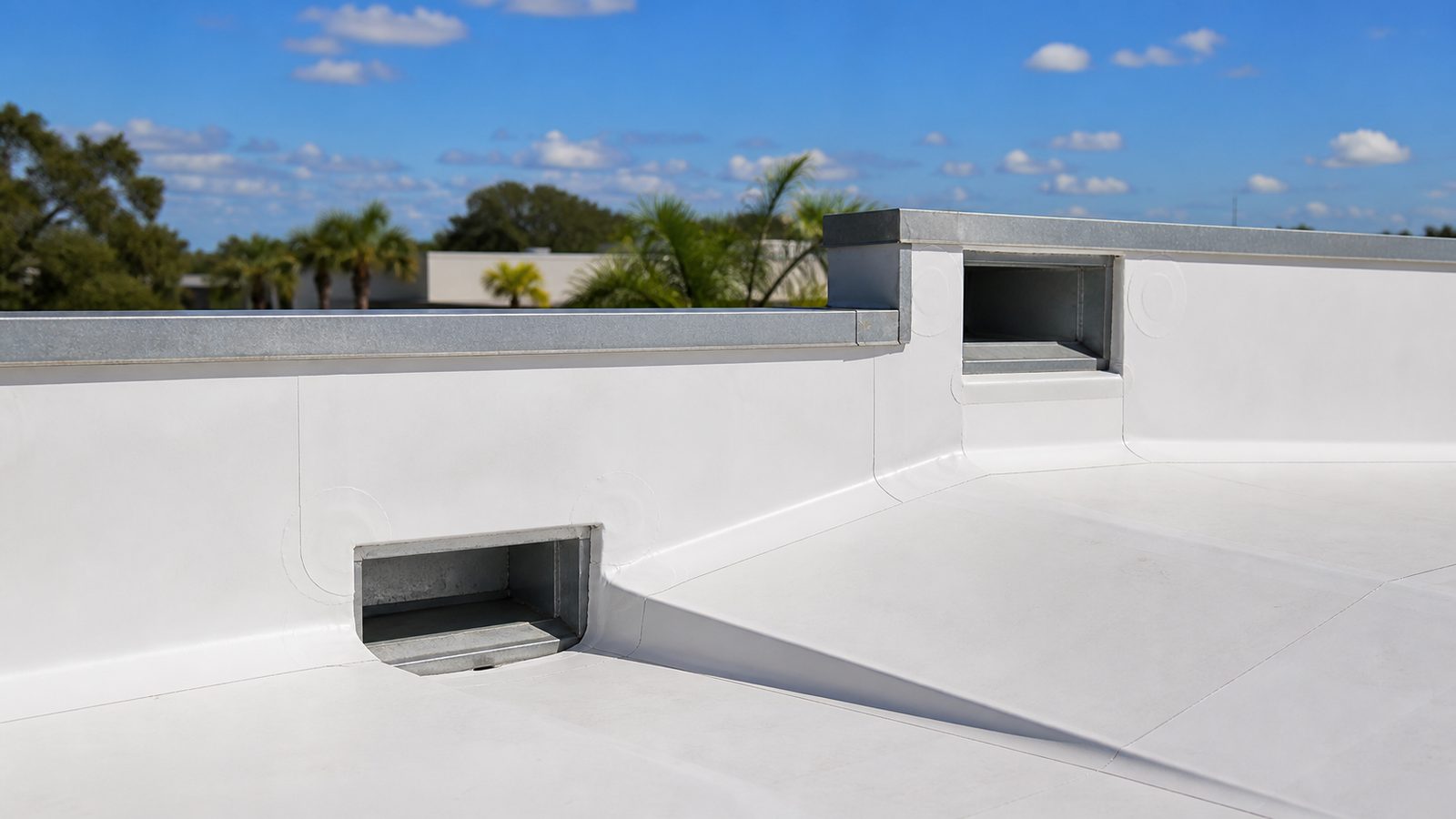
Visual inspection of all membrane surfaces for blistering, cracking, ponding water marks, and debris accumulation. Seam inspection — probe all seams with a screwdriver or seam probe tool to identify any areas of inadequate bond or weld failure. Drain inspection — verify that all drains are free of debris and that drain collars and clamping rings are secure. Flashing inspection — examine all penetration flashings, parapet cap flashings, and equipment curb flashings for separation, cracking, or uplift. Documentation — produce a written inspection report with photographs, repair recommendations, and a condition rating.
FM-compliant buildings in Florida with FM-rated roofing systems may have specific maintenance requirements defined in their FM approval documentation. Review the FM listing for your roofing system to confirm the maintenance protocol required for the rating to remain valid.
Annual maintenance cost for a commercial membrane roof in Northeast Florida: $0.05–$0.15 per square foot per year for inspection and minor repairs on a well-maintained system. Deferred maintenance compounds: a $5,000 repair identified in year three that is deferred to year five may become a $25,000 repair.
Ready to start? Get a written estimate in 48 hours. Call (904) 944-0278 or request a free consultation.
No call center. No coordinator. A JK principal reviews every inquiry and replies with a real number, not a range, not a follow-up form.
Request Free Estimate →