Hiring a general contractor (GC) in Jacksonville, Florida is one of the most consequential decisions you'll make on a construction project. Get it right and you hand off complexity to someone who manages it daily. Get it wrong and you absorb cost overruns, rework, permit failures, and the legal friction of trying to recover money from a contractor who's already moved on.
This guide is for homeowners planning renovations or custom builds, and for commercial developers evaluating GCs for ground-up or tenant improvement projects in Duval, St. Johns, Nassau, and Clay counties. It covers what a GC actually does, Florida's license structure, how to verify credentials, which contract type fits your project, and the questions that separate competent contractors from risky ones. By the end, you'll know exactly what to ask, what to look for, and what to walk away from.
Why Hiring the Right GC Matters: The Cost of the Wrong Choice
A poor GC selection can result in incomplete work, failed inspections, unpaid subcontractors (who can lien your property even if you paid the GC), and projects that drag 12 months past their scheduled completion date. In Jacksonville's current market, labor and material costs have risen enough that cost overruns on a $500,000 renovation can easily reach $75,000 to $150,000 when rework, delay penalties, and legal fees are factored in.
The most expensive contractor mistakes are not usually the result of bad luck — they are the result of skipped due diligence. Most homeowners and developers who end up in contractor disputes admit they did not verify the license, did not call references, or did not read the contract before signing.
Jacksonville has no shortage of GCs, but the range in quality is wide. The market includes nationally bonded firms, regional specialists, family-operated self-performers, and unlicensed operators who work without permits and disappear when problems arise. Knowing how to tell them apart before you sign protects your project and your property.
What a GC Actually Does vs. What They Subcontract
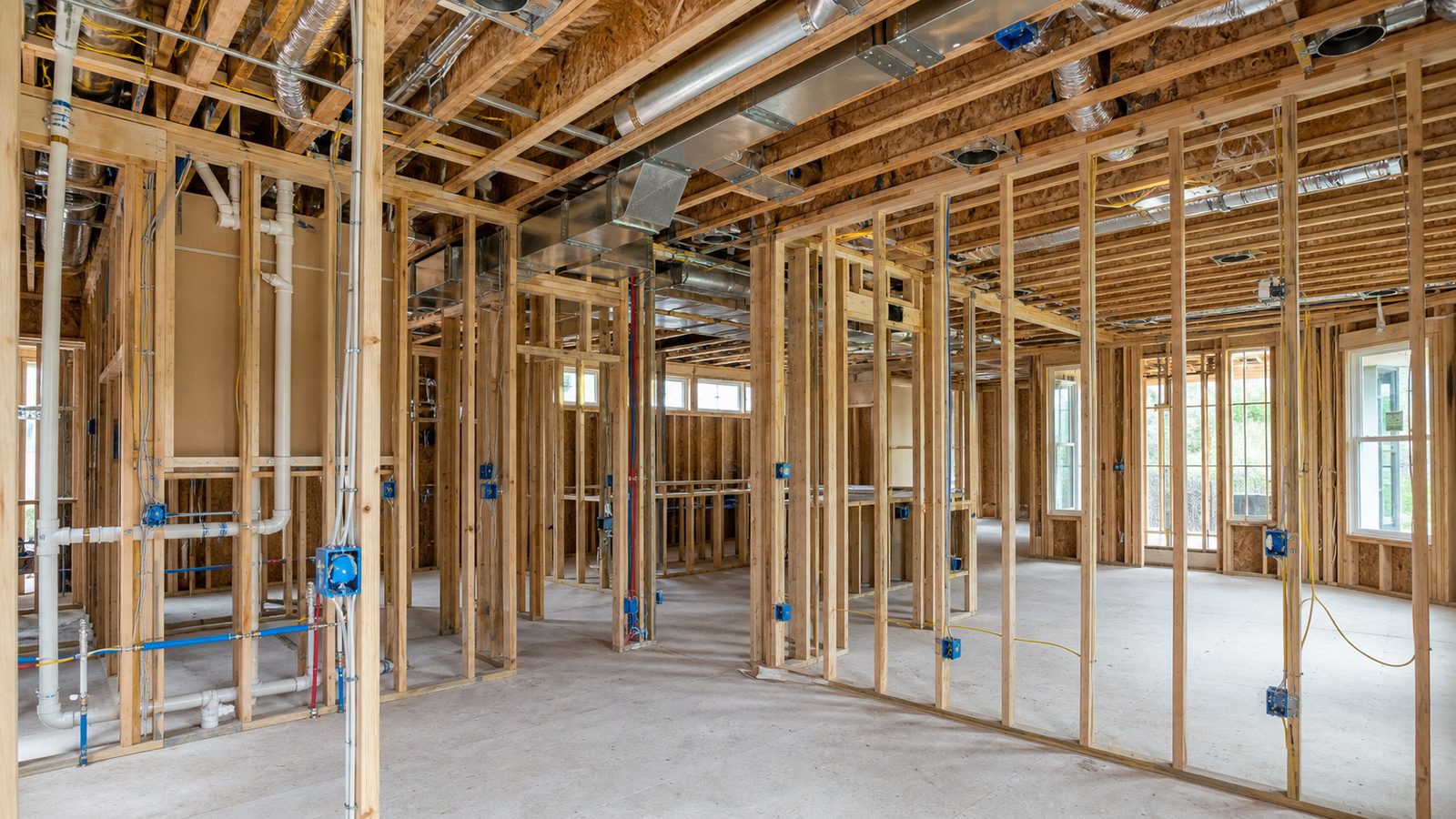
A general contractor is responsible for the total project: schedule, budget, subcontractor coordination, permit acquisition, safety compliance, and quality control from groundbreaking through Certificate of Occupancy (CO). The GC is the single point of accountability.
What the GC self-performs varies significantly by company. Some GCs are pure management firms — they hire out 100% of the trade work. Others self-perform core trades, which reduces markup layers and gives the GC direct control over quality and schedule on those scopes.
At JK Prestige Construction, we self-perform framing, concrete, drywall, finish carpentry, and roofing. Self-performing these trades means our field crews are on every site every day, not waiting on a subcontractor's availability.
Trades that GCs typically subcontract include:
- Mechanical, electrical, and plumbing (MEP)
- HVAC
- Specialty waterproofing
- Glazing and curtain wall
- Elevator and vertical transport
Ask any GC you evaluate: which scopes do you self-perform, and which do you subcontract? Follow up by asking who their primary MEP subcontractors are and how long those relationships have been in place. Long-term sub relationships are a proxy for consistent quality.
The 4 License Types in Florida
Florida requires contractors to be licensed through the Department of Business and Professional Regulation (DBPR). There are four primary license designations relevant to construction:
Certified General Contractor (CGC): The broadest license. A CGC can build any commercial or residential structure of any size, including high-rises. This is what you want for ground-up construction, major renovations, and commercial projects.
Certified Building Contractor (CBC): Covers residential and commercial projects up to three stories. Adequate for most residential renovations but limited on larger commercial work.
Certified Roofing Contractor (CRC): Required to pull roofing permits. A GC with a CRC license can self-perform roofing scopes. If your GC does not hold a CRC, they will subcontract all roofing.
Registered Contractor: A contractor registered in a specific county or municipality, not state-certified. A registered contractor can only pull permits in their registered jurisdiction. This matters if your project spans county lines.
For projects in Jacksonville (Duval County) and surrounding areas, require a state-certified CGC or CBC. Do not accept a registered contractor for significant work.

How to Verify License, Insurance, and OSHA Certifications
Verification takes ten minutes and eliminates a large category of risk.
License Verification
Go to the DBPR's online portal (myfloridalicense.com) and search by company name or license number. Confirm the license is active, not suspended or expired. Check whether the primary qualifying agent — the individual whose license the company operates under — is the person you're meeting with.
Insurance Verification
Require a certificate of insurance (COI) naming you as an additional insured. The policy should include:
- General liability: minimum $1M per occurrence, $2M aggregate for residential; $2M/$4M for commercial
- Workers' compensation: statutory limits per Florida law
- Builder's risk: should cover the replacement value of the project
Call the insurance carrier directly to verify the policy is active. Don't rely on a PDF alone.
OSHA Certifications
OSHA 10 training is the baseline for tradespeople. OSHA 30 is required for supervisors on most commercial sites. Ask whether the GC's field supervisors hold OSHA 30 cards, and ask to see them. On healthcare projects, look for ICRA (Infection Control Risk Assessment) training, which is required for work in occupied medical facilities.
JK Prestige crews hold OSHA 30 certifications and ICRA training across field supervisors.
Fixed-Price vs. Cost-Plus vs. GMP: Which Is Right for Your Project?
Contract structure determines how financial risk is allocated between you and the GC.
Fixed-Price (Lump Sum): The GC delivers the project for an agreed total. Cost overruns are the GC's problem, not yours. This structure benefits owners when scope is well-defined upfront. It requires a complete set of drawings and specifications before the contract is signed. Fixed-price contracts put the burden on the GC to manage budget, which filters out contractors who cannot estimate accurately.
Cost-Plus: You pay the actual cost of labor, materials, and subcontractors plus a GC fee (typically 10–20%). The risk of cost overruns falls on you. Cost-plus is appropriate when scope is genuinely undefined — for example, a renovation where the extent of substructure damage is unknown until demolition. Be cautious: cost-plus incentivizes more spending, not less.
Guaranteed Maximum Price (GMP): A hybrid. The GC commits to a ceiling price. If actual costs come in under, savings are typically split between owner and GC per a negotiated formula. GMP is common on larger commercial projects where the design is partially complete but not fully developed. It provides cost certainty while allowing some design flexibility.
For most residential renovations and custom home builds in Jacksonville, a fixed-price contract is appropriate and protective. JK Prestige uses fixed-price contracts on all eligible projects, giving clients a defined number before work begins.
The 10 Questions to Ask Before Signing
- Are you state-certified? What is your CGC or CBC license number?
- Which scopes do you self-perform, and which do you subcontract?
- Who are your primary subcontractors, and how long have you worked with them?
- Can you provide a current certificate of insurance with me named as additional insured?
- Do your supervisors hold OSHA 30 cards?
- What is your standard contract type — fixed-price, cost-plus, or GMP?
- How do you handle change orders? What is the approval process?
- What is your payment schedule, and is it tied to completion milestones?
- Who will be on site day to day — owner, superintendent, or a rotating crew?
- Can you provide three references from projects of similar scope completed in the past 18 months?
Red Flags in the Contract
Review every contract carefully before signing. Red flags include:
- No license or insurance number listed. A legitimate GC includes this.
- Large upfront payment required. Florida law limits initial deposits. Anything above 10% upfront for residential work is a warning sign.
- No milestone-based payment schedule. Payment should be tied to verified completion stages, not arbitrary calendar dates.
- Vague scope of work. "Renovation as discussed" is not a scope. Require itemized descriptions.
- No lien waiver provision. Florida's construction lien law allows subcontractors to lien your property even if you paid the GC in full. The contract should require the GC to provide conditional and unconditional lien waivers from all subs and suppliers at each draw.
- Unlimited change order markup. Define the GC's markup cap on owner-directed changes (typically 10–15%).
What to Expect After You Sign
Week 1–2: Permit application. In Duval County, permit review for residential renovations typically takes 2–4 weeks; commercial permits 4–8 weeks depending on complexity. Your GC should submit permits within 5 business days of contract execution.
Week 2–4: Pre-construction coordination. Long-lead materials are ordered. Subcontractor schedules are confirmed. A preconstruction meeting sets site rules, communication protocols, and schedule milestones.
Construction phase: Expect weekly progress updates at minimum. Change orders should be in writing, signed by both parties, before work begins. Inspections are scheduled by the GC and coordinated with the building department.
Closeout: The GC manages punch list completion, final inspections, and CO issuance. You should receive as-builts, warranty documents, and lien waivers from all subcontractors and suppliers before making the final payment.
JK Prestige's Approach
JK Prestige Construction is a Jacksonville-based, family-operated general contractor founded in 2017. We self-perform framing, concrete, drywall, finish carpentry, and roofing — five of the trades most GCs subcontract. Our principal answers every call and walks every site. We use fixed-price contracts and deliver written estimates within 48 hours of site visit.
We hold a CGC license, carry full general liability and workers' compensation insurance, and staff our field crews with OSHA 30-certified supervisors. Across 500+ completed projects and more than $2 billion delivered, our record is public: you can call our references, check our license, and verify our insurance before signing anything.
Whether you're planning a custom home, a whole-house renovation, or a commercial build-out, we're ready to walk your site and put a number in writing.
Ready to start? Get a written estimate in 48 hours. Call (904) 944-0278 or request a free consultation.
No call center. No coordinator. A JK principal reviews every inquiry and replies with a real number, not a range, not a follow-up form.
Request Free Estimate →