Jacksonville homeowners receive roofing estimates that vary by 40–60% for ostensibly the same job. The variation is not random — it reflects real differences in material specification, scope completeness, permit inclusion, and the contractor's willingness to document what they are and are not including in the price.
This guide explains every cost driver for roof replacement in Jacksonville, provides 2025 installed price ranges by material type, and gives you the line-item framework to evaluate any estimate you receive. The goal is not to make you an expert roofer. It is to make you an informed buyer who can tell the difference between a complete estimate and one that looks good until the change orders start.
JK Prestige Construction is a Jacksonville-based general contractor and GAF Master Elite certified roofing contractor. We self-perform roofing work throughout Duval, St. Johns, Clay, and Nassau counties. We provide fixed-price written estimates within 48 hours with a complete line-item scope — no surprises at tear-off. Our principal walks every site personally. See our roofing services at https://jkprestigeconstruction.com/#/roofing.
What Drives Roof Replacement Cost in Jacksonville
Seven factors determine the final cost of a roof replacement in Jacksonville. Understanding each one tells you what questions to ask before you sign a contract.
Roofing material is the largest single variable. Architectural asphalt shingles, metal roofing, and tile have significantly different material costs per square (100 square feet), and those differences compound across a full roof.
Roof slope and complexity affect labor hours directly. A simple gable roof with one ridge and two rakes takes less labor per square than a hip roof with four slopes, valleys, dormers, and skylights. Steeper slopes require specialized equipment, longer setup time, and slower installation rates.
Square footage is the base multiplier for both material and labor. A 1,500 square foot one-story home with a 6:12 pitch has approximately 1,800–2,000 squares of roof surface (the slope adds surface area beyond the footprint). A 2,500 square foot home with multiple dormers and a steeper pitch may have 3,500+ squares of roof surface.
Access determines how efficiently material can be staged and loaded. A single-story home with a driveway accessible by material delivery equipment is the baseline. A two-story home or a home where the roof area is obstructed by mature tree canopy adds labor cost.
Tear-off layers. Florida Building Code allows one existing layer to remain in a re-roofing scenario, but tear-off of the existing material is the correct practice and is discussed in detail below. Additional layers beyond one require tear-off regardless of preference. Each additional layer adds $0.50–$1.50 per square foot in tear-off labor and disposal cost.
Deck condition affects cost through a mechanism that cannot be fully determined until tear-off is complete. Deck repair ranges from $3 to $6 per square foot for damaged panels and can add $1,000–$5,000 or more to the total cost depending on the extent of deterioration. This is an area where honest estimates include an allowance; low-ball estimates omit it and bill it as a change order.
Permit and inspection fees are a direct project cost. In Jacksonville, residential roofing permits typically cost $200–$800 depending on the project value and scope. The permit must be pulled by the contractor, not the homeowner, for licensed contractor work. Any estimate that does not include the permit fee has either excluded it intentionally or will add it at contract signing.
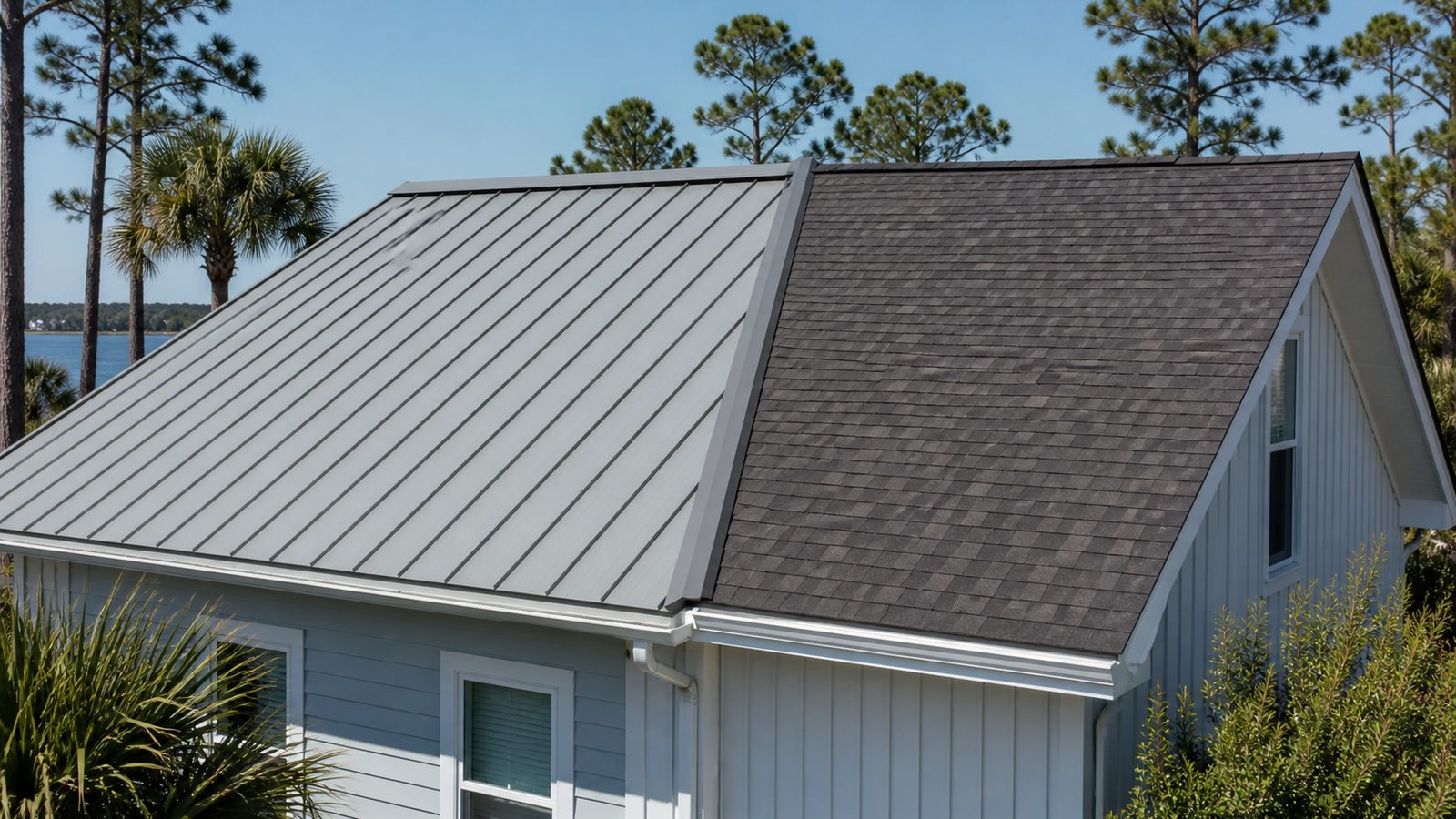
Architectural Asphalt Shingles: The Most Common Jacksonville Choice
Architectural (dimensional) asphalt shingles are the dominant roofing material in Duval County. They are installed on more Jacksonville homes than any other material by a significant margin. Understanding what drives the price range within this category is essential.
Standard architectural shingles from a major manufacturer (GAF Timberline HDZ, Owens Corning Duration, CertainTeed Landmark) installed on a 1,500–2,500 square foot home in Jacksonville: $8,000–$18,000. This range reflects:
Lower end ($8,000–$11,000): Simple roof geometry — one or two slopes, minimal valleys, no dormers or skylights. Single-story home. Deck in good condition. Standard synthetic underlayment with self-adhering ice and water shield at eaves, rakes, and valleys. Standard architectural shingle.
Upper end ($14,000–$18,000): Complex roof geometry — multiple slopes, valleys, dormers, skylights, or chimney flashing. Two-story home. Deck repair allowance. Full self-adhering modified bitumen underlayment over entire deck (required for some Florida Building Code configurations). Premium laminate architectural shingle with enhanced wind resistance rating.
The estimate in front of you should specify the shingle manufacturer, product name, and wind resistance rating. It should specify the underlayment type and coverage. It should include an explicit deck repair allowance — a real number, not "deck repairs billed at cost."
Six-nail installation is required under the Florida Building Code in Duval County's wind zone. This should be stated in the estimate. An estimate that does not specify the fastening pattern cannot be assumed to comply.
Impact-Resistant Shingles (Class 4 IR): Installed Cost and Insurance Benefit
Class 4 Impact-Resistant (IR) shingles meet the UL 2218 Class 4 impact resistance standard — the highest classification available. In Florida's insurance market, Class 4 IR shingles qualify for measurable wind mitigation discounts from many carriers.
Class 4 IR shingles from GAF (Timberline ArmorShield II), Owens Corning (Duration Storm), and other manufacturers carry a Florida Product Approval and are designed for the same installation pattern as standard architectural shingles. The material cost premium over standard architectural shingles is typically $0.50–$1.50 per square foot, which adds $750–$2,250 to the material cost on a standard residential project.
Installed cost for Class 4 IR shingles on a 1,500–2,500 square foot Jacksonville home: $10,000–$22,000. The range reflects the same geometry, complexity, and deck condition variables as standard architectural shingles — the material premium is consistent but the base labor and overhead vary.
The insurance discount for Class 4 IR shingles in Florida ranges from 10% to 25% depending on the carrier, the building's wind zone, and whether the home also has other wind mitigation features (hip roof geometry, secondary water resistance). On a policy with an annual wind premium of $3,000, a 15% discount generates $450 per year in savings. The payback period on the Class 4 IR shingle premium ($1,500 additional cost) at $450/year is 3.3 years — within the warranty period of the shingles.
Request a wind mitigation inspection after any roofing project. The wind mitigation inspector documents the roof covering type and submits the report to your insurer. Many Jacksonville homeowners pay the Class 4 IR premium and do not follow through on the insurance discount because they skip the wind mitigation inspection.
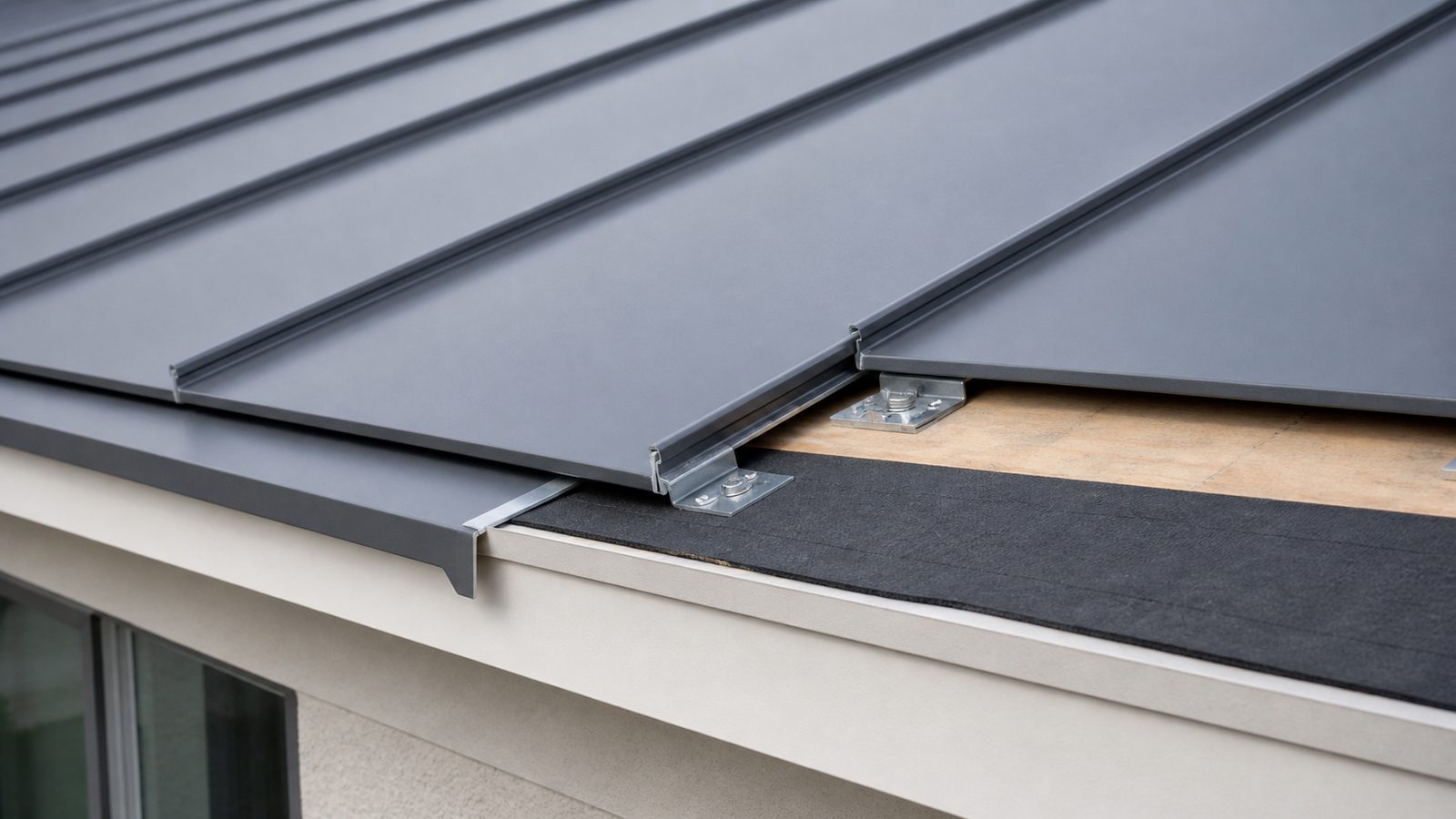
Metal Roofing: Exposed Fastener vs. Standing Seam
Metal roofing in Jacksonville divides into two product categories with significant cost and performance differences.
Exposed-fastener metal panels (often marketed as "corrugated" or "R-panel" or "5-V crimp") are installed with screws driven through the face of the panel. The fasteners penetrate the weather barrier. Over time, the rubber washer under each fastener degrades in Florida's UV environment, and the fastener point becomes a potential leak location. Exposed-fastener metal is appropriate for workshops, storage structures, and low-cost applications where periodic maintenance and fastener replacement are acceptable. Installed cost: $12,000–$25,000 for a residential application depending on complexity.
Standing seam metal panels attach to the structural support through concealed clips — no fasteners penetrate the panel face. Standing seam provides superior wind resistance, no fastener-point leak risk, and a service life of 40–70 years in Florida's climate. The panels expand and contract thermally without fastener binding. Standing seam qualifies for better insurance premium reductions and higher wind mitigation ratings. Installed cost: $18,000–$45,000+ for a residential application in Jacksonville. High-complexity roofs — steep pitch, multiple dormers, tile-to-metal transition details — can exceed $50,000.
The cost differential between exposed-fastener and standing seam is real, but the maintenance cost over a 20-year period frequently narrows it. An exposed-fastener roof that requires periodic fastener replacement and sealant at $1,500–$3,000 every 5–7 years adds $4,500–$9,000 in lifecycle maintenance cost that a standing seam roof does not require.
Metal roofing for Jacksonville residential applications should specify Florida Product Approval for the wind zone, a Kynar 500 or equivalent finish system for corrosion resistance in the coastal salt-air environment, and a concealed-clip attachment pattern for standing seam.
Concrete and Clay Tile: Jacksonville Costs and Structural Considerations
Concrete and clay tile is the premium residential roofing choice in Florida's market. Tile provides 50+ year service life, excellent thermal mass properties, and the aesthetic that defines many Jacksonville and Northeast Florida neighborhoods.
Clay tile (fired ceramic) is more expensive than concrete tile but provides superior color permanence — concrete tile can fade and require repainting after 15–20 years in Florida's UV environment. Clay tile maintains its color through the full material depth.
Concrete tile installed on a typical 1,500–2,500 square foot Jacksonville home: $22,000–$45,000. Clay tile on the same home: $30,000–$55,000+. The range within each material reflects slope complexity, valley count, and hip-and-ridge complexity.
Before specifying tile, verify structural capacity. Concrete tile weighs approximately 9–12 pounds per square foot. A standard asphalt-shingle-framed roof is designed for approximately 5–7 pounds per square foot of roofing dead load. Replacing asphalt shingles with tile on a home not designed for the additional dead load requires structural reinforcement of the rafters or trusses — a cost that should be assessed before the roofing estimate is finalized.
A structural assessment by a licensed structural engineer costs $500–$1,500 and is a required pre-condition for a tile roofing specification on any home not originally built with tile. Omitting this assessment and discovering the framing is inadequate after tear-off is an expensive problem.
Tile requires specific installation details at valleys, hips, ridges, and penetrations that differ from asphalt and metal installation. Not every roofer in Jacksonville is qualified to install tile correctly. Verify tile installation experience with references from Jacksonville-area tile roofing projects.
Flat and Low-Slope Roofing: TPO, EPDM, and Pricing in Jacksonville
Flat and low-slope roofing systems — found on porch additions, sun rooms, flat-roof contemporary homes, and the commercial-adjacent sections of mixed-use properties — require membrane systems rather than shingles.
TPO (Thermoplastic Polyolefin) membrane: The most common choice for residential flat additions and commercial-adjacent applications. 60-mil TPO installed in Northeast Florida: $8–$12 per square foot, including tear-off of one existing membrane, insulation inspection, and new membrane installation. A 400 square foot porch flat roof: $3,200–$4,800 installed. A 1,000 square foot flat roof section: $8,000–$12,000 installed.
EPDM (Ethylene Propylene Diene Monomer) membrane: $9–$14 per square foot installed. Used in applications where chemical exposure or specific design requirements favor the rubber compound over thermoplastic.
Both systems require proper drainage design. A flat roof section added to a sloped residential roof must have a drain point that does not trap water. Ponding water — water that remains on the surface more than 48 hours after a rain event — is a warranty exclusion condition for both TPO and EPDM.
See JK Prestige's complete roofing capabilities at https://jkprestigeconstruction.com/#/roofing.
The Tear-Off vs. Overlay Question
Florida Building Code allows re-roofing over one existing layer of roofing material in most residential configurations. Some contractors offer overlay (installing new shingles over existing shingles) to reduce cost by eliminating tear-off labor and disposal.
Tear-off is always the correct choice. Here is the math and the reasoning.
Tear-off cost savings of an overlay: approximately $1,000–$2,500 in labor and disposal cost on a typical residential project.
Costs of an overlay that tear-off avoids:
Deck condition cannot be assessed without removal of the existing material. A deck with soft spots, delaminated panels, or rot is invisible under an overlay. It is a condition that affects the structural integrity of the new roof and, if it causes premature failure, is excluded from the manufacturer's warranty.
The weight of two roofing layers exceeds the engineered dead load on most Jacksonville residential framing. Over time, this additional dead load contributes to framing deflection and fastener withdrawal.
Most manufacturer warranties explicitly exclude installations over existing roofing. An overlay with GAF materials installed by a GAF Master Elite contractor does not carry GAF warranty coverage — the warranty is void from installation day.
The overlay saves $1,500 today and costs you a non-warranted roof that cannot be assessed for deck integrity. Over a 20-year replacement cycle, that $1,500 in savings is a poor trade.
Permit Fees in Jacksonville: What They Cost and What They Trigger
All residential roof replacements in Jacksonville require a building permit. The City of Jacksonville, Duval County permit fee for a residential roof replacement is typically $200–$800, calculated as a percentage of the declared project value.
The permit triggers a final inspection by a city building inspector who verifies code compliance: fastening pattern, underlayment specification, and material Florida Product Approval. This inspection is the only independent quality verification your roof installation receives. Skipping the permit means skipping this verification.
Permit fees should be included in your estimate. An estimate that does not include the permit fee is either excluding it (you will pay it separately) or intending to work without a permit. Both are problems. Ask directly: "Is the permit fee included in this estimate?" and "Who pulls the permit — you or me?"
The answer to "who pulls the permit" should always be "the contractor." A homeowner-pulled permit implies the homeowner is acting as their own contractor, which may have liability implications and typically does not apply on contractor-installed work.
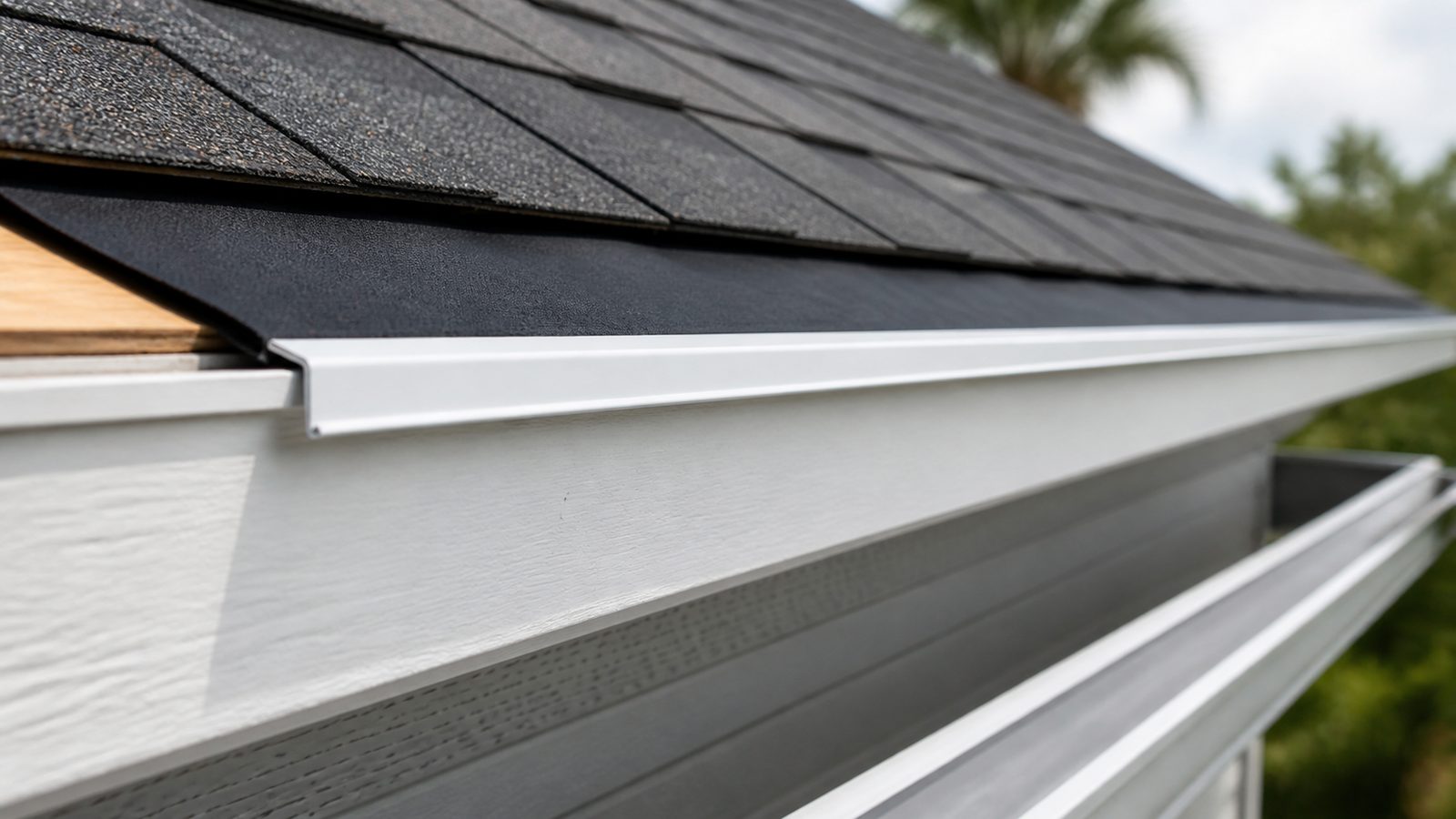
Hidden Costs: Flashing, Deck, and Fascia
Three categories of cost are frequently excluded from low-bid estimates and added as change orders during installation:
Flashing replacement. All step flashing, counter flashing, valley flashing, and kickout flashing should be replaced at every roof replacement — not reused. Reused flashing has been bent into place, sealed multiple times, and has aged as many years as the old roof. Reusing flashing saves $500–$2,500 in materials and installs a known liability. A complete estimate includes flashing replacement as a line item.
Deck repair. As discussed above, deck condition is confirmed at tear-off. A complete estimate includes a per-square-foot deck repair rate ($3–$6 per square foot) and a realistic allowance for the likely repair area. A zero-deck-repair estimate is not a complete estimate — it is an estimate that will have a deck-repair change order.
Fascia replacement. Fascia boards — the horizontal trim at the roof edge where gutters attach — are frequently rotted in Jacksonville's humidity environment. Fascia adjacent to roof areas with prior leak history or with blocked gutters is almost always compromised. A complete estimate notes fascia condition from the inspection and includes a replacement rate per linear foot. Fascia replacement in Jacksonville: $10–$20 per linear foot including materials and labor.
How to Compare Estimates: What Line Items to Require and What Omissions Reveal
A complete residential roof replacement estimate for Jacksonville should include these line items, explicitly:
Tear-off and disposal (specify number of layers to be removed). Deck repair allowance (square feet at a per-sqft rate). Underlayment specification (type, coverage area — full deck or selective coverage). Flashing replacement (specify types: step, counter, valley, kickout). Field shingles (manufacturer, product name, Florida Product Approval number, wind resistance rating). Ridge cap (specify manufacturer and wind resistance rating). Fastening pattern (six-nail for Duval County wind zone). Permit fee (included or explicitly excluded). Cleanup and debris removal.
Omissions to investigate:
No underlayment specification — ask what underlayment is being installed and whether it meets Florida Building Code for your roof pitch and material type.
No deck repair line — ask what they will charge per square foot if deck damage is found at tear-off, and ask for an estimated allowance based on their inspection.
No permit fee — ask whether it is included or billed separately and confirm the contractor will pull the permit.
No flashing replacement — ask whether all flashing is being replaced and what the cost is if it is not in the base price.
A contractor who cannot answer these questions from an estimate they wrote does not have a complete scope. An incomplete scope generates change orders. JK Prestige provides fixed-price estimates with complete scope documentation. Learn how we structure our estimates at https://jkprestigeconstruction.com/#/the-jk-way.
Ready to start? Get a written estimate in 48 hours. Call (904) 944-0278 or request a free consultation.
No call center. No coordinator. A JK principal reviews every inquiry and replies with a real number, not a range, not a follow-up form.
Request Free Estimate →