Ask a general contractor (GC) how they work and most will describe an operation that sounds like it does everything — site supervision, scheduling, quality control, budget management. Ask a follow-up question — who swings the hammers? — and you discover that most GCs subcontract 100% of the field work to specialty firms. The GC's field team consists of a superintendent who manages other companies' workers, not their own crews. The GC is a construction manager, not a construction company, regardless of what it says on the truck.
That distinction matters for project owners because the entity legally responsible for your building's quality controls no crew that touches it. When the framing is out of plumb, the superintendent tells the framing sub's foreman. The foreman consults with the subcontractor's owner. The subcontractor may or may not correct the work before drywall covers it. The GC has leverage — they hold the sub's final payment — but they do not have control.
Self-perform GCs are different. They employ the workers who build your project. When work is wrong, the superintendent directs their own employee to correct it. Schedule slips because a framing crew is slow? The superintendent can redirect two other crews from another zone. No mobilization wait, no sub contract dispute, no finger-pointing about whose scope includes the correction. This guide explains what self-perform actually means, what it delivers for project owners, and how to verify a GC's self-perform claim before you sign a contract.
What Self-Perform Means in Construction: The GC Owns and Manages the Labor Directly
Self-perform means the GC employs the workers who perform specific construction tasks. Those workers are on the GC's payroll — W-2 employees or 1099 workers under direct GC supervision — not employees of a subcontractor. The GC purchases the materials, provides the tools and equipment, manages the work sequence, and is accountable for production and quality on those tasks directly.
The legal and operational distinction is significant. When work is self-performed, the GC has direct control over:
- Which workers are on site each day
- What sequence they work in
- How quickly they respond to a quality correction
- Whether overtime or weekend work is deployed to recover schedule
- What tools and methods are used
When work is subcontracted, the GC manages the subcontractor through the subcontract agreement, the schedule, and the payment. The GC does not control which workers the sub sends, whether the sub's foreman is capable, or how quickly the sub responds to a non-conformance notice.
Self-perform is not inherently better for every trade on every project. Specialty work — mechanical systems, electrical, plumbing — requires licensed specialty contractors and is typically subcontracted even by the most vertically integrated GCs. But for the trades that fall within a GC's self-perform capability, the owner receives direct accountability that is structurally different from a managed subcontract.
The JK Prestige model is built on self-performing the trades where that control delivers the most value for the owner.
What Subcontracting Means: GC Hires Specialty Firms for Specific Scope
Subcontracting is the practice of engaging a licensed specialty firm to perform a defined scope of work under a contract with the GC. The subcontractor employs its own workers, provides its own equipment and materials (unless otherwise specified), and is responsible for its own work quality under the terms of the subcontract.
The GC manages subcontractors through contractual mechanisms: scope definition, schedule requirements, payment terms, quality standards, and OSHA (Occupational Safety and Health Administration) compliance requirements. A well-written subcontract protects the owner's interests by passing the GC's obligations down to the sub — but only if the GC actively enforces those obligations.
Subcontracting is appropriate for work requiring specialized licensing (Florida state licenses for electrical, plumbing, and mechanical contractors are required for those trades), specialized equipment, or manufacturing off-site (structural steel fabrication, precast concrete). The GC's job is to select qualified subs, write airtight scope, and supervise the work rigorously.
The problem with fully subcontracted GCs is accountability diffusion. When a subcontracted drywall crew installs fire-rated assemblies incorrectly and the GC did not inspect the framing before wallboard was applied, everyone has a story about whose responsibility the error was. The owner has one party — the GC — but the GC points to the sub.
Why Most GCs Subcontract Everything: Lower Fixed Overhead, Flexibility, and Apparent Simplicity
The economics of full subcontracting are straightforward. A GC with no field crews has no workers' compensation insurance for field labor, no craft benefit costs, no tool inventory, no equipment maintenance, and no fixed craft payroll through slow periods. The overhead is low, the operation is scalable, and the GC can take on projects in different trade mixes without retooling.
For the GC, this model is financially logical. For the owner, it is a different calculation. The GC's low overhead does not mean lower project cost — the subcontractor's overhead and profit are included in the sub's price, and the GC marks up the sub's price with its own fee. The owner pays for the sub's overhead, the sub's profit, and the GC's markup on both. That layering of margins can cost 12–20% more than a GC who self-performs those trades.
The "apparent simplicity" of a fully brokered GC also breaks down under schedule pressure. When concrete is four days behind and the owner asks the GC to accelerate, the GC calls the sub. The sub says they need to redeploy a crew from another project. That conversation takes 48–72 hours. A self-perform GC can redirect their own crew in an afternoon.
The 5 Real Benefits of Self-Perform for the Project Owner
1. Schedule Control
Self-perform GCs control their own crew's mobilization, work pace, and redeployment. When weather delays a week of exterior work, the GC redirects their framing crew to interior rough framing. There is no sub mobilization wait and no sub contract amendment discussion. On a 10-month project, this flexibility can save 2–4 weeks of critical path schedule.
2. Quality Accountability
The superintendent who manages a self-perform crew is accountable for that crew's work product. There is no intermediary. When framing tolerances are wrong, the superintendent directs the crew to correct the work immediately — not after a formal non-conformance notice is issued, logged, responded to, and resolved through the subcontract dispute mechanism.
3. Cost Transparency
Self-perform work is priced at actual labor, material, and equipment cost — no subcontractor markup. Owners on open-book or GMP (Guaranteed Maximum Price) contracts can see exactly what the GC is paying for self-perform labor versus brokered subcontracts. There is no sub overhead-and-profit layer obscuring the real cost of the work.
4. Faster Punch-List Resolution
At project closeout, punch-list items on self-perform trades are resolved by the GC's own crew — available immediately, not dependent on a subcontractor scheduling a return trip. Punch-list drag on a commercial project commonly extends closeout by 30–60 days; self-perform GCs compress that timeline significantly.
5. Single Warranty Holder
When framing, drywall, and finish carpentry are all self-performed by one GC, warranty claims have a single point of contact — the GC. When those trades are subcontracted to three different companies, warranty claims begin with the question of which trade is responsible, which turns into a dispute.
The Limitations of Self-Perform
Self-perform is not universally superior. Three limitations define where it does not apply:
Self-perform is not economical for specialty licensed trades in every market. Electrical, plumbing, and mechanical systems require licensed specialty contractors. A GC can self-perform rough electrical in some markets but cannot hold the state specialty contractor license required in Florida for permitted electrical work.
Self-perform requires sustained crew volume to be economical. A GC who self-performs framing needs a consistent volume of framing work to keep skilled crews employed year-round. An occasional framing project does not justify the overhead of a permanent crew.
Self-perform does not eliminate the need for subcontracting. Even the most vertically integrated GC subcontracts some trades. The question is which trades the GC self-performs, not whether subcontracting is used at all.
Which Trades JK Prestige Self-Performs and Why
JK Prestige self-performs five core trades on every applicable project. The selection is not arbitrary — it reflects the trades where direct GC control delivers the highest impact on schedule, quality, and cost.
Framing
Framing is critical path on virtually every structure. A subcontracted framing crew that falls behind can delay MEP rough-in, drywall, and every subsequent trade. JK Prestige's own framing crews work directly under a JK superintendent with authority to redeploy, add shifts, or sequence zones differently without a subcontract amendment.
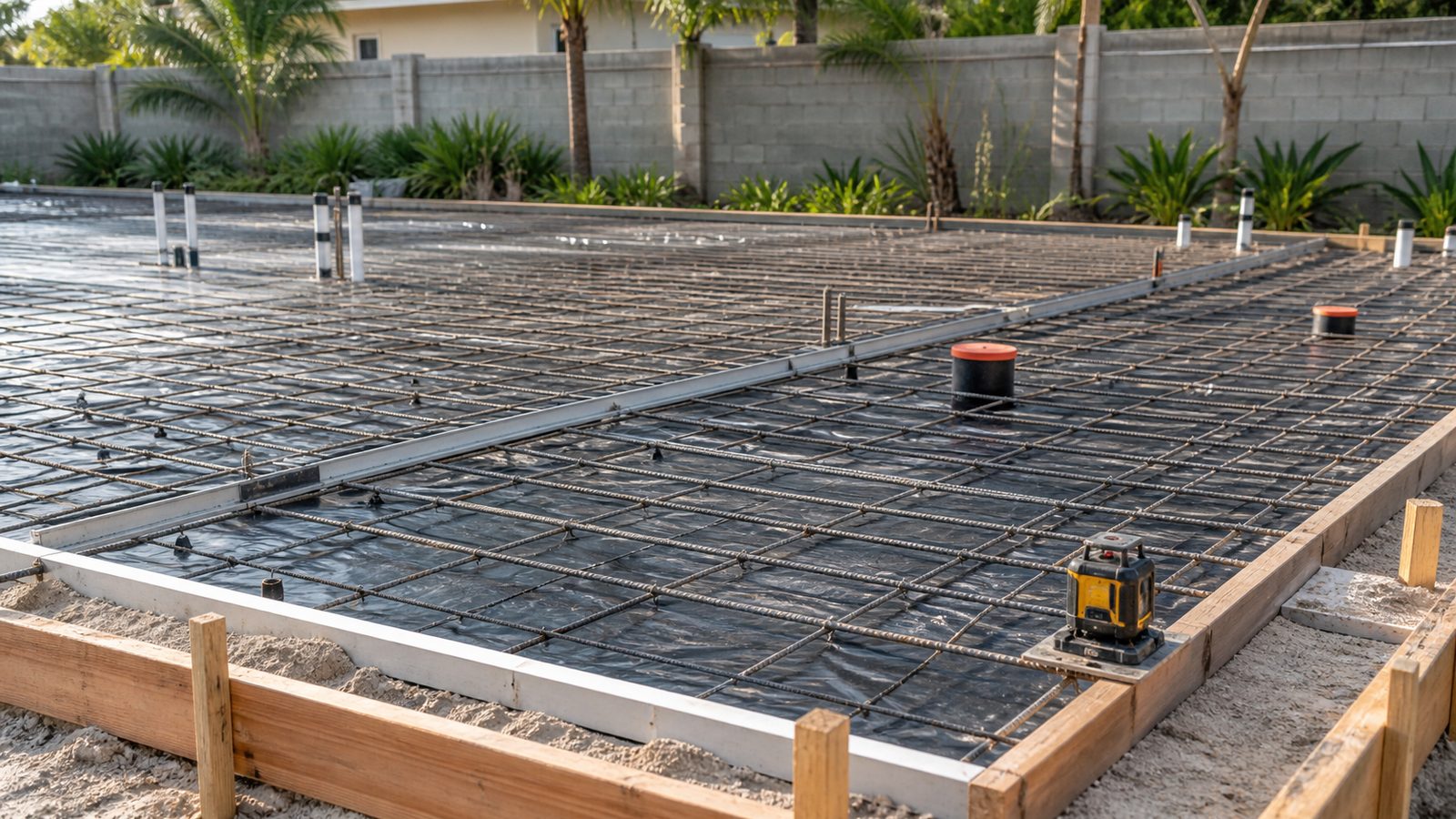
Concrete
Concrete quality — mix design compliance, reinforcing placement, pour sequence, curing — is foundational to the structure. On healthcare and commercial projects, slab flatness and elevation tolerances affect every subsequent trade. JK Prestige's self-perform concrete crews maintain the quality control standards required for OSHA 30-compliant and ICRA (Infection Control Risk Assessment)-compliant healthcare projects.
Drywall
Drywall fire ratings are a life safety requirement. An incorrectly installed fire-rated assembly — wrong gypsum board type, missing head-of-wall detail, incorrect fastener pattern — fails inspection and requires tear-out. JK Prestige's self-perform drywall crews know the fire rating details that the GC's own superintendent will inspect and approve, creating a tighter quality loop than a subcontracted crew.
Finish Carpentry
Finish carpentry continuity with framing is critical on custom residential and commercial tenant improvement projects. When the same GC's crews do both framing and finish, dimensional errors caught at framing are corrected before they compound into finish problems. JK Prestige's custom home work relies on this trade continuity.
Roofing
JK Prestige holds GAF Master Elite and CertainTeed certification, which requires maintaining specific installation standards across all roofing work. A self-perform roofing crew trained to those certification standards installs to a higher and more consistent standard than a subcontracted roofing crew that may not hold the same certifications.
How JK Vets and Manages Subcontracted Trades
For trades that are subcontracted — MEP, site utilities, glass and glazing, specialty finishes — JK Prestige applies a defined qualification and management process.
The trade packet sent to prospective subs includes: scope sheet with explicit inclusions and exclusions, OSHA 30 compliance requirement, insurance certificate requirements (minimum $1M general liability, $1M auto, statutory workers' compensation), and JK's three-week look-ahead schedule format for coordination meetings.
Subcontractors are selected on demonstrated commercial references in the same trade category, not on bid price alone. A mechanical sub who has completed three hospital projects in Northeast Florida is evaluated differently from one whose references are light commercial tenant improvements.
JK Prestige's commercial project work applies this vetting process to every subcontracted trade on every project.
The Hybrid Model: Self-Perform the Critical Path, Subcontract Specialty Work
The practical structure for a vertically integrated GC is a hybrid: self-perform the trades on the critical path, subcontract specialty work requiring dedicated licensing. On a hospital addition, that means JK Prestige's own crews do concrete, framing, and drywall — the envelope that everything else attaches to — while licensed mechanical, electrical, and plumbing (MEP) subcontractors perform their specialty work under JK's coordination and supervision.
This hybrid maintains the owner's benefit of self-perform quality and schedule control on the critical path trades while using licensed specialty firms where Florida statute requires a specialty contractor license.

How to Evaluate a GC's Self-Perform Claim
Self-perform is frequently claimed and infrequently verified. Verify before you sign.
Ask specifically which trades the GC self-performs. "We do a lot of the work ourselves" is not an answer. "We self-perform framing, concrete, drywall, and finish carpentry with our own W-2 employees" is an answer.
Ask for the name and resume of the foreman who will lead each self-perform trade on your project. A self-perform GC has a foreman. A brokered GC has a superintendent who manages subs — they cannot name a foreman because they do not employ one.
Ask for a certificate of workers' compensation insurance listing the trade classifications covered. A GC whose WC policy does not include framing or concrete labor classifications does not employ framing or concrete workers.
Ask for one reference project where you can speak directly with a superintendent or foreman, not just the project manager.
Cost Comparison: Self-Perform vs. Brokered
On the trades a GC self-performs, the direct cost savings versus brokered subcontracting typically run 8–15%. That range reflects:
- Elimination of the subcontractor's overhead (typically 10–15% of direct cost)
- Elimination of the subcontractor's profit margin (typically 5–10%)
- Partially offset by the GC's permanent crew overhead (benefits, tools, training)
On a $2M framing and drywall scope, 8–15% savings represents $160,000–$300,000 in direct cost reduction. In an open-book GMP structure, those savings accrue to the owner through the savings sharing provision or through a lower GMP ceiling at bid.
Fixed-price projects benefit from self-perform differently: the GC carries more of the risk directly (no sub to blame for an error) but also retains the cost savings as part of the fixed-price margin. The owner's benefit is schedule and quality, not necessarily a lower bid price — though in a competitive bid scenario, a self-perform GC can price more aggressively on the trades it controls.
Ready to start? Get a written estimate in 48 hours. Call (904) 944-0278 or request a free consultation.
No call center. No coordinator. A JK principal reviews every inquiry and replies with a real number, not a range, not a follow-up form.
Request Free Estimate →