Tenant improvement (TI) allowances are one of the most negotiated and least understood elements of a commercial lease in Jacksonville. A tenant can sign a lease with a $65-per-square-foot TI allowance, assume the space will be ready to occupy for that amount, and then discover three months later that their actual construction cost is $95 per square foot. The gap — $30 per square foot in this example — is a $90,000 out-of-pocket cost on a 3,000-square-foot space that the tenant did not budget.
This guide is written to eliminate that gap. It covers how TI allowances work, what Jacksonville allowances look like in 2025 by building class, what they actually pay for versus what comes out of the tenant's pocket, how to negotiate effectively in the current market, the full construction process from lease execution to Certificate of Occupancy (CO), the most common TI budget mistakes, and the landlord-versus-tenant GC dynamic that determines who controls the construction. Whether you are a first-time tenant, an expanding business, or a developer evaluating lease structures, this guide gives you the numbers and the process you need to make informed decisions.
JK Prestige Construction has completed TI projects across Jacksonville, from Southside medical office to Northside industrial flex. This guide reflects what we see on actual projects, not theoretical market data.
What a TI Allowance Is and How It's Calculated
A tenant improvement allowance (TIA) is a sum of money provided by the landlord to fund construction of the tenant's space. It is typically expressed as a dollar amount per square foot of rentable area and disbursed to reimburse the tenant (or pay the contractor directly) for approved construction costs.
The allowance is not a discount on rent — it is capital contributed by the landlord in exchange for a lease commitment, typically amortized into the rent rate over the lease term. A landlord providing $70/sqft on a 5,000-square-foot space ($350,000) will structure the deal so the rent rate covers the amortized cost of that capital over the lease term at a market interest rate. The tenant pays for the allowance through rent, whether or not they spend the full amount.
How Allowances Are Set
Landlords calculate TI allowances based on: the condition of the space being delivered (shell, warm shell, vanilla box), the tenant's credit quality and lease term, the building class and market vacancy, and the landlord's cost of capital. Longer lease terms (7 to 10 years) support higher allowances because the landlord has more rent periods over which to amortize the investment. Strong-credit tenants (national brands, publicly traded companies) can negotiate higher allowances than local first-time tenants.
Jacksonville TI Allowances in 2025 by Building Class
These are current market ranges for Duval County and the immediately surrounding Jacksonville metro area:
| Building Class / Delivery | Typical TI Allowance (2025) |
|---|---|
| Class A office (Deerwood, Town Center, Southside) | $65–$90/sqft |
| Class B office (Regency, Baymeadows, Arlington) | $35–$55/sqft |
| Shell space (tenant builds everything) | $80–$130/sqft |
| Retail (inline, strip center) | $20–$50/sqft |
| Industrial flex | $15–$35/sqft |
| Medical office (gross lease structures) | $60–$100/sqft |
Shell delivery allowances are higher because the tenant is building more — the landlord delivers four walls, a roof, and a slab, and the tenant installs everything from the HVAC system to the restroom partitions. The allowance reflects the scope, not the landlord's generosity.
Class A allowances in Jacksonville's Southside and Deerwood Park have held relatively firm through 2024–2025 because vacancy in premium product remains low. Class B suburban office has more negotiating room due to higher vacancy.
What TI Allowances Actually Cover vs. What Tenants Pay Out-of-Pocket
This is the source of most tenant budget surprises.
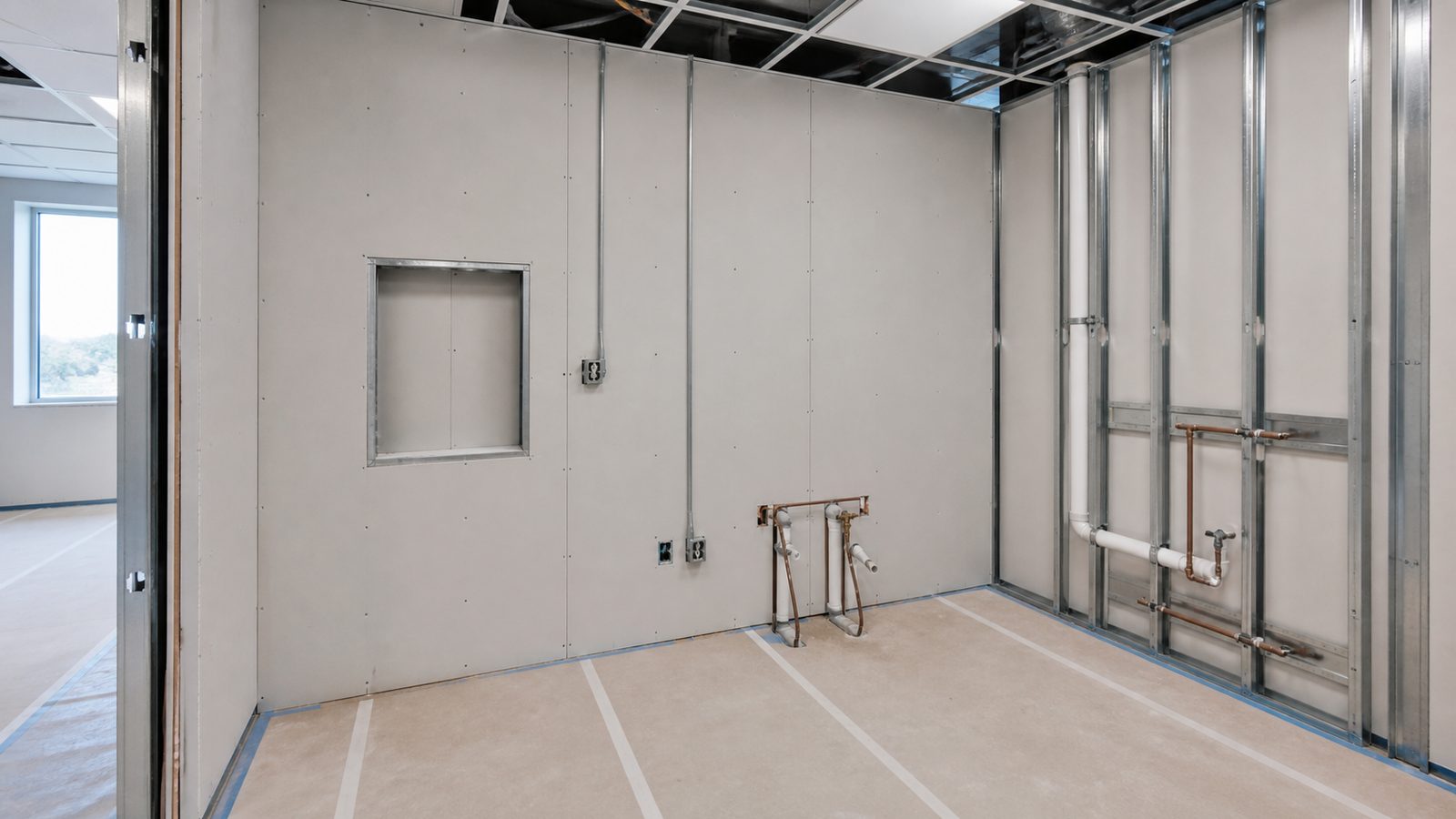
Typically Covered by TI Allowance
- Demolition of existing improvements
- Framing (interior partition walls, soffits, ceiling structure)
- Drywall and taping
- HVAC distribution (ductwork, diffusers, VAV boxes) — note: the base building HVAC may not be included
- Electrical (branch wiring, outlets, lighting fixtures, panel upgrades)
- Plumbing (restrooms, break room sinks, floor drains)
- Fire protection modifications (sprinkler drops, coverage adjustments)
- Flooring (carpet, VCT, LVP — specification-dependent)
- Ceilings (suspended grid or drywall)
- Painting
- Doors and hardware (interior)
- Permit fees (typically)
- Contractor overhead and profit
Typically NOT Covered — Tenant Pays Out-of-Pocket
- Furniture, fixtures, and equipment (FF&E): desks, chairs, shelving, equipment
- Audio-visual and technology (IT infrastructure, security cameras, access control)
- Signage (interior and exterior)
- Moving costs
- Low-voltage systems (data cabling, phone, security) — sometimes excluded from TI
- Specialty equipment (medical equipment, restaurant equipment, laboratory fixtures)
- Costs above the TI allowance cap
The most common budget mistake: a tenant receives a $70/sqft TI allowance, estimates $65/sqft for construction, and then discovers that their business requires $15/sqft in IT infrastructure, $12/sqft in signage and branding, and $8/sqft in specialty equipment — none of which the TI covers. Total out-of-pocket: $35/sqft or more, on top of the construction gap.
Getting a GC Estimate Before Signing the Lease
This is the single most valuable step a tenant can take before lease execution, and most tenants skip it.
A preliminary construction estimate — even based on a schematic floor plan before final design — establishes whether the TI allowance is sufficient, what the likely out-of-pocket exposure is, and whether the lease economics work before the tenant is committed. Most good GCs will provide a preliminary estimate at no cost for a real opportunity.
In Jacksonville's current market, JK Prestige provides 48-hour fixed-price estimates. Bring us a floor plan sketch and the landlord's delivery condition description, and we can tell you what the construction cost is likely to be — and where the gaps are. This protects you from signing a lease with an insufficient allowance. See how we work with commercial clients for more on our estimating process.
Shell vs. Warm Shell vs. Vanilla Box vs. Turnkey
Delivery condition is not standardized. These terms have different meanings in different transactions. Always confirm in writing what the landlord delivers before budgeting your TI scope.
Shell (Cold Shell or Cold Dark Shell)
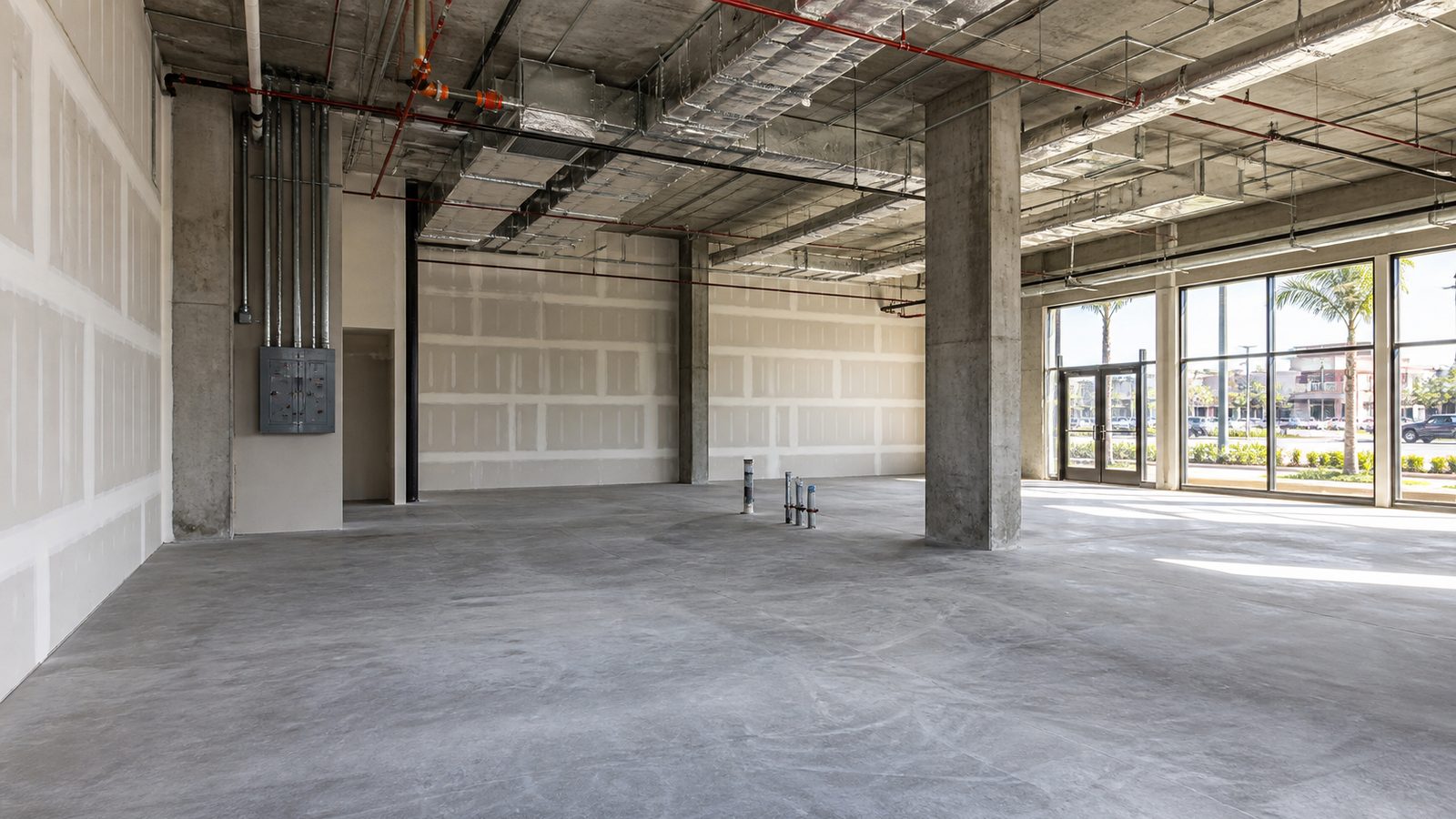
The landlord delivers: structural walls and slab, roof, exterior glazing, and an electrical panel stub. No interior improvements. No HVAC. No plumbing rough-in (or minimal). The tenant builds everything.
Shell delivery is most common in industrial flex, some retail, and build-to-suit medical. The TI allowance for shell delivery must cover the entire interior — HVAC, electrical distribution, plumbing, walls, ceilings, and finishes.
Warm Shell
The landlord delivers: everything in shell delivery plus HVAC units (possibly) and electrical distribution to the tenant's panel. Plumbing may include restroom rough-in. Interior improvements (walls, ceilings, finishes) are the tenant's responsibility.
Warm shell is common in multi-tenant office buildings and some retail centers. The HVAC question is critical: does "warm shell" include HVAC units but not distribution? Or distribution but not units? This is a $8 to $15/sqft variable. Get it in writing.
Vanilla Box
The landlord delivers a move-in-ready blank canvas: HVAC distribution, recessed lighting, demising walls, restrooms built to code, painted walls, and suspended ceiling. The tenant provides furniture, branding, technology, and specialty build-out.
Vanilla box delivery is common in Class A office and higher-quality retail. The TI allowance for a vanilla box delivery covers upgrades above the standard finish, specialty rooms, and any configuration changes.
Turnkey
The landlord builds the space to the tenant's specifications and delivers a completed, move-in-ready suite. The TI allowance is internal to the landlord's deal — the tenant sees only the finished space. Turnkey is common in major chain retail deals (the landlord builds to the tenant's prototype) and some medical office leases.
Negotiating TI Allowances in Jacksonville's 2025 Market
Jacksonville's office market had a vacancy rate of approximately 14 to 17 percent across Duval County in 2024, with higher vacancy in suburban Class B product. That vacancy gives tenants leverage, particularly in buildings where the landlord is carrying empty space.
Leverage Points for Tenants
Lease term: offering 7 or 10 years instead of 3 or 5 gives the landlord more amortization runway and supports a higher allowance. Calculate whether the additional rent commitment is worth the allowance increase for your business.
Credit profile: a tenant with strong financials (audited statements, good Dunn and Bradstreet rating, or a national brand affiliation) can negotiate higher allowances because the landlord's risk of default is lower.
Market vacancy: in buildings with meaningful vacancy, the landlord's cost of carry on empty space is substantial. A $500,000 TI allowance on a space that has been vacant 18 months is a better deal for the landlord than 6 more months of zero rent plus broker fees.
Timing: landlords close deals at the end of quarter and fiscal year to hit revenue targets. A tenant willing to commit quickly at the right time in the quarter has negotiating leverage.
Allowance overage structure: if the landlord won't increase the allowance, negotiate for an overage structure — the tenant can spend above the allowance cap, with the overage amortized into the rent at a defined interest rate. This keeps the tenant's cash flow flexible without requiring the landlord to increase upfront capital.
The TI Construction Process: Lease Execution to Move-In
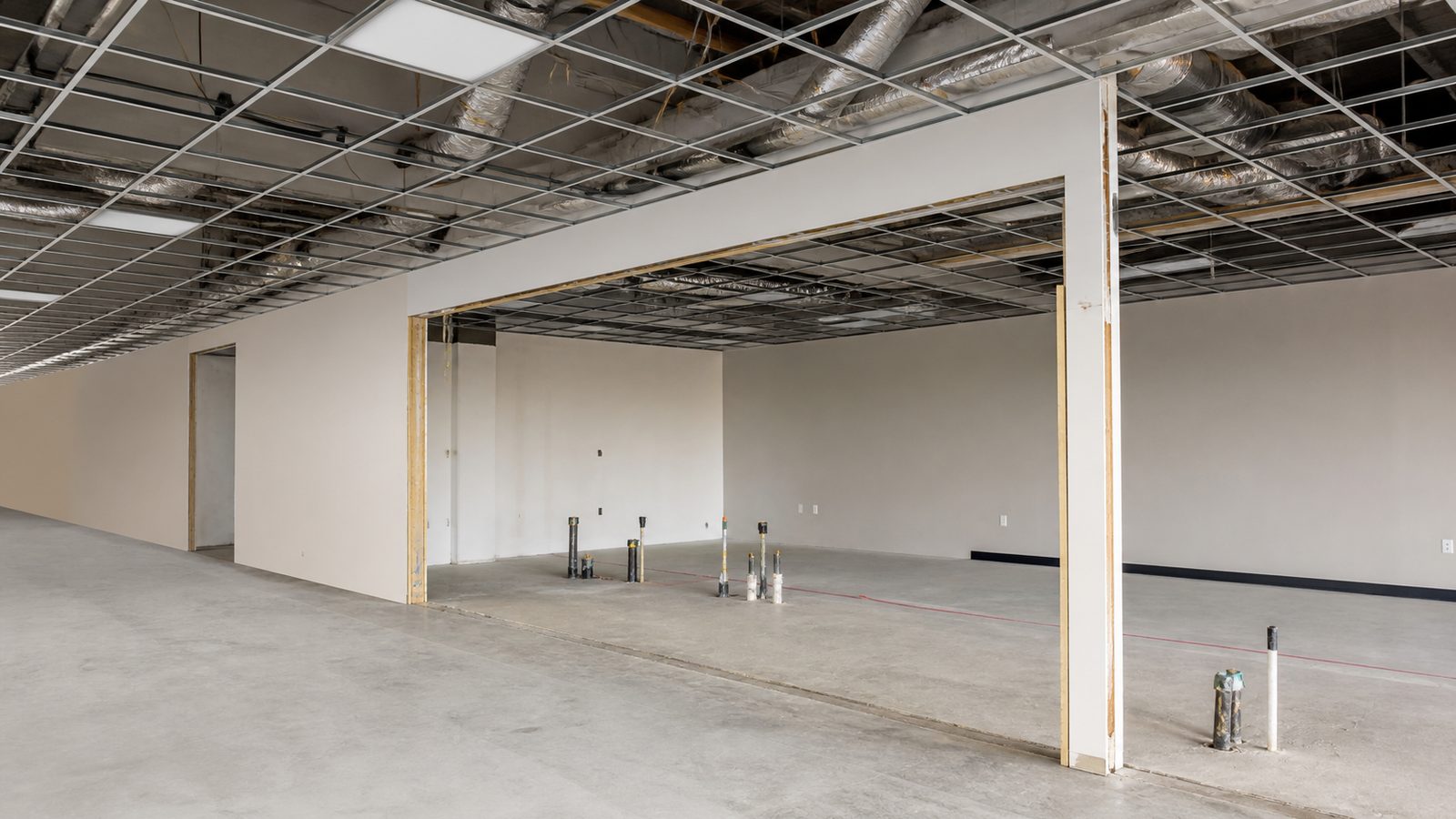
Most first-time tenants underestimate the time between lease signing and occupancy. The process:
- Lease execution (Week 1): lease is signed, TI allowance and delivery condition are locked.
- GC selection (Weeks 1–4): tenant selects a GC and begins design. Ideally the GC is selected before lease execution so the estimate is already in hand.
- Design and construction documents (Weeks 3–10): architect or designer produces permit-ready drawings. Complexity determines duration: basic office is 3 to 5 weeks; medical or restaurant is 6 to 10 weeks.
- Permit submission (Weeks 10–12): building permit submitted to Duval County Building Inspection Division.
- Permit review (Weeks 12–18): standard commercial TI permits run 3 to 6 weeks for complete applications. Medical or food service (separate health department review) adds time.
- Construction (Weeks 18–28 for standard office; 24–38 for medical or restaurant): permit in hand, construction begins.
- Inspections and CO (Weeks 28–32): final inspections by building, mechanical, electrical, and fire departments. CO issued.
- Move-in (Week 32+): after CO.
Total time from lease execution to occupancy: 5 to 9 months for standard office or retail; 8 to 14 months for healthcare or restaurant. If the tenant's lease start date is tied to a build-out completion date, confirm that the timeline above fits within the lease term or negotiate a rent-free period of appropriate duration.
For our renovation and TI project experience, see JK Prestige's renovation capabilities.
Avoiding the Most Common TI Budget Mistakes
Allowance set without a GC estimate. The landlord and broker set the TI allowance based on market comparables, not your actual construction scope. Get an independent GC estimate before you accept the allowance as adequate.
No contingency. TI projects consistently run into scope additions: field conditions that don't match the landlord's as-built drawings, code upgrades triggered by the renovation, and tenant-requested changes. Budget a 10 percent contingency on top of the hard cost estimate.
FF&E excluded from planning. Furniture and technology are frequently overlooked in the total occupancy budget. On a 3,000-square-foot professional services office, FF&E and technology can easily run $80,000 to $150,000 — unrelated to TI but payable before opening day.
Construction started without a permit. Starting work before a permit is issued — even minor framing — can result in stop-work orders, fines, and required demolition of completed work. In Duval County, inspectors visit active commercial sites.
Inadequate scope documentation. TI scopes change frequently between lease execution and construction start. Every scope change should be documented in writing with a revised cost estimate. Undocumented verbal scope additions are the primary source of construction disputes.
Wrong GC for the project type. A residential contractor doing commercial TI work will miss code requirements, have no commercial subcontractor network, and be unfamiliar with commercial inspection processes. Verify that your GC has commercial TI experience in Duval County specifically.
Landlord vs. Tenant GC: Who Controls Which Arrangement
Landlord-Controlled Construction (Landlord Build)
The landlord manages construction using their preferred GC, billing against the TI allowance. The tenant approves plans and pays overages. Common in large corporate landlord portfolios.
Tenant risk: the landlord's GC may not be the most cost-efficient option for the tenant's scope. The tenant has less visibility into pricing and may not be able to negotiate the GC's markup. Overage disputes are resolved with the landlord, not the GC directly.
Tenant-Controlled Construction (Tenant Build)
The tenant hires their own GC, manages the construction, and the landlord reimburses from the TI allowance against paid invoices or draws. Most common in Jacksonville's local and regional landlord market.
Tenant benefit: full control over GC selection, pricing, schedule, and quality. Tenant can select a GC with fixed-price contracts and direct principal involvement — the two factors that most reduce budget risk.
Always confirm the landlord's approval rights. Most leases require landlord approval of the tenant's GC and construction drawings before work begins. Non-approved GC work can result in the landlord refusing to fund the TI allowance.
JK Prestige's TI Experience in Jacksonville
JK Prestige Construction has completed tenant improvement projects across the Jacksonville market — office, medical, retail, and industrial flex — self-performing framing, drywall, finish carpentry, and concrete where applicable. Our fixed-price contracts mean the TI allowance gap is defined before construction starts, not discovered through change orders. The founder walks every site and is reachable directly by the tenant throughout the project.
We provide written estimates within 48 hours of receiving a floor plan and delivery condition description. If you are in lease negotiation and need a construction cost number before signing, call us before you sign. For more on our approach, see the JK Way and our renovation and TI project experience.
Ready to start? Get a written estimate in 48 hours. Call (904) 944-0278 or request a free consultation.
No call center. No coordinator. A JK principal reviews every inquiry and replies with a real number, not a range, not a follow-up form.
Request Free Estimate →