When you compare home builders in Florida, you'll encounter two fundamentally different business structures. One is a franchise model — a national or regional brand (Arthur Rutenberg, ICI Homes, Maronda) licenses its plans, specs, and purchasing relationships to a local builder. The other is an independent custom general contractor (GC) who builds to your specifications with direct accountability to you and no brand layer in between. Both produce homes. The operating model determines who controls the scope, who answers your questions, who owns the warranty, and how much flexibility you actually have. For a luxury home in Jacksonville, the difference in operating model is the difference between a collaborative custom build and an elaborately marketed semi-custom process.
What a Franchise Builder Model Actually Means
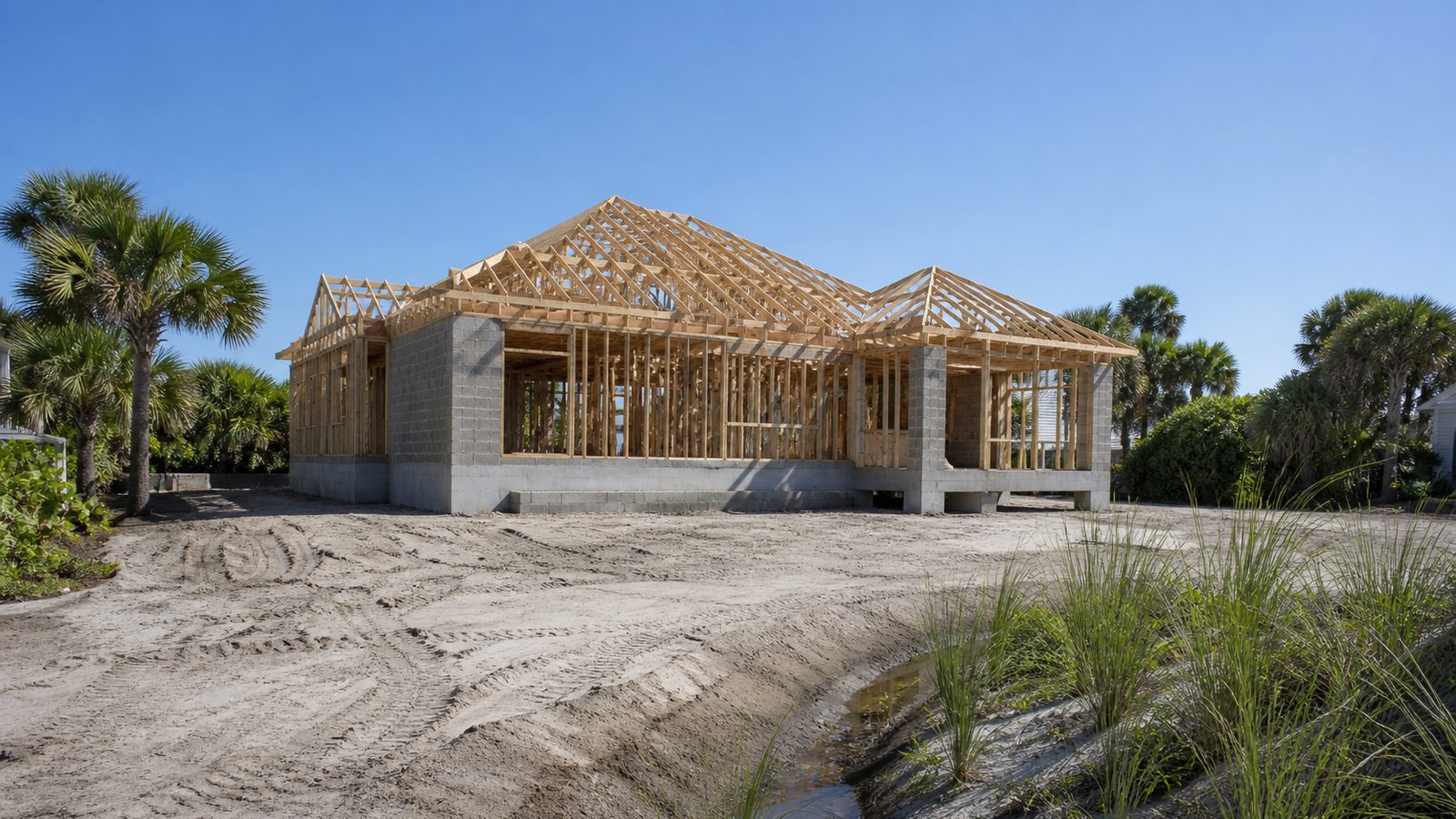
Franchise builder is a specific business structure that is often misunderstood as simply a large or well-known builder. A franchise builder is a local businessperson who has paid for the right to build homes under a national or regional brand name, using that brand's proprietary plans, material specifications, and purchasing contracts.
The local franchisee typically operates with significant brand-imposed constraints:
- Plans: The franchise owns the design library. You choose from approved plans and approved modifications. Plans outside the library are not available, or carry significant premium costs because they require design work the franchise system didn't anticipate.
- Materials: The franchise negotiates volume pricing with specific manufacturers and suppliers. You choose within those contracts. Substitutions outside approved materials require exceptions, and exceptions cost money.
- Trade contractors: The franchisee builds relationships with local subcontractors over time, but those relationships are theirs to manage within the franchise's operating standards. The brand doesn't backstop trade performance — the franchisee does.
- Warranty: The brand name may appear on the warranty document, but the warranty is administered by the local franchisee. If the local franchisee goes out of business, the brand's obligation is limited to what's written in the franchise disclosure document.
The brand layer creates a second party between you and the person building your home. When you call to discuss a design modification, you're calling the franchisee. When you escalate a complaint, it goes from the franchisee to the franchise, which has its own timeline and process. You are not talking to the builder. You are talking to the brand's representative.
Accountability Chain: One Party vs. Three
The clearest way to understand the difference is to trace the accountability chain when something goes wrong.
Franchise model accountability chain: You → Local franchisee → Franchise corporate → Subcontractor who did the work
If a seam opens in your drywall at month nine, you call the local franchisee. The franchisee contacts the drywall subcontractor they used — a sub they may or may not still have a relationship with. If the sub disputes responsibility, the franchisee may escalate to the franchise's warranty department. Depending on the franchise agreement, the corporate brand may offer support, or may defer to the local operator.
Principal-led custom builder accountability chain: You → Named principal (one call)
On a JK Prestige custom home, the named principal who signed your contract handles all issues — design changes during construction, schedule questions, and post-occupancy warranty claims. One person. One direct number. No routing.
Because JK self-performs framing, drywall, and finish carpentry with its own crews — rather than coordinating subcontractors — there's no subcontractor to dispute responsibility when a trade issue arises. The people who built it work for JK. The person who answers the phone owns the outcome.
Scope Flexibility: What You Can Actually Change
A franchise builder's value proposition is partially built on efficiency — standardized plans, standardized materials, standardized processes. That efficiency has a cost: scope flexibility is limited by what the franchise system permits.
Common limitations in franchise custom home programs:
- Ceiling height variations outside the standard offering add premium cost because they require structural recalculation the franchise system didn't pre-engineer
- Mechanical system substitutions (geothermal instead of conventional HVAC, for example) may not be available in the franchise's approved systems or may require exceptions that the local franchisee can't approve unilaterally
- Material selections outside the approved vendor list trigger additional procurement costs and schedule uncertainty
- Structural modifications to approved plans require franchise-level engineering review, adding weeks and cost
With an independent custom GC, scope is defined by what the architect designs and what the owner approves — not by a plan library. If you want a 12-foot first-floor ceiling, you design a house with a 12-foot first-floor ceiling. If you want geothermal HVAC, solar-ready panel sizing, and Lutron lighting control, you scope it, price it, and build it. The only constraints are site, structural engineering, and budget.
This doesn't mean everything is cheaper with a custom builder. It means the scope isn't artificially constrained by a franchise system.
Change Orders: How the Process Differs
Change-order theater is an industry norm — particularly with franchise and production builders who use allowances to keep the base price low and recapture margin through scope additions. Here's how it works:
A franchise builder quotes a base price that includes an allowance for, say, kitchen cabinets: $18,000. The allowance sounds reasonable. When you actually select cabinets, the custom-height full-overlay option you want costs $31,000. The $13,000 difference becomes a change order. This plays out across tile, countertops, plumbing fixtures, lighting, and landscaping — every line where an allowance was set conservatively.
With a fixed-price contract and full pre-construction scope documentation, this problem doesn't exist because it's engineered out at the start. JK's pre-construction process requires that material selections be made before the contract price is locked — not after. The fixed price covers your actual selections, not a generic allowance placeholder. If the scope doesn't change, the price doesn't change.
See how the fixed-price process works from site walk through completion at The JK Way.
Warranty Depth: Who Is Actually Behind It
The warranty question is where the franchise model creates the most ambiguity for buyers.
A franchise brand's warranty may appear on the warranty document — giving the impression that the brand stands behind the work. Read the franchise disclosure document carefully: the brand typically warrants that the franchisee will perform the warranty, not that the brand will step in if the franchisee doesn't. If the local franchisee closes, reorganizes, or disputes a claim, the brand's direct obligation is narrow.
An independent custom GC's warranty is as strong as the builder's financial stability and operating continuity — and for a principal-led builder, it's personal. The named principal's name is on the warranty. Their reputation in the local market is at stake on every post-occupancy claim.
On a JK Prestige custom home, the one-year workmanship warranty is administered directly by the named principal, with a 24-hour response time on urgent issues and five-business-day scheduling on non-urgent inspections. No third-party warranty company. No claims adjuster. The person who built your home handles the repair.
What to Compare Before You Sign With Any Builder
When evaluating a franchise builder against an independent custom GC, ask these questions in writing:
- If the local franchisee closes during or after my build, what is the brand's specific obligation?
- What are the approved plan modification limits, and what triggers a franchise-level review?
- Who handles post-occupancy warranty claims — the local franchisee, a third-party warranty administrator, or the corporate brand?
- What percentage of the base-price allowances have historically matched actual client selections?
- Who is the named individual responsible for my project from design through warranty?
A franchise builder with strong local execution can build a good home. The question is whether the brand layer adds protection and value, or whether it adds cost and complexity to a process that would be cleaner with direct principal-to-owner accountability.
Explore JK's approach to custom home delivery at our custom homes expertise page, and see completed luxury residential projects in the project portfolio.
Get a written estimate in 48 hours — contact a JK Prestige principal directly.
No call center. No coordinator. A JK principal reviews every inquiry and replies with a real number, not a range, not a follow-up form.
Request Free Estimate →