Most first-time commercial developers in Jacksonville come from one of three backgrounds: successful residential investors who want to step into retail or office; professionals who want to develop their own building rather than lease space; or residential home builders who want to deliver a commercial project for the first time. All three groups share a common starting point — they know construction broadly but do not know commercial construction specifically, and they are about to spend money in a market where that gap is expensive.
Commercial construction is not residential construction at a larger scale. The permitting path through Duval County's Development Review Committee (DRC) is structurally different from a single-family permit. The contract structures — Guaranteed Maximum Price (GMP), design-build, design-bid-build — carry different risk profiles than a fixed-price residential contract. The financing is different, the team is different, and the mistakes that cost money are different. This guide covers the full path from project type selection through certificate of occupancy (CO) for first-time commercial developers in Jacksonville and Northeast Florida.
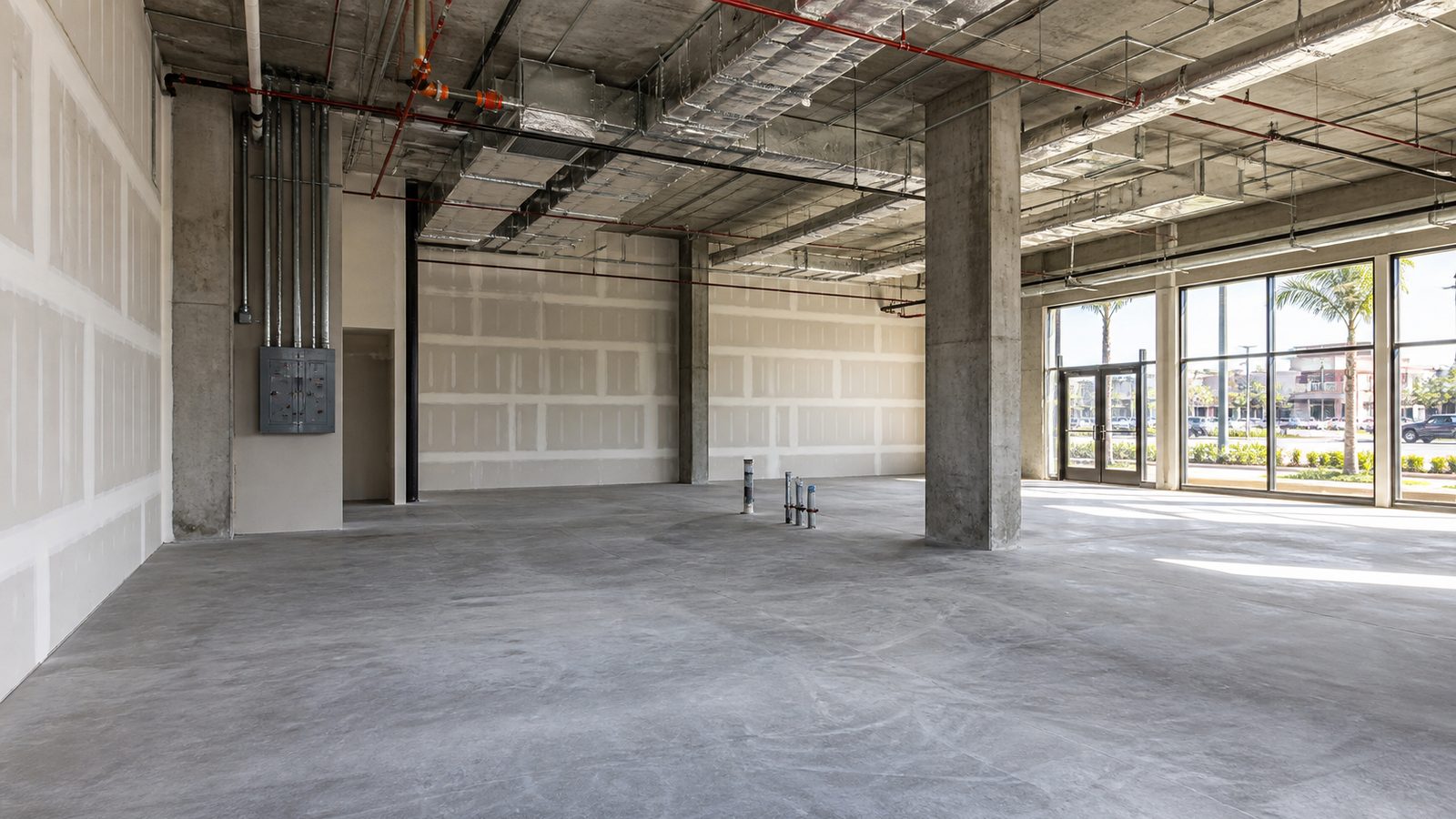
What Commercial Construction Project Types Exist in Jacksonville
Before assembling a team or talking to a GC, first-time developers need to define what type of commercial project they are building. Project type determines the permitting path, the regulatory requirements, the right contract structure, and how the construction cost benchmarks.
Tenant Improvement (TI)
A tenant improvement is construction within an existing commercial building — leasing a shell space and building it out for a specific tenant. TI is the lowest-barrier entry point to commercial development. The existing structure eliminates foundation, framing, and roofing costs. Permitting is through the building department with no DRC involvement for most TIs. TI costs in Jacksonville 2025 run $45–$150 per square foot depending on finish level and MEP (mechanical, electrical, plumbing) complexity.
Ground-Up Office and Retail
Building a new office or retail building on raw land is the classic commercial development. It involves site acquisition, civil engineering, utility extension, and full building construction. Ground-up construction in Jacksonville 2025 runs $150–$250 per square foot for typical office and retail, excluding land and soft costs.
Mixed-Use
A mixed-use project combines residential units with ground-floor commercial space. Jacksonville's mixed-use activity is concentrated in Riverside, Avondale, and the growing urban core along the Southbank and Northbank. Mixed-use projects require coordination of residential and commercial permitting and are more complex structurally than single-use buildings.
Industrial
Distribution, manufacturing, and flex industrial are among the fastest-growing project types in Duval, Nassau, and St. Johns counties. Industrial construction is less finish-intensive than office or retail, with shell costs running $40–$70 per square foot for tilt-up construction and $45–$80 for steel frame. JK Prestige's industrial project experience covers NE Florida distribution and flex facilities.
Building Your Development Team
Commercial development requires a team that residential investors are not accustomed to assembling.
General Contractor
The GC is the most consequential selection. Choose a licensed GC with verifiable commercial references in the specific project type — a GC whose references are all residential custom homes is not the right GC for a 30,000-square-foot medical office building. Verify the CGC (Certified General Contractor) license at the Florida DBPR (Department of Business and Professional Regulation) and confirm it is active.
Architect
The architect of record (AOR) produces the construction documents and navigates the permitting process. Commercial projects require an architect licensed in Florida. For healthcare, look for an architect with AHCA (Agency for Health Care Administration) experience and healthcare design history.
Civil Engineer
The civil engineer handles site design: grading, stormwater, parking, utility connections, and the permit drawings required for FDOT (Florida Department of Transportation) driveway permits and St. Johns River Water Management District (SJRWMD) environmental review. Civil engineering is frequently underestimated in soft costs by first-time developers.
MEP Engineer
Mechanical, electrical, and plumbing engineers design the building systems. On larger projects ($10M+), MEP engineers hold separate contracts with the architect or owner. On smaller projects, the architect may include MEP design in their contract through affiliated engineers.
Attorney
A real estate attorney reviews land purchase contracts, title issues, easements, and lease agreements. For projects with construction financing, the lender's attorney will be heavily involved in loan closing.
Lender
Commercial construction financing is different from residential mortgage products. Lenders for commercial projects include regional banks, credit unions, SBA lenders, and construction loan specialists. The lender typically requires a draw schedule, title insurance, and inspection reports before each loan advance.
Delivery Method Selection
The choice of delivery method — how design and construction are contracted — affects cost, schedule, and risk allocation.
Design-Bid-Build (DBB)
The traditional linear sequence: the owner hires an architect who produces complete construction documents, the owner bids those documents to GCs, the owner awards a contract to the selected GC, and construction begins. DBB delivers the most competitive pricing because GCs bid against complete documents. The tradeoff is schedule: design must be 100% complete before construction begins, adding 4–9 months to the overall project timeline.
DBB is appropriate for first-time developers who want maximum owner design control, have a flexible schedule, and are not dealing with a complex program that requires GC input during design.
Design-Build (DB)
A single contract covers both design and construction — one entity is responsible for delivering the building from concept to CO. Design-build compresses schedule by overlapping design and construction phases and is typically 10–20% faster than DBB. The tradeoff is reduced owner control over design — the design-build entity controls design decisions to manage their fixed price.
Design-build is appropriate for straightforward commercial projects where the owner's program is clear, the schedule is driven by a lease commencement or operational deadline, and the owner is comfortable delegating design decisions within a defined scope.
GMP (Guaranteed Maximum Price)
GMP contracts allow construction to begin before design is complete, compressing schedule similarly to design-build but retaining the owner's separate design team. The GC provides preconstruction services during design and establishes a GMP when design reaches 60–75% completion. GMP is standard on hospital and complex commercial projects. For a first-time developer, GMP requires active cost management — the owner must understand how to audit the open-book cost structure.
JK Prestige's project delivery experience spans all three delivery methods; the recommendation depends on project type and owner capacity.
The Pro Forma: How Construction Costs, Soft Costs, and Contingency Fit Into Your Model
The development pro forma is the financial model that determines whether the project is viable. Construction cost is only one component.
Construction (Hard) Costs
The GC contract amount — all labor, materials, and equipment for the building itself. Hard costs in Jacksonville vary significantly by project type and finish level; get a GC estimate before finalizing your pro forma.
Soft Costs
Soft costs include architecture and engineering fees (typically 6–12% of hard costs on commercial projects), permitting fees, surveys, geotechnical investigation, environmental review, lender fees, title insurance, legal fees, and the owner's project management cost. First-time developers routinely underestimate soft costs by 20–30%.
Contingency
Most lenders require a minimum 10% contingency on construction costs. Experienced developers carry 15–20% on complex projects. Contingency is not optional padding — it is capital set aside for design changes, unforeseen site conditions, and market price movement during construction.
A 10% contingency on a $5M project is $500,000. If your pro forma only works if construction costs are within 5%, reconsider the project or renegotiate the land price.
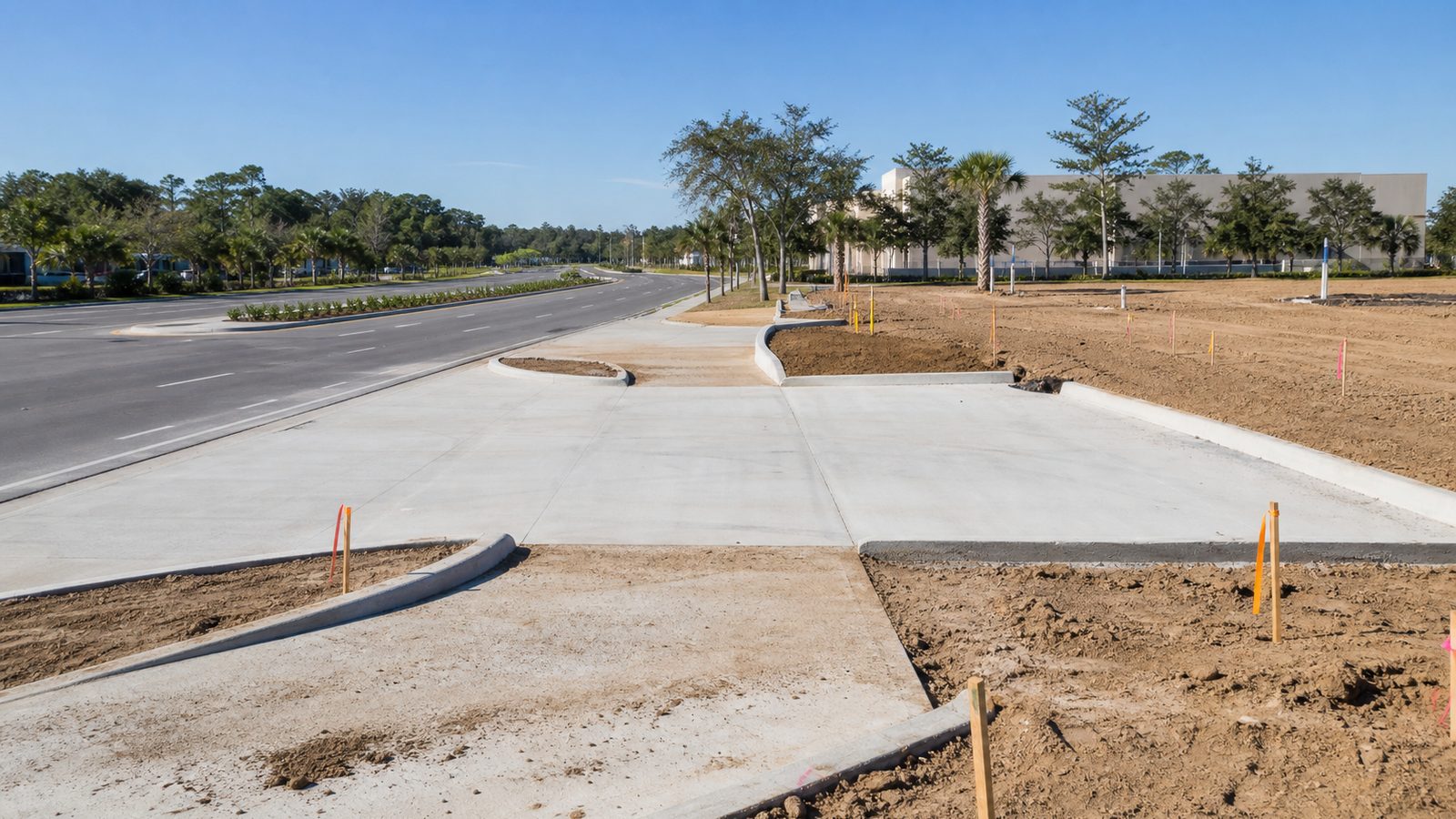
Site Acquisition and Due Diligence in Jacksonville
In Duval County, commercial site due diligence covers five critical areas.
DRC Zoning
The Duval County Development Review Committee (DRC) reviews all commercial development applications above a threshold size and for certain uses. Confirm that your intended use is permitted by right in the existing zoning, or identify what variance or rezoning is required and how long that process takes.
Wetlands
Northeast Florida has significant wetland coverage that is not always visible on a site visit. A wetland delineation by a qualified environmental consultant — and SJRWMD review if delineation indicates regulated wetlands — is required before finalizing a land purchase. Wetlands within the buildable area of a site can reduce the developable area by 50% or make the site unviable.
FDOT Access
If the site fronts a state road, FDOT controls driveway permitting. FDOT driveway permits can take 90–180 days and may require traffic studies, turn lane improvements, or signal coordination at the developer's cost.
Utility Capacity
Confirm with JEA (Jacksonville Electric Authority) that water, sewer, and electrical capacity is available at the site and what the connection fees and extension costs will be. In fast-growing areas (Nassau County, western St. Johns County), utility extension costs for commercial projects can exceed $500,000.
Geotechnical Investigation
A geotechnical investigation (soil boring report) is required by most structural engineers and lenders. Jacksonville's coastal geology — with its clay, sand, and occasional limestone layers — produces variable conditions that affect foundation type and cost.
Permitting Timeline in Duval County
First-time developers routinely underestimate permitting time when building their project schedule.
Commercial permit applications in Duval County go through the Development Services Division. Processing time for a typical commercial permit (office, retail, tenant improvement) runs 4–8 weeks for plan review, though resubmittals for corrections can add 2–4 weeks per review cycle.
Projects that trigger DRC review — larger-scale developments, projects requiring site plan approval, uses requiring special exception — add 2–4 months to the permitting timeline. DRC meetings are scheduled monthly; missing a submission deadline means a full month's delay.
Healthcare and hospital projects add AHCA plan review, which runs 60–90 days and may have its own corrections cycle. AHCA review runs concurrently with local building review on most projects.
Plan your project timeline backward from your target occupancy date, add the construction duration, and then add the permitting timeline. Most first-time commercial projects in Jacksonville take 12–24 months from land contract to CO.
GC Selection for First-Time Developers
Selecting the right GC is the most consequential decision a first-time commercial developer makes.
Verify the CGC license at DBPR. The license must be active and in good standing. Ask for commercial references specifically — three to five completed commercial projects of similar size and type, with owner contacts you can call.
Ask about self-perform capability. A GC who self-performs framing, concrete, and drywall has more direct schedule control than one who subcontracts all field work. Ask which trades they self-perform, and verify the claim by asking for the workers' compensation insurance policy showing those trade classifications.
Verify bonding capacity. For projects over $500,000, confirm the GC can obtain a performance bond and payment bond in the amount of the contract. For projects over $2M, verify the bonding company is rated A-/VIII or better by AM Best.
Ask for a fixed-price contract with a written scope, not a cost-plus arrangement with an undefined ceiling. JK Prestige offers fixed-price contracts with 48-hour estimate turnaround so developers have the budget certainty their pro forma requires.
Commercial Construction Financing
First-time developers face a more complex financing landscape than residential buyers.
Construction loans fund the building process — the lender advances funds in draws tied to construction completion milestones, and the developer pays interest only during construction. At completion, the construction loan converts to a permanent loan (a "mini-perm") or is paid off by refinancing.
SBA 504 loans are available for owner-occupied commercial projects (at least 51% of the building will be occupied by the borrower's business). SBA 504 offers below-market fixed rates on the permanent loan portion, with a 10–25 year term. First-time developers often overlook SBA 504 because the process is complex, but the interest savings over the loan term are significant.
Most commercial lenders require 20–30% developer equity, a signed lease from a creditworthy tenant (for speculative projects), and personal guarantees from the principals.
Managing the Project: Your Role During Construction
First-time developers often attempt to manage construction too closely or not closely enough. The appropriate owner role is:
Attend monthly OAC (Owner-Architect-Contractor) meetings. Review the GC's monthly pay application against the schedule of values before approving payment. Visit the site at least once per month — not to manage the work, but to observe progress and ask questions. Respond promptly to RFIs and submittal reviews that require owner direction. Approve change orders in writing before the GC proceeds.
The things to delegate to the GC: daily site management, trade coordination, inspection scheduling, safety management, and subcontractor supervision. If you are on site daily second-guessing the superintendent, you have either hired the wrong GC or have more time to spend than most first-time developers do.
Lease-Up and Occupancy: CO Requirements and Tenant Coordination
A certificate of occupancy (CO) from the local building department is the legal authorization for building occupancy. The CO is issued after all inspections pass, all corrections are addressed, and the building complies with the Florida Building Code as permitted. Healthcare facilities require additional AHCA final survey before clinical occupancy.
For multi-tenant commercial projects, phased occupancy may be available — tenants in completed spaces can occupy under a temporary certificate of occupancy (TCO) while remaining spaces are completed.
Tenant move-in coordination requires scheduling the GC's punch-list work around tenant deliveries and build-out activities. Define the move-in date and coordinate with the GC at least 60 days in advance.
Common First-Time Developer Mistakes in Jacksonville
Underestimating permitting time is the most universal mistake. Add a minimum 60-day buffer to whatever the GC's schedule shows as the permit timeline.
Choosing the low bid is the second. The GC who bids 15% below their competitors is either going to make it up in change orders or default. Reference-check the low bidder as aggressively as the higher bidders.
Under-funded contingency is the third. A 5% contingency is insufficient for a first commercial project. Carry 15%.
Designing before talking to a GC is the fourth. Owners who complete 60% design documents before getting a GC cost estimate invest significant design fees and then discover the design is over budget. A GC consultation at schematic design (30% documents) costs nothing and saves $50,000 in redesign fees.
The fifth mistake is signing a contract without a fixed price and a defined scope. Cost-plus and time-and-materials contracts with no ceiling expose first-time developers to unlimited cost risk. Require a fixed price or a GMP with a defined ceiling before breaking ground.
Ready to start? Get a written estimate in 48 hours. Call (904) 944-0278 or request a free consultation.
No call center. No coordinator. A JK principal reviews every inquiry and replies with a real number, not a range, not a follow-up form.
Request Free Estimate →