Building a custom home in Florida is not the same financial transaction as buying an existing house. You are borrowing money against a home that does not exist yet, which means the lender is underwriting a project, not a property. The requirements are stricter, the paperwork is heavier, and the wrong general contractor (GC) can get your loan rejected before it starts.
This guide walks through every step of securing construction financing, from understanding the loan types to navigating Florida-specific issues that catch builders off guard. The numbers and timelines here reflect Jacksonville and Northeast Florida conditions as of 2025.
Step 1: Understand the Difference Between a Construction Loan and a Construction-to-Permanent Loan
A straight construction loan is short-term debt — typically 6 to 18 months — that covers the build. When the home is finished and a certificate of occupancy (CO) is issued, the loan matures and you pay it off, usually by refinancing into a traditional mortgage. You pay two sets of closing costs.
A construction-to-permanent loan (also called a one-time-close or C-to-P loan) combines both phases. You close once, the loan funds the build in draws, and it automatically converts to a 15- or 30-year mortgage when the CO is issued. You pay one set of closing costs. Most owner-occupants building a single custom home prefer C-to-P because it reduces transaction costs and locks the permanent rate at the start.
Which you choose depends on your lender's product lineup, your credit profile, and whether you want rate certainty for the permanent phase now or prefer to shop rates at conversion.

Step 2: Know What Lenders Require Before They'll Approve the Loan
Construction lenders are underwriting a risk that traditional mortgage underwriters never see: the risk that the project goes over budget, the builder walks, or the house doesn't get built at all. To mitigate that, they require documentation that proves the project is real and the numbers are defensible.
Expect to provide:
- Signed construction drawings. Permit-ready plans from a licensed architect or designer, not concept sketches.
- A detailed project budget. Line-itemized, with allowances defined. Lenders will not fund a vague scope.
- A fixed-price GC contract. This is non-negotiable for most construction lenders (more on this in Step 3).
- An appraisal based on plans. An appraiser will value the completed home using the drawings and comparable sales. The loan-to-value (LTV) ratio is calculated against this future value, not against the lot.
- Builder qualifications. Many lenders require proof of the GC's license, insurance (general liability and workers' compensation), and track record. Some lenders maintain an approved builder list.
- Lot ownership or purchase contract. If you already own the lot free and clear, that equity counts toward your down payment.
Down payments on construction loans typically run 20 to 25 percent of the total projected cost (lot plus construction). Some programs accept 10 percent with strong borrower profiles, but these are less common in the current rate environment.
Step 3: Understand Why Lenders Require a Fixed-Price Contract
A time-and-materials (T&M) contract — where you pay the GC's actual costs plus a markup or hourly rate — is unfundable for most construction lenders. The reason is straightforward: the lender cannot set a loan amount against an open-ended cost structure. If the project costs $600,000 on a T&M basis or $900,000, the lender has no way to know which loan size to approve.
A fixed-price contract transfers cost risk to the GC. The lender now has a defined maximum cost, which anchors the appraisal, the loan amount, and the draw schedule. If something costs more than estimated, that is the GC's problem, not the bank's.
At JK Prestige Construction, every custom home project runs on a fixed-price contract. The budget detail we provide — line-itemized by trade — is the same document your lender's underwriting team will review. We build the level of specificity lenders need into our pre-construction process because vague budgets delay closings. See how JK structures project delivery for more on our pre-construction phase.
Step 4: Align the Draw Schedule with Your GC's Payment Milestones
Once the loan is approved, funds are not released in a lump sum. The lender releases money in draws as defined phases of construction are completed and verified by an independent inspector or bank representative. Typical draw stages:
- Foundation complete
- Framing complete (rough framing, sheathing, and roof deck)
- Rough mechanical, electrical, and plumbing (MEP) complete
- Insulation and drywall complete
- Finishes and punch list
- Final draw at CO issuance
The draw schedule in your loan documents must match your GC's payment schedule. If your GC expects payment at framing but the bank's next draw is not until rough MEP, you have a cash flow problem that stalls the project. Nail this alignment before you sign either document.
Budget a 10-percent retainage on each draw. Many lenders hold back 10 percent of each draw and release it at project completion. Your GC needs to know this and build their cash flow around it.
Step 5: Know the Typical Construction Loan Terms in Florida
Interest during the construction phase is charged only on the funds that have been drawn, not on the full loan amount. This is called interest-only during construction. If your total loan is $700,000 but only $200,000 has been drawn, you pay interest on $200,000.
Standard construction loan parameters in 2025 Florida:
- Term: 6 to 18 months for the construction phase
- Rate: Typically prime plus 1 to 2 percent, variable during construction
- Interest payments: Monthly, based on outstanding balance
- Inspection fee: $150 to $300 per draw inspection, paid by borrower
- Draw frequency: Usually no more than once per month
If you are using a C-to-P loan, the permanent rate is usually locked at closing. Understand whether your lock is float-to-close or a hard lock, and what extension fees apply if the build runs long.
Step 6: Account for Florida Flood Zone Implications
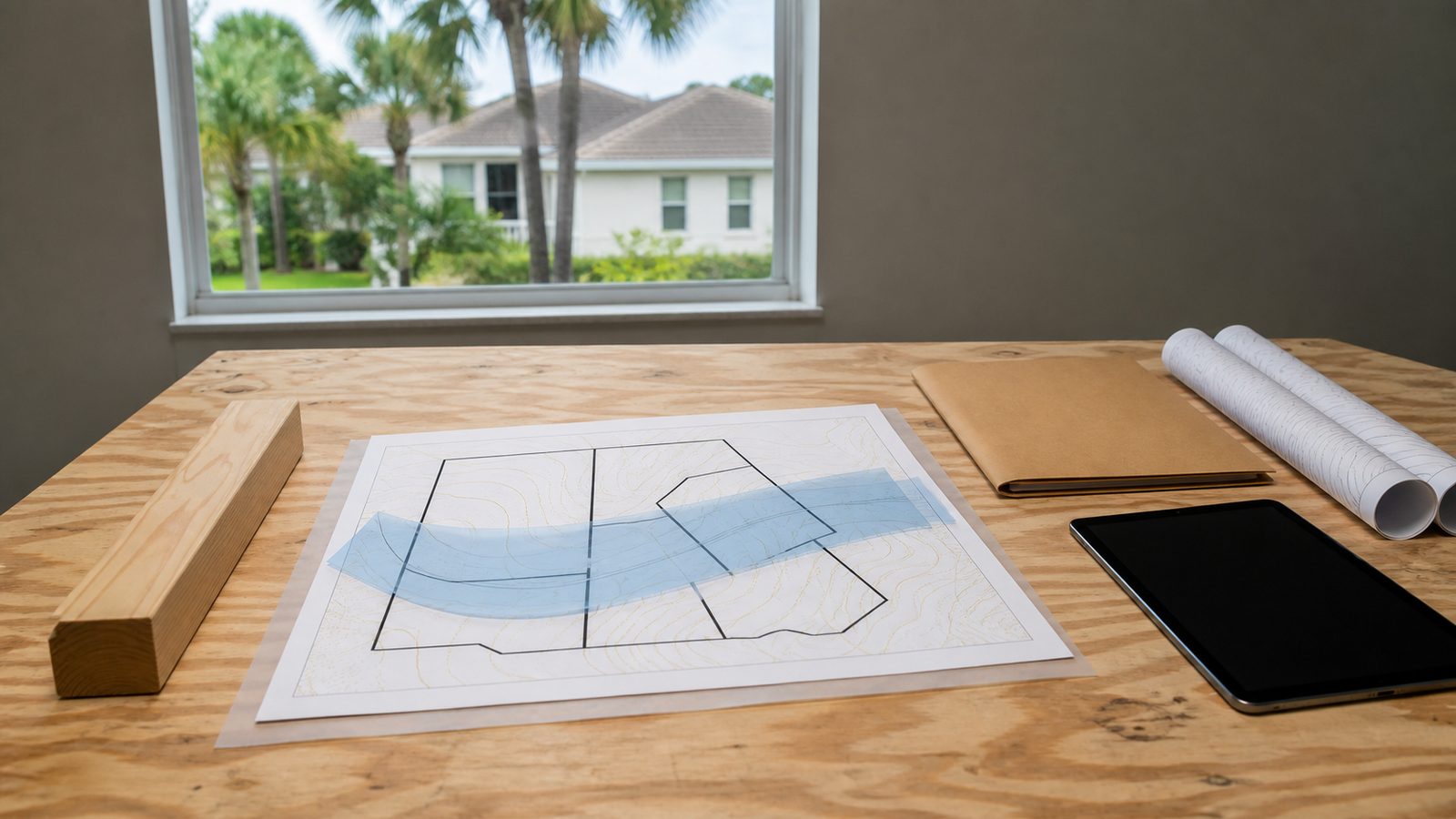
Florida is not a uniform market. Where your lot sits on FEMA's Flood Insurance Rate Map (FIRM) affects your project cost, your insurance requirements, and your appraisal.
If your lot is in a Special Flood Hazard Area (SFHA) — Zone AE, VE, or similar — the lender will require flood insurance during construction and the permanent phase. More critically, the first finished floor elevation must meet or exceed the Base Flood Elevation (BFE) shown on the FIRM map, plus any freeboard required by local ordinance. In Duval County, some areas require first floor 1 to 2 feet above BFE.
Raising finished floor elevation costs money — fill, elevated slabs, or stemwall foundations. This must be in your GC's budget and reflected in the appraisal. A flood elevation certificate from a licensed surveyor is often required at or before the final draw. Budget $500 to $800 for the certificate.
Higher BFE also affects insurance premiums, which affects the appraiser's income approach calculation if the appraiser factors operating costs. Get a flood zone determination before the appraisal is ordered.
Step 7: Understand Construction Loan Closing Costs
Construction loan closing costs are higher than a standard mortgage because you are paying for more services:
- Origination fee: 1 to 1.5 percent of the loan amount
- Appraisal fee: $600 to $1,200 for a plans-based appraisal (more complex than a standard appraisal)
- Title insurance: Standard, based on loan amount
- Draw inspection fees: Paid per draw, not at closing, but budget them upfront
- Builder's risk insurance: Required during construction; typically $1,500 to $3,000 annually on a $700,000 build
If you are doing a two-close approach (construction loan then permanent mortgage), you pay closing costs twice. On a $700,000 project, that can add $15,000 to $25,000 in transaction costs versus the one-time-close approach.
Step 8: Select a Lender Experienced with Custom Construction
Not every bank offers construction loans, and not every bank that offers them has underwriters who know how to process them. A lender that primarily does residential purchase mortgages will take longer, ask for more documentation redundantly, and may not know how to handle Florida-specific issues like SFHA flood zones or septic-to-sewer conversions.
Questions to ask a construction lender:
- How many construction loans did you close in Duval County last year?
- Do you use an in-house inspector or an approved third party for draw inspections?
- What is your target from completed application to first draw?
- What happens if the build runs past the construction loan term?
- Do you have an approved builder list, and is my GC on it?
Regional banks and credit unions with local branches in Jacksonville often outperform national lenders on construction loans because their underwriters know the local market, the appraisers, and the permitting timelines.
Pro tip: Get the construction lender involved before you hire the architect. The lender's appraisal requirements may affect the level of drawing detail your architect produces. Starting this conversation at the design phase saves weeks.
Warning: Do not sign a GC contract contingent on "owner securing financing" without a hard deadline. If financing takes longer than expected and your GC has another project start, you lose your slot in their schedule.
Get a written estimate in 48 hours. Call (904) 944-0278 or request a consultation.
No call center. No coordinator. A JK principal reviews every inquiry and replies with a real number, not a range, not a follow-up form.
Request Free Estimate →