Most renovation disputes in Jacksonville do not start with bad workmanship. They start with a contract that was never designed to protect you in the first place. Vague scope. T&M billing with no ceiling. Verbal promises that disappeared when the demo crew showed up.
The way to avoid change-order surprises is not to find a contractor you trust. It is to hire a contractor whose contract structure makes surprises impossible. That starts with knowing what to look for — and what to walk away from.
This is a practical guide to hiring a renovation GC (general contractor) in Jacksonville. No fluff. Specific questions, specific red flags, and the standards a contractor has to meet before you hand them your house.

Fixed-Price vs. Time-and-Materials: The First Decision
The single most important question you will ask any renovation contractor is: is this a fixed-price contract or a time-and-materials (T&M) contract?
Fixed-price means the contractor commits to a dollar amount for a defined scope of work. If the scope doesn't change, the price doesn't change. The risk of cost overruns sits with the contractor, not you.
T&M means you pay for hours worked and materials consumed, plus a markup. The risk of overruns sits entirely with you. A T&M contractor has no structural incentive to finish efficiently — every hour they spend is an hour they bill.
Some contractors use hybrid structures: a "not-to-exceed" T&M contract. This puts a ceiling on what you pay, but you still pay every dollar of cost up to that ceiling, and there is no incentive for the contractor to manage cost below it.
The only contract that puts the contractor's and your interests in alignment on cost and schedule is a fixed-price contract. That is the structure JK Prestige uses on residential renovations. The JK Way requires a written scope before demolition starts and a price that doesn't move if the scope doesn't move.
When a contractor tells you "it depends what we find" as a reason they can't give you a fixed price, they are telling you they haven't done the preconstruction work required to commit to one. That is a process problem, not an information problem.
What a Renovation Contract Must Include
Before you sign, the contract must cover these elements in writing. If any of these are missing, ask for them to be added. If the contractor refuses, walk.
Scope of Work
A real scope document lists exactly what is being done: which rooms, which systems, what materials, what finishes. It identifies what is explicitly excluded. "Kitchen renovation" is not a scope of work. A scope of work for a kitchen gut-reno looks like this:
- Demolition: remove all existing cabinetry, counters, flooring, drywall (to studs), electrical rough-in, and plumbing rough-in
- Framing: fur out north wall to accommodate new plumbing rough-in location
- Plumbing rough-in: relocate drain and supply to new island position; install dishwasher supply and drain
- Electrical rough-in: new 200A panel subpanel for kitchen circuit load; install dedicated circuits for refrigerator, dishwasher, microwave, and island outlets to current NEC code
- Insulation: R-19 batt in all exterior walls; closed-cell spray foam at rim joist
- Drywall: 5/8" Type X at ceiling; 1/2" on walls; tape and finish to Level 4
- Cabinets: owner-supplied; contractor to install
- Counters: owner-specified quartz; contractor to template and install
- Flooring: owner-specified LVP; contractor to install including transitions
- Exclusions: appliances, plumbing fixtures above rough-in, painting
That is a scope of work. If the document you receive reads like a brochure instead of a field list, it is not ready to sign.
Payment Schedule
Payment milestones should be tied to construction milestones, not calendar dates. Standard structure:
- 10–20% deposit at contract signing (mobilization)
- Draw at rough-in inspection passing
- Draw at drywall completion
- Draw at substantial completion
- 5–10% retainage at final walkthrough and punchlist close
Do not sign a contract that requires 50% upfront before any work begins. Do not sign a contract with no retainage — retainage is the only leverage you have to ensure the punchlist gets completed.
Change Order Process
Every contract must specify in writing how scope changes are handled. The standard: change orders are in writing, include the additional scope description and the additional cost, and require your written approval before work proceeds. No verbal change orders. No retroactive billing at project end for "extra work" that was never documented.
Warranty Terms
Residential renovation work in Florida carries a statutory one-year warranty on workmanship. Your contract should specify this, and it should name a specific person as the contact for warranty claims — not "the company." At JK Prestige, the principal who signed your contract handles year-one warranty issues directly.
License and Insurance Verification
Florida requires general contractors to hold a state license. Verify the contractor's license at myfloridalicense.com before signing. You need the license number. You need proof of general liability insurance (ask for a certificate of insurance naming you as an additional insured). You need proof of workers' compensation coverage — if a crew member is hurt on your property and the contractor lacks workers' comp, you may be liable.

How to Verify a Jacksonville Contractor's License and Insurance
- Get the contractor's Florida state license number. A licensed general contractor in Florida holds a CGC (Certified General Contractor) or CBC (Certified Building Contractor) license.
- Go to myfloridalicense.com → Verify a License. Search by name or license number. Confirm the license is active and in good standing.
- Request a certificate of insurance (COI) naming you as an additional insured. The certificate should show general liability (minimum $1M per occurrence) and workers' compensation.
- Call the insurer listed on the COI to confirm the policy is active. COIs can be forged or issued against lapsed policies.
- Check the contractor's permit history with the City of Jacksonville Building Inspection Division. A GC who has pulled permits for similar projects in the city has a verifiable track record. A GC who can't point you to closed permits on comparable projects is a risk.
Why OSHA 30 Supervision Matters on Residential Projects
Most homeowners do not know to ask about this, and most residential renovation contractors do not volunteer it. OSHA 30 refers to the 30-hour OSHA training certification for construction supervisors — a course covering hazard recognition, fall protection, trenching, electrical safety, and site safety management.
In Florida, OSHA 30 is not legally required on residential renovations. But it matters because the supervisor running your jobsite is making daily decisions about how to handle the conditions that create injuries: working at height on a gut-reno with no guardrails, handling electrical live circuits during demo, operating in confined spaces when replacing MEP. A supervisor with OSHA 30 training has been formally trained to recognize and mitigate these hazards.
At JK Prestige, all supervisory employees hold OSHA 30 certification. That is the same standard we hold on hospital construction and warehouse projects. The safety standard does not change because the job is residential.
Red Flags in a Renovation Contract or Sales Process
These are not minor concerns. These are patterns that have preceded real financial damage for Jacksonville homeowners:
- No written scope before demolition. The scope document is not delivered until after demo is done and you're committed. By then, there's no leverage.
- Verbal promises about price or timeline. If it's not in the contract, it doesn't exist.
- Large upfront deposit (50% or more). A contractor requesting half the contract value before mobilization has cash-flow problems. Legitimate contractors structure payment to material and construction milestones.
- No permit discussion. A contractor who doesn't raise permits on a gut-reno scope is either planning to skip them or doesn't know they're required. Either answer is disqualifying.
- "We use our own guys" for some trades but brokers for others — with no clarity on which. Know exactly which trades the contractor self-performs and which they subcontract. Self-perform on framing and drywall means schedule control. Brokering everything out means your schedule depends on whether subs show up.
- No owner communication structure. "I'll keep you posted" is not a communication plan. Weekly written updates, a named point of contact, and an owner portal or equivalent are minimum standards.
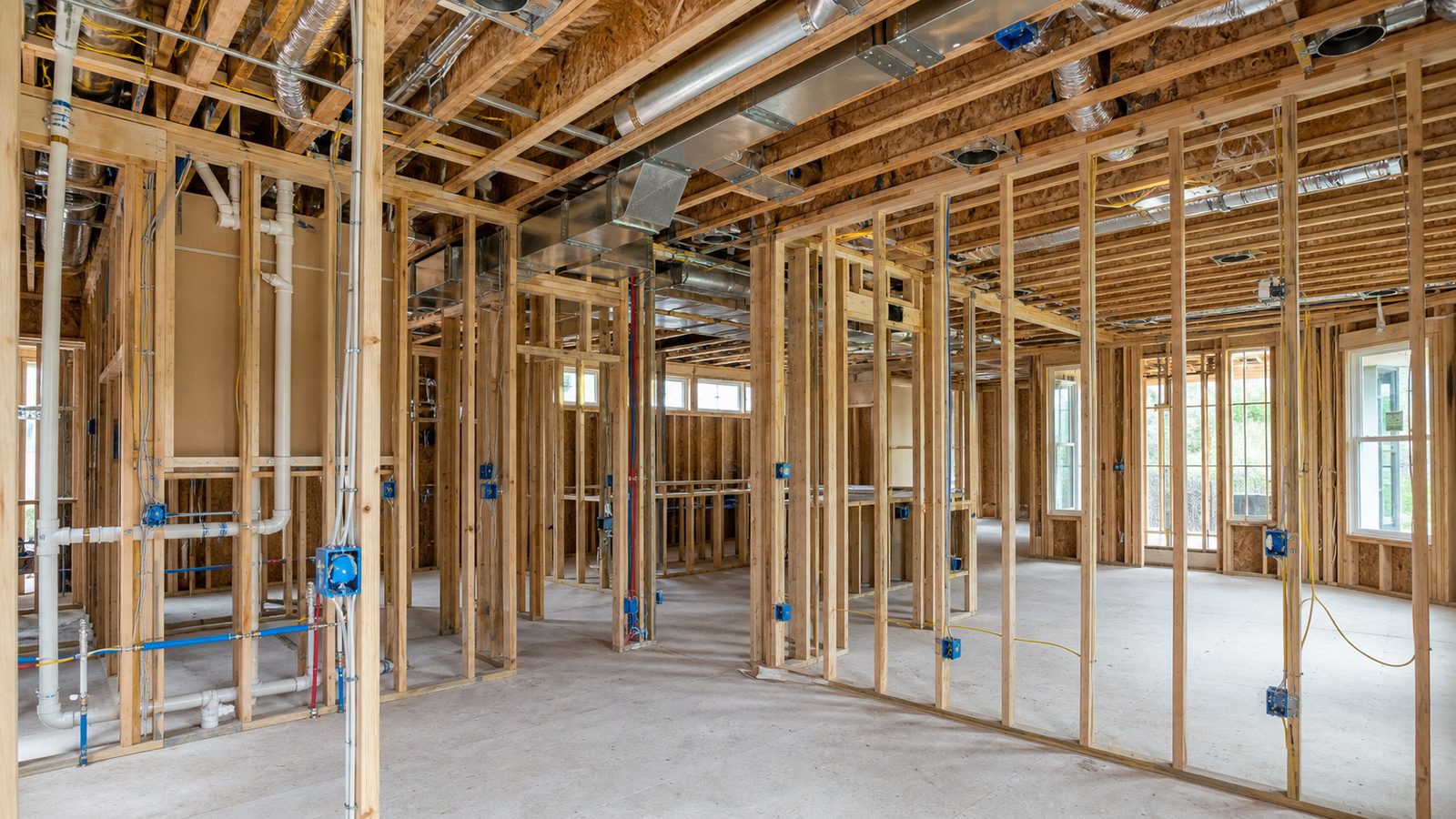
How to Evaluate Self-Perform vs. Brokered Trades
This distinction affects your project more than most homeowners realize. A GC who self-performs the critical-path trades — framing, drywall, finish carpentry — controls their own schedule. When a drywall crew needs to be on site Tuesday, they show up Tuesday. When a frame correction is needed, the framing crew is a phone call away, not a separate company negotiating schedule.
A GC who brokers every trade out is essentially a coordinator. Their quality and schedule depend on the availability and performance of third-party companies they do not employ. When a sub falls behind or does poor work, the GC has limited leverage.
At JK Prestige, our own crews perform framing, drywall, and finish carpentry — not brokered. On your renovation, that is the difference between a schedule that holds and one that slips every time a sub reschedules. See the renovation work our crews have delivered.
The Right Question to End Every Contractor Interview
After you've checked licenses, reviewed the contract structure, confirmed insurance, and asked about permit history, end with this question: "Who will I call if something goes wrong at 7am on a Tuesday, and will you answer?"
A principal-led GC gives you one answer: the person in front of you. That person's direct number is in your contract, and they answer it. JK Prestige operates this way by design — not because it's a differentiator you selected, but because it is the only operating model that holds a project accountable from contract signing through the final punchlist.
Get a written gut-reno estimate in 48 hours. contact JK Prestige Constructor. A principal answers.
No call center. No coordinator. A JK principal reviews every inquiry and replies with a real number, not a range, not a follow-up form.
Request Free Estimate →