If your downspouts dump water two feet from your foundation, you already know the problem. In Jacksonville's flat, sandy yards, that water doesn't run off, it sits, soaks toward the footing, and eventually shows up as a wet baseboard or a soft spot in the lawn. Running the downspout into a buried drain line is one of the most cost-effective things a homeowner can do to protect a slab foundation. It is also a job with a few real rules attached, mostly about where that water ends up. Here is how to do it right.
When You Need a Permit in Jacksonville
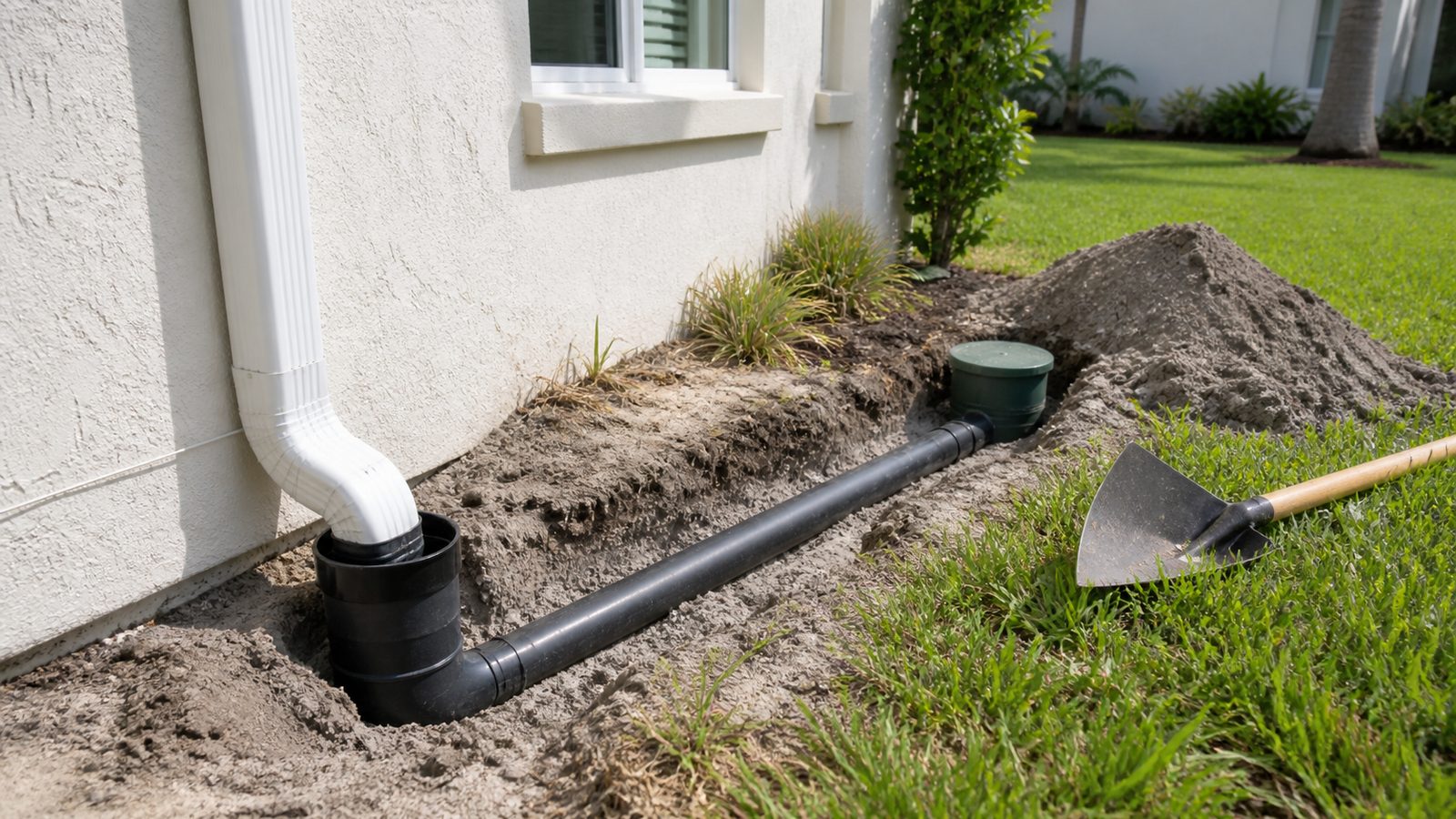
For most homeowners, a buried extension pipe that stays on your own lot and daylights to a splash area or pop-up emitter is routine maintenance, similar to replacing a fence section, and typically does not trigger a building permit. Where it stops being simple is the discharge point. You cannot legally route roof water onto a neighbor's property, into the street or a roadside swale, or into a public stormwater pipe, inlet, or ditch without authorization. Those are part of the City's stormwater system. The same caution applies if any part of the work falls inside a recorded drainage easement or a platted retention area, which are often regulated separately from ordinary yard work.
Before digging, call 811 (Sunshine State One Call) to have underground utilities marked, which Florida law requires and which is free. If you have any doubt about your discharge point relative to a right of way, easement, or public drainage structure, call the City of Jacksonville Building Inspection Division to confirm whether your project needs a permit, and contact Public Works if the work touches anything the City maintains.
Tools and Materials
- Solid Schedule 40 PVC pipe, 3 or 4 inch
- PVC couplings, two 45-degree elbows, downspout adapter
- PVC primer and cement
- Pop-up drainage emitter sized to the pipe
- Shovel or rented mini trencher
- Hand tamper, clean fill or gravel for the pipe bed
- 4-foot level or line level and string
- Hacksaw or PVC pipe cutter, tape measure, marking flags
Step-by-Step
- Plan the route. Choose the shortest run with steady downhill slope, away from the house and the lot line, clear of any septic field, well, or marked utility.
- Trench to depth. Dig roughly 6 to 12 inches deep, angled consistently downhill. Sandy soil digs easily but the walls collapse easily too, so keep the trench narrow.
- Set your slope. Aim for at least 1 inch of drop per 8 to 10 feet of pipe, roughly 1 to 2 percent grade, checked with a level as you go. A flat or reverse-sloped run is the most common reason these systems hold water.
- Choose solid PVC over corrugated pipe. Corrugated plastic is cheaper, but its ridges catch leaves and sediment and are nearly impossible to snake out once clogged. Solid PVC costs more and needs glued joints, but it clears in minutes if it backs up.
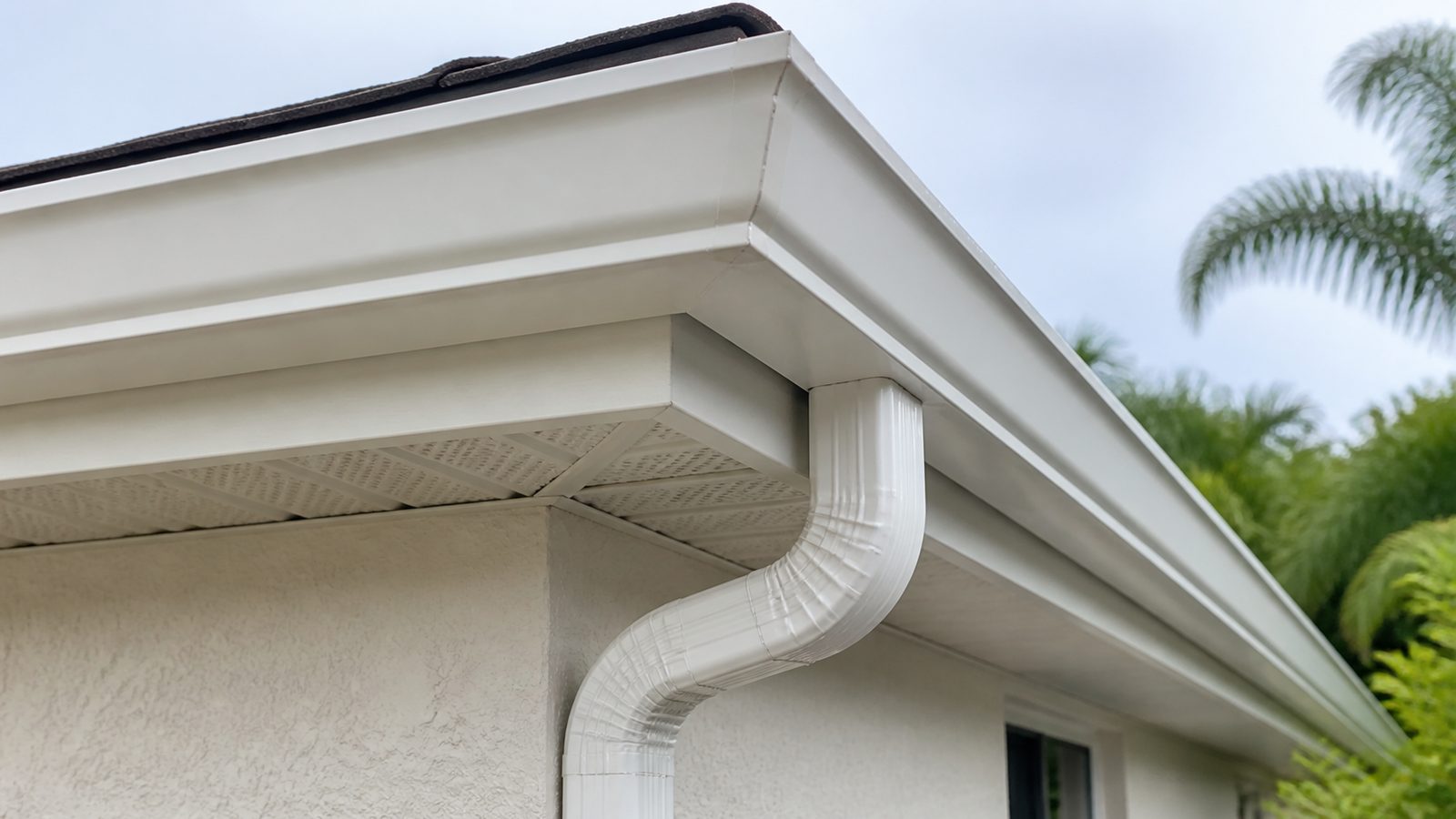
- Connect at the downspout. Cut the downspout to leave a short stub, install a downspout adapter transitioning into round PVC, and glue the joint with primer and cement.
- Lay and glue the pipe. Dry-fit the run first, using two 45-degree elbows rather than a single 90 at sharp turns, since a gentler bend clogs less often. Prime and cement each joint and let it set before backfilling.
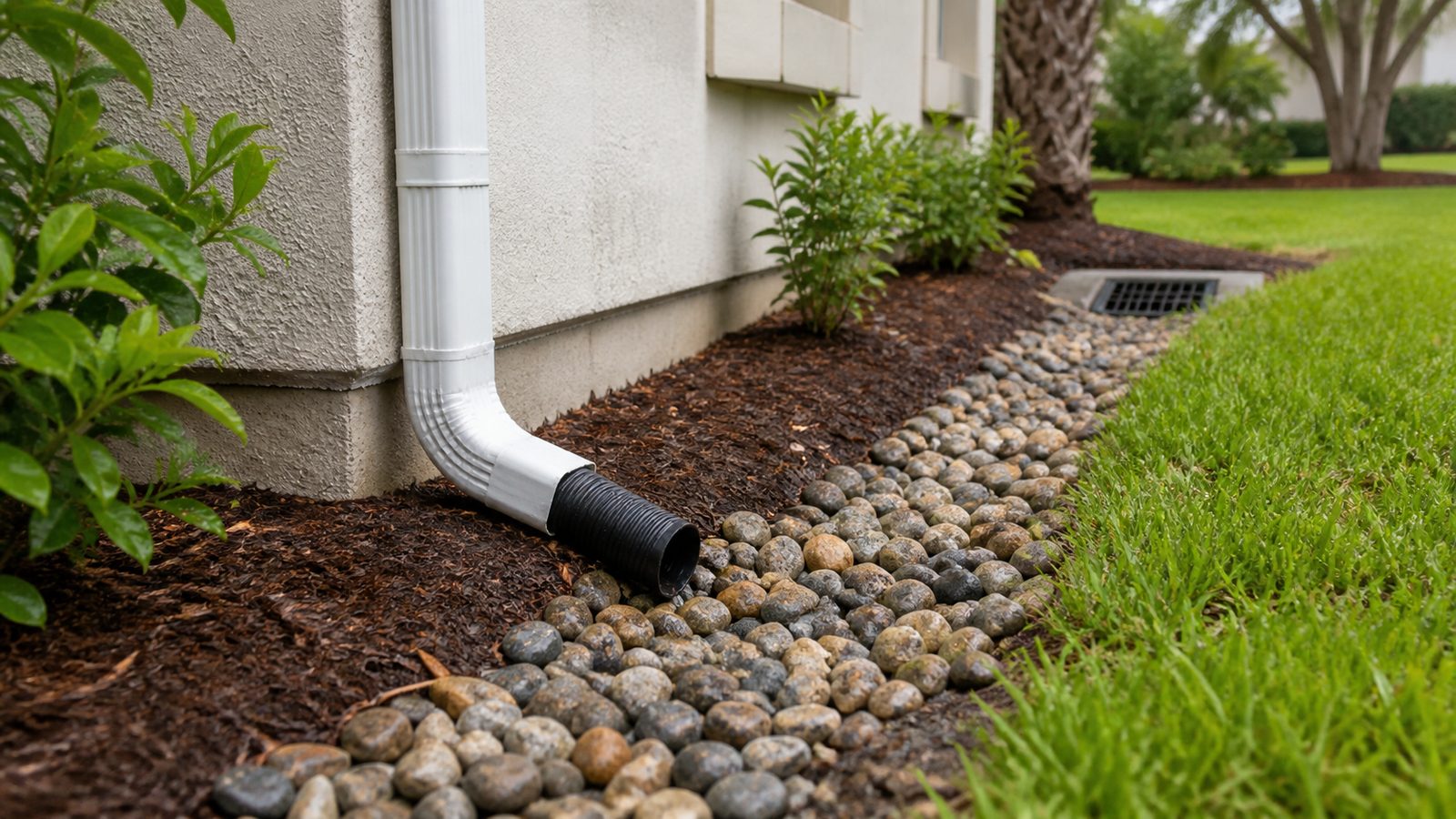
- Install the pop-up emitter. Set it flush with finished grade where water can spread across a splash area or planted bed on your own property. The spring-loaded lid opens under storm pressure, then reseats and keeps debris out between rain events.
- Backfill and compact. Bed the pipe in clean fill or gravel if the soil is loose, then backfill in layers, tamping as you go so the trench doesn't sink later.
- Test it. Run a hose into the gutter for several minutes and confirm water exits cleanly at the emitter, with no backup and no seepage at any joint.
Jacksonville Climate Considerations
Duval County's flat terrain and sandy soil mean gravity has to do all the work, which is why the 1 to 2 percent grade matters more here than in hillier parts of the state. Much of Jacksonville, especially near the river and in low-lying neighborhoods, also sits on a high water table. During wet season, or after a tropical system, that table can rise close enough to the surface that a buried line has nowhere to drain to, and it backs up from the outlet end rather than the inlet. If a system backs up only in heavy weather, a high water table is usually why, and the fix is often relocating the discharge point, not replacing the pipe.
Jacksonville's summer brings intense, short thunderstorm bursts almost daily from June through September, and hurricane season adds multi-day rain events that saturate the ground. Size the system for those bursts, not a light drizzle. Any low spot where water lingers for a day or two, including a poorly sloped trench, breeds mosquitoes fast, one more reason a pop-up emitter that drains fully beats a splash block that leaves a puddle.
What It Costs in Jacksonville (DIY vs. Hiring a Pro)
Rough, unofficial estimates that vary with run length, soil, and downspout count.
| Scope | DIY (materials only) | Hiring a Pro |
|---|---|---|
| Single downspout, 15-20 ft run, PVC, pop-up emitter | $60 - $150 | $350 - $700 |
| Whole-house system, 3-4 downspouts | $250 - $500 | $1,500 - $3,500 |
| French drain tie-in or gravel bed upgrade | $50 - $150 | $300 - $800 per run |
DIY suits a single short run in soil you can dig by hand. A pro makes more sense with multiple downspouts, roots or hardscape, a high water table, or a route near a property line, easement, or right of way, where a mistake becomes a legal problem instead of a wet lawn.
When to Call JK Prestige
If your yard holds water no matter what you try, if you're seeing signs of foundation moisture, or if your discharge point is anywhere near a neighbor's property, an easement, or the City's stormwater system, it's worth having someone who self-performs this work take a look before you dig. We set the grade correctly the first time and know which discharge points around Jacksonville need a call to the City. A fixed-price quote up front means no surprises once the trench is open.
No call center. No coordinator. A JK principal reviews every inquiry and replies with a real number, not a range, not a follow-up form.
Request Free Estimate →