Standing water is one of the most common complaints Jacksonville homeowners bring to contractors. The city sits at nearly sea level, its terrain is remarkably flat, and summer rain events can drop two or three inches in under an hour. If your yard pools after every storm, or if water is creeping toward your foundation, a french drain is often the right fix. This guide walks through the process — the planning, the materials, the digging, and the Jacksonville-specific considerations that most generic tutorials skip entirely.
When You Need a Permit in Jacksonville
Before you touch a shovel, call Sunshine 811 at 811 or online at sunshine811.com. Florida law requires you to call at least two full business days before any digging. Utilities including gas, water, electric, and cable are marked at no cost, and hitting a line without calling first creates serious liability.
On the permitting side, Duval County typically does not require a permit for a standard residential french drain that keeps water on your own property. However, permits are required when the drainage project involves grading that redirects stormwater flow, connects to the public stormwater system, or involves any structure near a wetland or conservation area.
There are three places you are not permitted to discharge drainage in Jacksonville:
- A neighbor's property. Redirecting your water problem onto an adjacent lot is a code violation and creates civil liability.
- Wetlands and conservation buffers. Northeast Florida has extensive wetland areas. Discharging into a wetland without an environmental permit violates state and federal rules.
- Public right-of-way. You cannot pipe yard water into a sidewalk strip, swale, or street unless it connects through an approved stormwater connection.
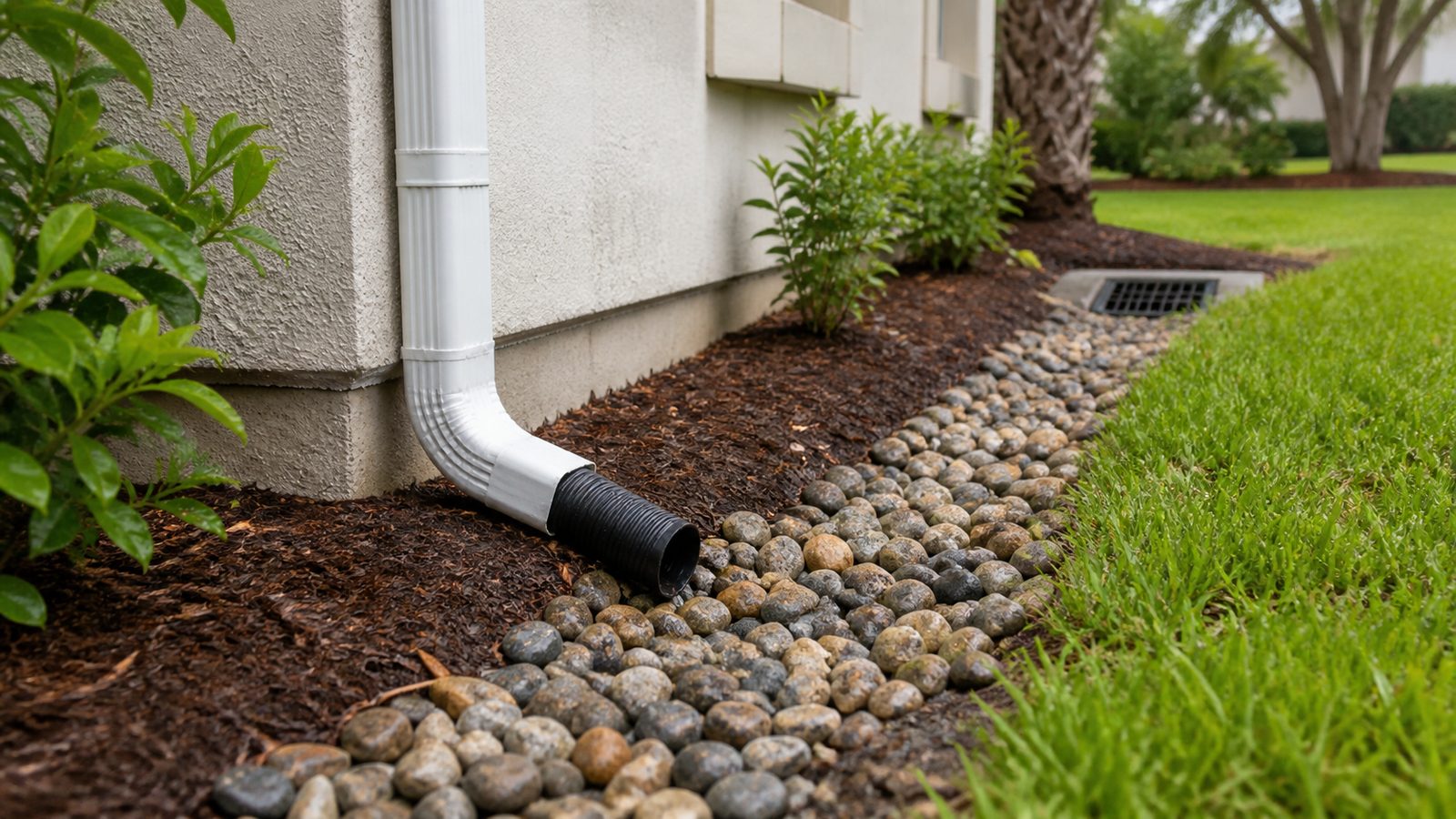
Jacksonville's high water table — particularly in neighborhoods near the St. Johns River, Arlington, the Westside, or any marsh-adjacent area — also matters here. If your water table sits only a foot or two below grade, a standard dry well won't absorb anything. You may need to daylight the pipe to a drainage swale, retention pond, or lower elevation point on your property.
Tools and Materials
- Perforated 4-inch PVC or corrugated pipe (solid end cap for one end, open or daylighted at the outlet)
- Washed drainage stone or crushed granite (1.5-inch clean gravel — no fines)
- Non-woven geotextile filter fabric (4 oz or 6 oz weight)
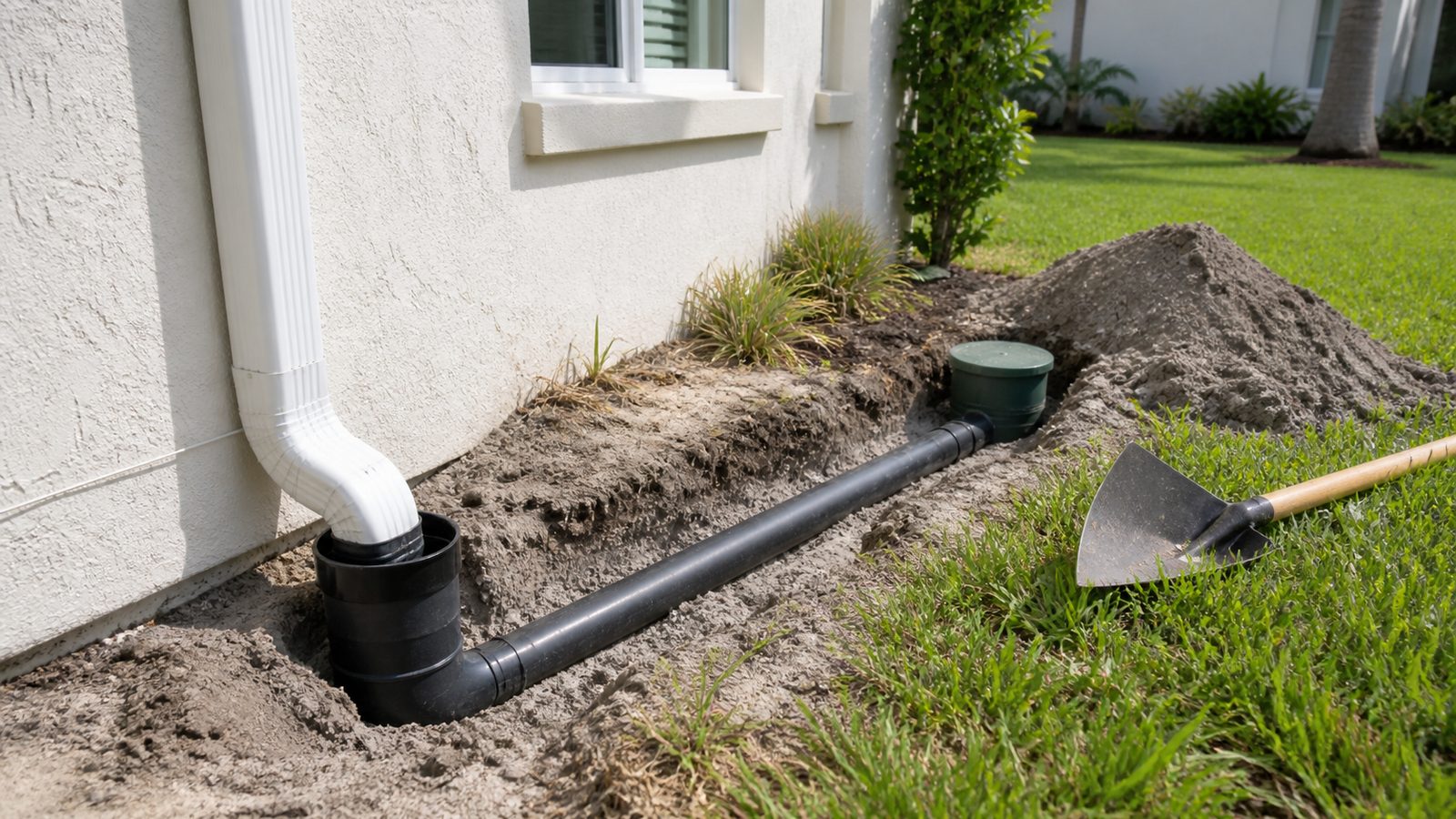
- Catch basin or channel drain at the collection point (if draining a patio or driveway edge)
- Sod cutter or flat spade
- Trenching shovel or rented trenching machine
- Level and 4-foot or 6-foot straight board
- Laser level or line level and string
- Tamper
- Wheelbarrow
- Marking paint or flags (for your 811 markings)
- Work gloves and eye protection
Step-by-Step
- Map the water path. Walk your yard during or right after a heavy rain and observe where water collects and which direction it moves — or fails to move. Mark the lowest point on your property where you can legally outlet the pipe. This could be a swale along the street, a natural low spot, or a dry well if your soil percolates well enough.
- Call 811 and wait. Make the call, get your markings, wait the two full business days, and then verify the flags before digging. This step is not optional.
- Lay out your trench line. Mark the trench from the collection point to the outlet using paint or stakes and string. Keep curves gentle — tight bends restrict flow.
- Establish your slope. A french drain needs a minimum fall of 1 inch per 10 feet of run to drain reliably. In Jacksonville's flat yards this can be a challenge. Use a string line and line level, or a laser level, to confirm you have adequate fall along the entire length. If your yard is truly flat, you may need to dig deeper at the outlet end, or use a sump pump system instead.
- Dig the trench. Standard depth is 18 to 24 inches, and 12 inches wide. For high water table areas, you rarely want to go deeper than 24 inches — you may hit groundwater, which turns your drain into a pipe that fills from below.
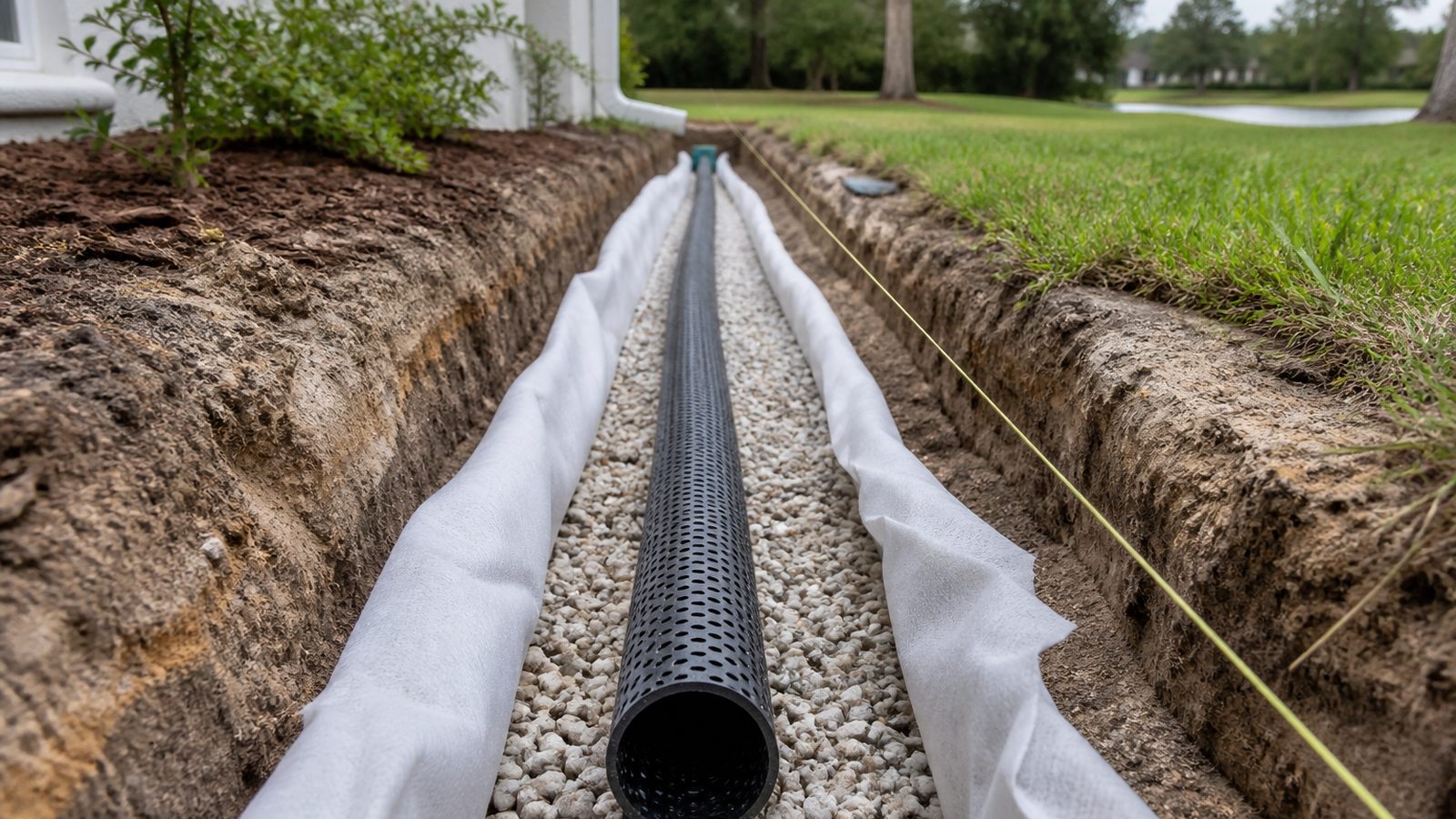
- Line the trench with filter fabric. Lay a continuous run of geotextile fabric into the trench, draping it up both sides and leaving extra hanging over the edges. This fabric keeps sand and clay fines out of your gravel and pipe. In Jacksonville's sandy soil, skipping the fabric means your drain silts up within a few seasons.
- Add a gravel bed. Pour 3 to 4 inches of clean washed gravel on top of the fabric, then compact lightly.
- Set the pipe. Lay perforated pipe holes-down in the gravel. Holes-down is the correct orientation — it allows water to rise up from saturated soil into the pipe, rather than collecting debris at the top perforations.
- Cover with gravel. Fill the trench with gravel to within 4 to 6 inches of the surface, keeping the fabric wrapped over the top of the gravel (the "burrito" wrap). The fabric keeps your gravel clean from above.
- Fold and close the fabric, backfill. Fold the fabric flaps over the top of the gravel bundle, then backfill with soil and re-sod or seed.
- Test the outlet. Before finishing, run a hose into the inlet and confirm water flows freely out the outlet end. Any blockage is easier to address now than after the yard is restored.
Jacksonville Climate Considerations
Jacksonville's climate creates a specific set of drainage challenges that don't apply in most parts of the country.
Flat terrain. Much of Duval County is flat enough that there is little natural fall to work with. This forces contractors and homeowners to engineer slope into the trench itself, or to route drains to the nearest available lower point — sometimes quite a distance away.
High water table. Neighborhoods close to the St. Johns River, its tributaries, or the coastal marshes can have groundwater sitting within 18 to 24 inches of the surface. A french drain in these areas cannot rely on soil absorption — it must daylight to an outlet.
Intense summer rain. Jacksonville receives most of its annual rainfall between June and September, often in fast, heavy convective storms. A drain system that handles a half-inch rain without issue can be overwhelmed by a two-inch-per-hour event. Sizing your pipe and gravel trench appropriately for peak flow matters.
Sandy soil. Most of Northeast Florida sits on sandy, well-draining soil — which sounds helpful but creates a silting problem. Without proper filter fabric, fine sand migrates into gravel and pipe rapidly, clogging the system within a year or two.
Mosquito pressure. Standing water in Jacksonville breeds mosquitoes within 48 to 72 hours. A properly functioning french drain that eliminates chronic pooling is a legitimate public health improvement, not just an aesthetic one.
What It Costs in Jacksonville (DIY vs. Hiring a Pro)
| Approach | Typical Cost Range |
|---|---|
| DIY (materials only, 50 ft run) | $300 – $600 |
| Pro installation, basic yard drain (50–75 ft) | $1,500 – $3,500 |
| Pro installation, complex system (200+ ft, catch basins) | $4,500 – $10,000+ |
| Sump pump system addition | $1,200 – $2,500 |
Costs vary based on trench length, soil conditions, outlet options, and whether equipment access is available. These are local estimates based on typical Northeast Florida contractor pricing and should be confirmed with at least two quotes.
When to Call JK Prestige
A DIY french drain works well for isolated pooling in a single yard zone with a clear outlet. Call us when water is reaching your foundation or slab, when your lot is large enough that a single run won't solve the problem, or when your water table prevents a simple drainage solution. JK Prestige handles complex grading, multi-zone drainage systems, and drainage work that intersects with foundation repair — and we'll tell you upfront if a drain alone won't fix your problem.
No call center. No coordinator. A JK principal reviews every inquiry and replies with a real number, not a range, not a follow-up form.
Request Free Estimate →