Jacksonville sits in a Mixed-Use Wind Zone with real exposure to Category 1–3 hurricane landfalls and tropical storm debris events every season. If your home has unprotected windows or doors during a named storm, you are one flying shingle away from a pressurization failure that can lift an entire roof section. Installing hurricane shutters is one of the highest-leverage improvements a Jacksonville homeowner can make — but doing it right means understanding Florida Building Code, Duval County permitting, the right anchor type for your wall material, and how to document the work so your insurance carrier actually lowers your premium.
When You Need a Permit in Jacksonville
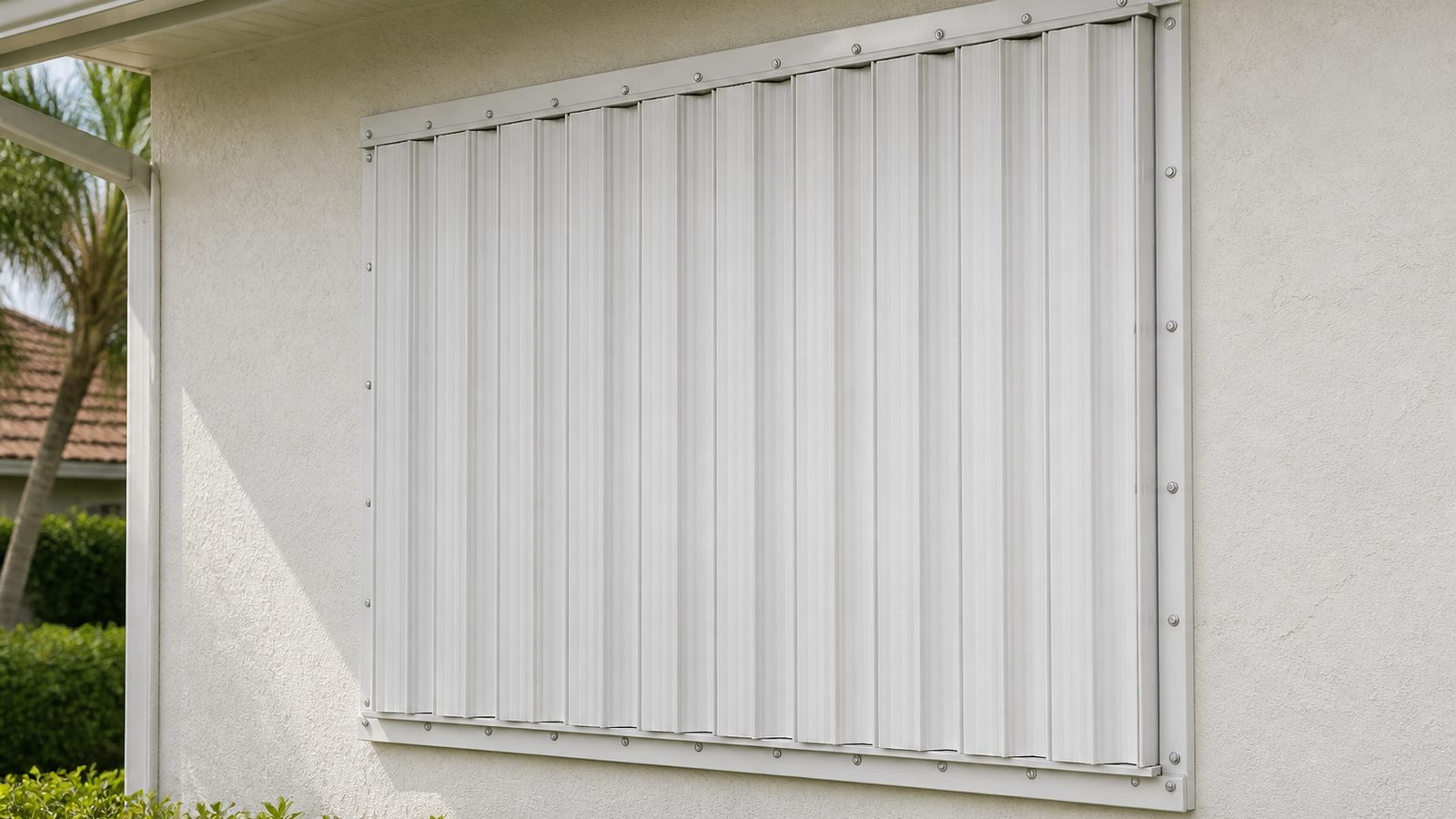
Duval County Building Inspection Division requires a building permit for any permanently attached hurricane protection system. This includes accordion shutters, roll-down shutters, and any panel track system anchored to the structure. Temporary fabric or panel systems that are stored and deployed only for named storms occupy a gray area — many contractors still pull a permit because the anchor bolts are permanent even if the panels are not.
What Florida Building Code (FBC) Section 1609 and Chapter 14 actually require:
- Product Approval or NOA (Notice of Acceptance): Every shutter panel, track, and hardware component must carry either a Florida Product Approval number (issued by the Florida Department of Business and Professional Regulation) or a Miami-Dade County NOA. These are separate from brand reputation — a product can be well-built and still fail FBC if it was not tested to the large-missile or small-missile impact standard required for your wind speed zone.
- Design Wind Speed: Jacksonville falls within the 130–140 mph ultimate design wind speed range depending on distance from the coast. The permit application will ask for your specific wind exposure category (B or C). Coastal properties and properties with long wind fetches use Exposure C, which requires heavier anchoring.
- Opening Protection vs. Whole-Home Pressurization: FBC distinguishes between protecting individual openings and achieving whole-home pressurization. The latter — closing every glazed opening and exterior door — qualifies for the strongest insurance credit (the opening protection credit on the wind mitigation form). Partial protection does not qualify.
Permit fees in Duval are calculated as a percentage of declared project value. Budget $150–$350 for the permit itself on a typical single-family installation.
Tools and Materials
Shutter types you will choose between:
- Accordion shutters — permanently hinged at the sides, fold flat when open; most popular for Jacksonville because they deploy in seconds
- Roll-down shutters — coil into a housing above the opening; available in manual or motorized; highest cost, cleanest look
- Bahama shutters — single panel hinged at the top, propped open at an angle; provide shade and partial storm protection; do not meet large-missile impact standard for all openings
- Storm panels (aluminum or steel) — stored flat, installed in tracks before a storm; lowest cost, most labor at storm time
- Fabric/screen systems — polypropylene woven screens tensioned across openings; approved for small-missile only in most Jacksonville wind zones; not suitable for all openings
Tools and hardware:
- Hammer drill with SDS bit set (3/8" and 1/2" carbide-tipped for concrete block; standard twist bits for frame construction)
- Torque wrench (anchor bolts must be torqued to manufacturer specification)
- Level, tape measure, chalk line
- Stainless steel or hot-dip galvanized anchor bolts (316 stainless preferred within one mile of salt water)
- Tapcon anchors or wedge anchors rated for the substrate
- Track sections, header and sill channels (product-approved set)
- Safety glasses, hearing protection
Step-by-Step
- Measure each opening. Width at top, middle, and bottom; height at left, center, and right. Use the smallest dimension for ordering. Measure from outside face of frame to outside face of frame for panel clearance.
- Verify substrate. Knock and probe to identify block, frame with OSB sheathing, or stucco-over-frame. Your anchor schedule changes with each substrate. Block requires wedge anchors or Tapcons into solid mortar; frame construction requires through-bolts into structural framing members, not just sheathing.
- Lay out anchor points. Follow the product approval document — it specifies anchor spacing (typically 6"–12" at corners, 12"–18" in field). Mark with chalk line. Anchor spacing is not optional; it is what the testing was done to.
- Drill pilot holes. Use hammer drill for masonry. Drill depth must exceed embedment requirement by at least 1/2". Blow out dust with compressed air before setting anchor.
- Install tracks or mounting brackets. Start with the sill channel, set level. Install head track. Check plumb on both jamb tracks before tightening any fastener fully. Shim as needed to achieve plumb.
- Torque fasteners. Follow torque specification in product approval. Under-torqued anchors pull out; over-torqued anchors crack block face or strip threads. Use a calibrated torque wrench, not feel.
- Install panels or load accordion/roll-down system. For accordion shutters, hang panels in tracks and test fold action. For storm panels, confirm they engage top and bottom tracks without binding.
- Test operation and document. Open and close fully. For motorized roll-downs, test manual override. Keep product approval numbers and installation photos — the inspector will verify anchor count, torque, and product approval labels on panels.
Jacksonville Climate Considerations
Northeast Florida is not just a tropical storm corridor — it is also a salt-air environment. Homes within two miles of the Intracoastal, St. Johns River, or the beach face accelerated corrosion on aluminum tracks, galvanized fasteners, and painted steel panels. Specify 316-grade stainless fasteners or hot-dip galvanized hardware rated for marine exposure. Rinse shutters with fresh water after any storm event and inspect hardware annually.
Wind-borne debris is the primary threat in Jacksonville storms. Large debris — lumber, roof tile, fence sections — constitutes the large-missile threat that FBC Impact-rated products must resist. Small-missile testing covers gravel and roofing granules. Accordion and roll-down systems rated for impact will carry the large-missile designation; some fabric screens are rated small-missile only and will not satisfy the insurance inspector for full opening protection credit.
The other Jacksonville-specific consideration is flood interaction. Lower-level openings in flood zones need shutters that do not trap water during surge — fabric systems that vent or panels that can be removed quickly matter in combined wind-surge events.
What It Costs in Jacksonville (DIY vs. Hiring a Pro)
| Shutter Type | DIY Materials (per opening) | Pro Installed (per opening) |
|---|---|---|
| Storm panels (aluminum) | $80–$150 | $200–$350 |
| Bahama shutters | $300–$600 | $600–$1,100 |
| Accordion shutters | $500–$900 | $900–$1,600 |
| Roll-down (manual) | $700–$1,200 | $1,200–$2,000 |
| Roll-down (motorized) | $1,000–$1,800 | $1,800–$3,500 |
These ranges reflect Northeast Florida supplier and labor pricing and exclude permit fees. Whole-home accordion installations on a 1,500 sq ft single-story home with eight openings typically run $7,000–$12,000 professionally installed in the Jacksonville market.
DIY is possible for panel systems on frame construction. Block homes with accordion or roll-down systems require hammer drilling, torque verification, and product-specific installation sequences that most homeowners find difficult to execute to inspection standard on the first attempt.
When to Call JK Prestige
If you want the installation to pass inspection, qualify for a wind mitigation report, and actually hold during a storm, the anchoring has to be done to the product approval specifications — and that requires the right bits, the right torque, and documentation your insurance inspector can verify. JK Prestige pulls the permit, installs to the product approval, and coordinates the inspector walk-through. A properly documented installation can generate an opening protection credit on your Citizens or private carrier wind mitigation form that reduces your annual premium by hundreds of dollars, often enough to recover a significant portion of the installation cost over three to five years.
No call center. No coordinator. A JK principal reviews every inquiry and replies with a real number, not a range, not a follow-up form.
Request Free Estimate →