Signing a fixed-price contract without reading it is not much safer than signing a cost-plus contract. The protection a fixed-price contract provides depends entirely on what "scope" means in that document — and the scope language is where most construction disputes originate.
A fixed-price contract that says "complete kitchen renovation per attached drawings, all work included" is not the same as one that says "complete kitchen renovation including demo, rough-in, drywall, cabinetry per $18,000 allowance, tile per $6,500 allowance, countertops per $12,000 allowance, fixtures per $3,000 allowance, appliances by owner, permits by contractor, all inspections included." The second contract is negotiated. The first is a dispute waiting to happen.
This guide covers every clause worth negotiating before you sign a fixed-price construction contract in Florida.

Step 1: Understand What Is In Scope vs. What Is Excluded
The exclusions list in a construction contract is as important as the inclusions list. Read both. Mark every exclusion and ask yourself: "Is this something I expected to be included?"
Common exclusions that surprise owners:
- "Painting by owner" — you expected the contractor to paint
- "Appliances by owner" — delivery and installation are separate
- "Permit fees billed at cost" — not included in the fixed price
- "Temporary power costs billed at cost"
- "Furniture removal and storage by owner"
- "Landscaping restoration after excavation not included"
- "Roof penetrations for new HVAC by mechanical sub, not included in GC scope"
Every item on the exclusions list is a cost you will pay, either to the contractor as a change order or to someone else. Add up all exclusions and factor them into your total project cost estimate before signing.
After you identify scope gaps, negotiate: which exclusions can be brought inside the fixed price, and at what cost? A contractor who cannot or will not add clear scope items to a fixed price may not be offering a truly fixed-price contract.
Step 2: Negotiate Allowances to Match Your Actual Selections
Allowances are placeholders — not guarantees. If the contract lists a $12,000 cabinet allowance and the cabinets you want cost $22,000, you owe a $10,000 change order. That is not a surprise — it is the contract working as written.
The negotiation: replace low or placeholder allowances with your actual selections or realistic estimates based on the product tier you intend to select.
Steps to negotiate allowances:
- Before signing, select (or at minimum narrow down) every allowance item — cabinetry, tile, fixtures, countertops, appliances.
- Get pricing from suppliers for the products you want. Use those numbers as the allowance amounts in the contract.
- If you have not yet selected items, use a defined product tier ("mid-range semi-custom kitchen cabinetry as specified in Section 4, Exhibit B") rather than a dollar amount. Make the tier specific enough that both parties agree on what it means.
- Get the contractor to confirm in writing that the allowance amount is realistic for the specified tier.
Allowance negotiation is not about spending more or less — it is about making the contract accurately reflect what you are building. A well-negotiated allowance structure means the total contract price is the actual project cost, not the starting point for change orders.
Step 3: Ask for a Lien Waiver Schedule
Florida's Construction Lien Law (Chapter 713) allows subcontractors and suppliers to place liens on your property for unpaid work, even if you have paid your GC in full. You can pay your contractor $150,000 and still have a lien placed by a drywall sub that the contractor did not pay.
A lien waiver schedule requires your GC to deliver signed conditional lien waivers from all subcontractors and suppliers with each payment request. A conditional waiver states that the sub/supplier waives lien rights upon receipt of payment — it protects you as soon as payment clears.
Negotiate this language into the contract before signing:
"Contractor shall deliver to Owner executed conditional lien waivers from all subcontractors and material suppliers with each application for payment. Owner shall have no obligation to make payment without receipt of such waivers."
This is standard language in commercial construction contracts. Residential contractors sometimes omit it. Insist on it.
Step 4: Confirm Retainage Structure
Retainage is a percentage of each payment that the owner holds back until project completion and punch-list sign-off. It gives the contractor a financial incentive to finish the punch list.
Standard retainage in Florida residential construction: 10% of each payment, released at substantial completion or final Certificate of Occupancy. On a $150,000 project, that is $15,000 held until the job is done.
Some contractors push back on retainage, particularly on smaller projects. A reasonable compromise: 10% retainage through the rough-in phase, dropping to 5% after drywall is complete, with full retainage release at punch-list sign-off.
Do not agree to zero retainage. Without retainage, you have no financial leverage to get the contractor back to complete the punch list after they have moved to the next job. Punch lists in Florida residential construction are notoriously slow to close on projects without retainage clauses.
Step 5: Add a "No Work Without Signed Change Order" Clause
This is the most important sentence you can add to a construction contract:
"Contractor shall perform no additional work beyond the defined scope without prior written authorization from Owner in the form of a signed change order specifying the additional scope and cost. Verbal authorizations shall not be binding."
Without this clause, a contractor can perform additional work, claim you verbally approved it, and bill you for it. This is one of the most common residential construction disputes in Florida.
The clause does not prevent change orders — it structures them. The contractor identifies an out-of-scope item, writes a change order with a specific description and cost, and you sign before work proceeds. No surprises.
Some contractors push back on this clause because it slows down their ability to keep work moving. The correct response is: "If it is a genuine change, writing it up takes 5 minutes. If you cannot do that, why not?"
Step 6: Confirm What Constitutes a Change vs. What Is Included in Fixed Price
Contractors and owners frequently disagree about what "fixed price" covers. Define it in the contract.
Typical items that are included in a proper fixed-price contract scope:
- All labor and materials to complete the defined work
- Debris removal and hauling
- Permit fees (or specify if billed at cost)
- All inspections required for Certificate of Occupancy
- Warranty on workmanship per the warranty clause
Typical items that are legitimately separate (change orders):
- Owner-directed changes after contract signing (different tile, added outlet, relocated door)
- Unforeseen conditions discovered after demo that could not have been seen during pre-bid walkthrough (hidden rot, abandoned pipe, undisclosed prior water damage)
- Material substitutions requested by owner after contract execution
Define "unforeseen conditions" specifically. A contractor who claims every rough-in surprise as an "unforeseen condition" is using that category as a change-order generator. The contract should specify what evidence is required to document an unforeseen condition (photos, written description, pre-existing vs. contractor-caused).
See how JK Prestige structures fixed-price proposals to minimize ambiguity on change order triggers.
Step 7: Get a Pre-Construction Inspection Clause for Unforeseen Conditions
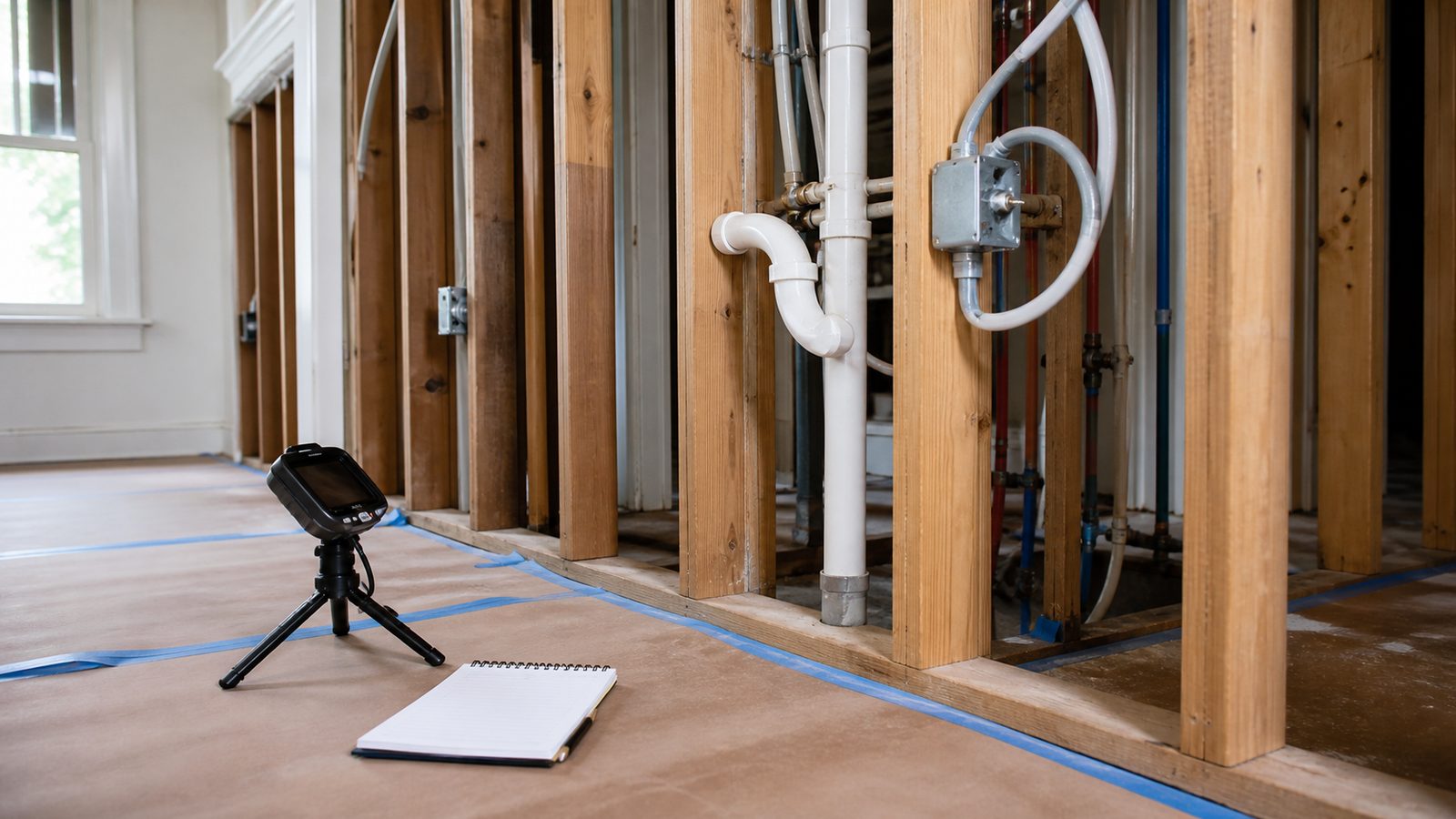
One way to reduce unforeseen-condition disputes is to do a more thorough pre-construction investigation before the contract is signed. For older homes — particularly pre-1970 Jacksonville construction in Riverside, Avondale, or Springfield — add a pre-construction inspection clause.
This clause allocates a fixed number of hours (typically 2–4) for the contractor to open walls, inspect the attic, and evaluate the plumbing and electrical before the contract price is locked. The cost of this inspection ($500–$1,500 for a 2–4 hour investigation) is far less than a surprise $8,000 change order after demo.
Language example: "Prior to execution of the contract, Contractor shall perform a pre-construction investigation of the following areas: [list areas]. Any unforeseen conditions identified during this investigation shall be incorporated into the fixed price. Conditions not discovered during the investigation and not discoverable by reasonable inquiry shall be eligible for change order treatment."
This clause reduces risk on both sides. The contractor has less change-order risk; you have fewer surprises.
Step 8: Review Payment Milestones — Work Completed, Not Calendar
Payment milestones should be tied to work completed, not to calendar dates. "Payment due 30 days after contract signing" regardless of construction progress is not a milestone — it is a calendar payment. It gives the contractor access to your money without performance.
Correct milestone structure:
- Mobilization payment (10–15%) at contract signing
- Second payment at completion of demolition and rough-in
- Third payment at completion of drywall and rough inspections
- Fourth payment at substantial completion (all work complete, pending punch list)
- Final payment at punch-list sign-off and Certificate of Occupancy
The milestones should be specific and verifiable — not "framing complete" but "framing inspected and passed by Duval County." Inspection records are documentation. A contractor's word is not.
Review JK Prestige's renovation process to understand how fixed-price projects are managed milestone by milestone.
Get a written estimate in 48 hours. Call (904) 944-0278 or request a consultation.
No call center. No coordinator. A JK principal reviews every inquiry and replies with a real number, not a range, not a follow-up form.
Request Free Estimate →