Jacksonville does not show up on lists of the fastest-growing construction markets by accident. The drivers are specific, measurable, and compound each other in ways that create sustained construction demand across multiple sectors simultaneously. Duval County added roughly 12% to its population between 2020 and 2024 — one of the fastest growth rates among Florida's major counties. Behind that number is a set of real economic forces that translate directly into square footage on the ground.
This is what JK Prestige observes from jobsites across NE Florida in 2025: where demand is coming from, what it is building, and what it means for project timelines and costs for owners who want to build here.
The Five Real Drivers of Jacksonville's Construction Growth
1. Population Growth Putting Stress on Every Building Type
Duval County's 12% population increase from 2020 to 2024 is not a rounding error. The county added approximately 110,000 residents in four years. Those residents need housing, medical care, retail, and warehouse-delivered goods.
The growth is not uniform across Jacksonville. St. Johns County to the south — Ponte Vedra, Nocatee, St. Johns — is one of the fastest-growing counties in the entire United States. Nassau County to the north (Amelia Island, Yulee) is building at a pace that has outstripped its permitting infrastructure. Both counties pull GC capacity from the Jacksonville metro.
The residential construction surge feeds commercial: new neighborhoods generate demand for medical offices, grocery-anchored retail, and schools. All of it competes for the same subcontractor capacity.
2. JAXPORT Expansion Driving Industrial and Logistics Construction
JAXPORT — the Jacksonville Port Authority — is one of the most active capital investment stories in Southeast port infrastructure. The port has invested over $1 billion in the last decade in container infrastructure, and the deepening of the St. Johns River to 47 feet allows post-Panamax vessel calls that were not possible a decade ago.
The downstream effect is not subtle. The logistics real estate market around JAXPORT and along the I-10/I-95 corridors west and south of downtown Jacksonville is among the tightest in the Southeast. Vacancy rates for Class A industrial space in the Jacksonville metro have stayed below 4% for most of the last two years. That vacancy rate is a construction signal: more space is being absorbed faster than it can be built.
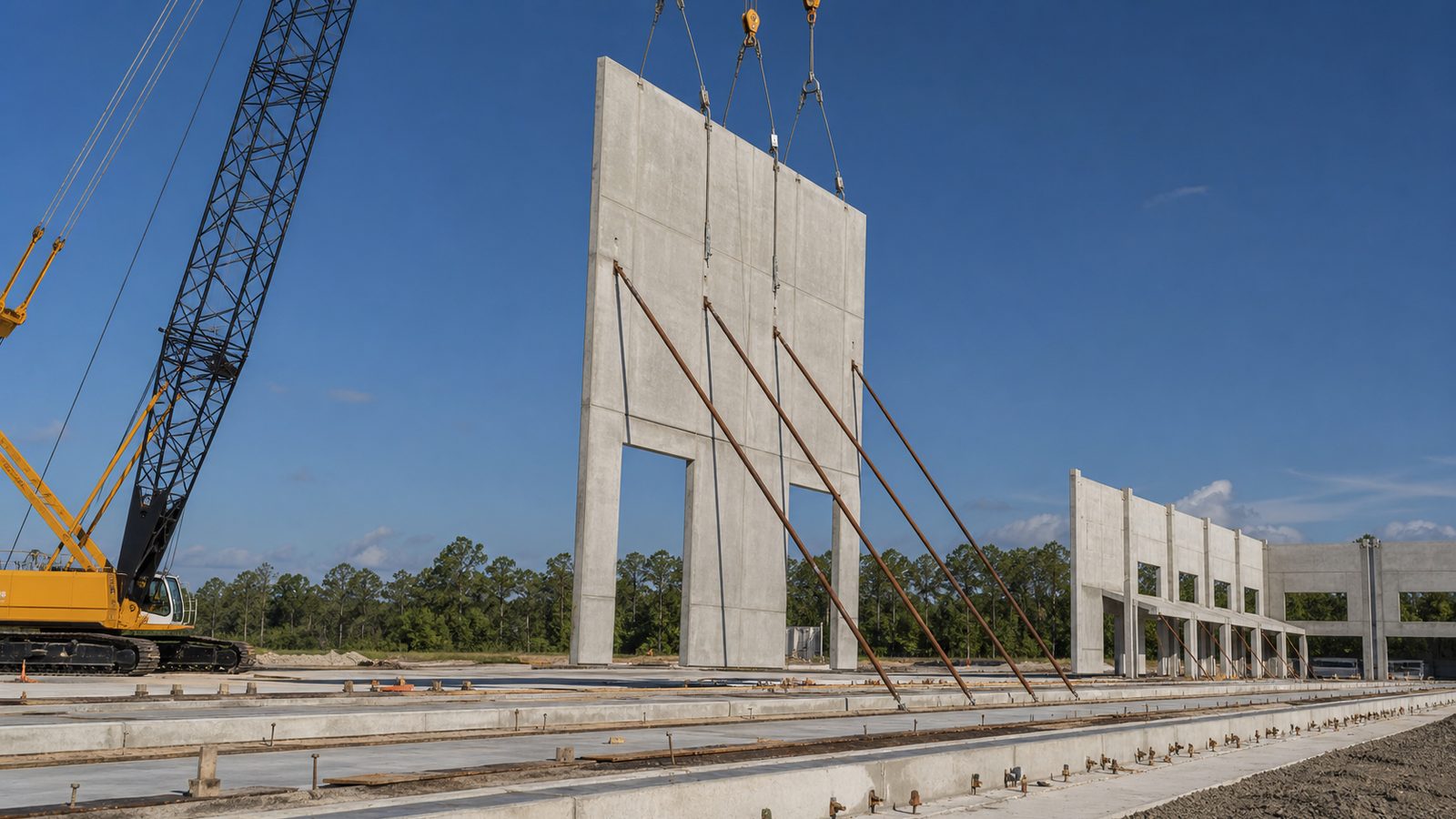
JK Prestige's warehouse and industrial construction work in NE Florida reflects this demand directly. The pipeline of tilt-up and clear-span projects in Duval and Nassau counties in 2025 is the strongest it has been since JK was founded in 2017.
3. Healthcare System Expansion Across All Major Networks
Every major healthcare system operating in Jacksonville has active capital programs in 2025:
- UF Health Jacksonville — expanding its North Tower and outpatient capacity on the downtown campus
- Mayo Clinic Florida — continuing campus growth in the San Pablo corridor
- Baptist Health — multiple hospital and medical office building (MOB) projects across the Baptist network
- Ascension St. Vincent's — facility updates and capacity additions
- VA Medical Center Jacksonville — federally funded expansion program
Healthcare construction is not interchangeable with commercial construction. Infection Control Risk Assessment (ICRA) compliance, National Fire Protection Association (NFPA) 99 medical gas standards, laminar-flow HVAC in surgical suites, and lead-lined radiology rooms require a specific skill set. The GC capacity in Jacksonville that can actually execute healthcare construction at a GMP contract level is thin. There are fewer than a dozen regional firms with the ICRA-trained superintendents and healthcare GMP experience to compete for these projects.
That supply constraint is a pricing signal. Well-qualified healthcare GCs in Jacksonville are not negotiating against each other on price — they are negotiating on schedule certainty and risk track record.
4. Military Presence Driving Residential Demand Around Bases
Naval Station Mayport and Naval Air Station (NAS) Jacksonville are two of the largest military installations in Florida. Combined, they generate sustained residential demand from military families relocating to Jacksonville on permanent change of station (PCS) orders.
Military relocation patterns create a particular kind of residential construction demand: it is continuous, counter-cyclical to some extent (military PCS doesn't pause when interest rates rise the way civilian buyer demand does), and concentrated in specific school districts around the bases. Custom home and renovation demand in neighborhoods like Ortega, Mandarin, and the beaches communities tracks closely with base population levels.
5. No State Income Tax Driving In-Migration from High-Tax States
Florida's lack of a state income tax is not new, but its effect on in-migration from New York, California, New Jersey, and Illinois has been accelerating since 2020. Jacksonville benefits from this trend differently than Miami and Tampa: it offers lower cost of living, more land, and less competition for housing than South Florida, while still sitting inside a growing metro with a major port and hospital ecosystem.
The buyers relocating from high-tax states often have higher purchase budgets than the Jacksonville market's historic median. Many are buying homes to renovate, land to build on, or commercial space to expand businesses into. The demand they bring is concentrated at the upper end of the residential and commercial construction market — exactly where JK Prestige operates.
What Jacksonville's Growth Means for Construction Timelines and Costs in 2025
Growth at this pace does not come without friction. Every owner building in Jacksonville right now is operating in a constrained market on at least one dimension.
Skilled Labor Competition
Every GC in NE Florida is competing for the same pool of carpenters, concrete finishers, drywall hangers, and roofing crews. JK Prestige self-performs the critical trades — framing, concrete, drywall, finish carpentry, and roofing — with our own crews. We do not broker these trades. When the labor market tightens, owners who hired a GC that brokers everything out feel it first: their GC's subs move to higher-margin jobs, and the schedule slips.
Self-perform is not an abstract differentiator in a tight labor market. It is a schedule hedge.
Permit Queue Lengths
Duval County's Building Inspection Division has seen residential plan review times extend from 2-3 weeks in 2019 to 4-6 weeks in 2025. Commercial review is longer. Projects that require concurrent Fire Marshal review or environmental permitting add further time. JK Prestige submits complete, code-compliant drawings on first submission. Every re-submittal is a lost month.
Material Lead Times Specific to the Jacksonville Market
The post-storm material shortage dynamic applies to Jacksonville's general supply chain as well. Windows, structural steel, and electrical gear all carry lead times in 2025 that require early procurement decisions. JK's pre-construction phase identifies long-lead items before ground breaks and locks procurement — preventing the schedule compression that occurs when a GC orders materials at permit issuance rather than 12 weeks earlier.
What This Means for Owners Planning Projects in 2025-2026
Owners who want to break ground in Q1 2026 need to be in pre-construction now. GC booking windows for quality firms in Jacksonville are running 6-12 months. Waiting until permit issuance to order long-lead materials pushes realistic completion dates into late 2026.
See how The JK Way handles pre-construction lock-in: GC availability, long-lead procurement, and permit submittal all happen before ground breaks. The schedule baseline is set at pre-construction, not at kickoff.
What JK Prestige Brings to This Market
JK Prestige has operated in Jacksonville since 2017. Across 500+ projects and more than $2 billion in construction value, what we know about this market is specific:
- The subcontractor capacity that exists at a quality level is thinner than the number of subs on any licensed contractor list suggests
- Permit re-submittals are the most common avoidable schedule killer in Duval County
- Material shortages after storm events are unpredictable but manageable with forward procurement
- The clients who have the best outcomes are the ones who start pre-construction before they think they need to
If you are planning a commercial, industrial, healthcare, or residential project in NE Florida, get a written estimate in 48 hours from a JK principal. Not a coordinator. Not a call center. The person who signs the contract.
Call (904) 944-0278 — a principal answers.
No call center. No coordinator. A JK principal reviews every inquiry and replies with a real number, not a range, not a follow-up form.
Request Free Estimate →