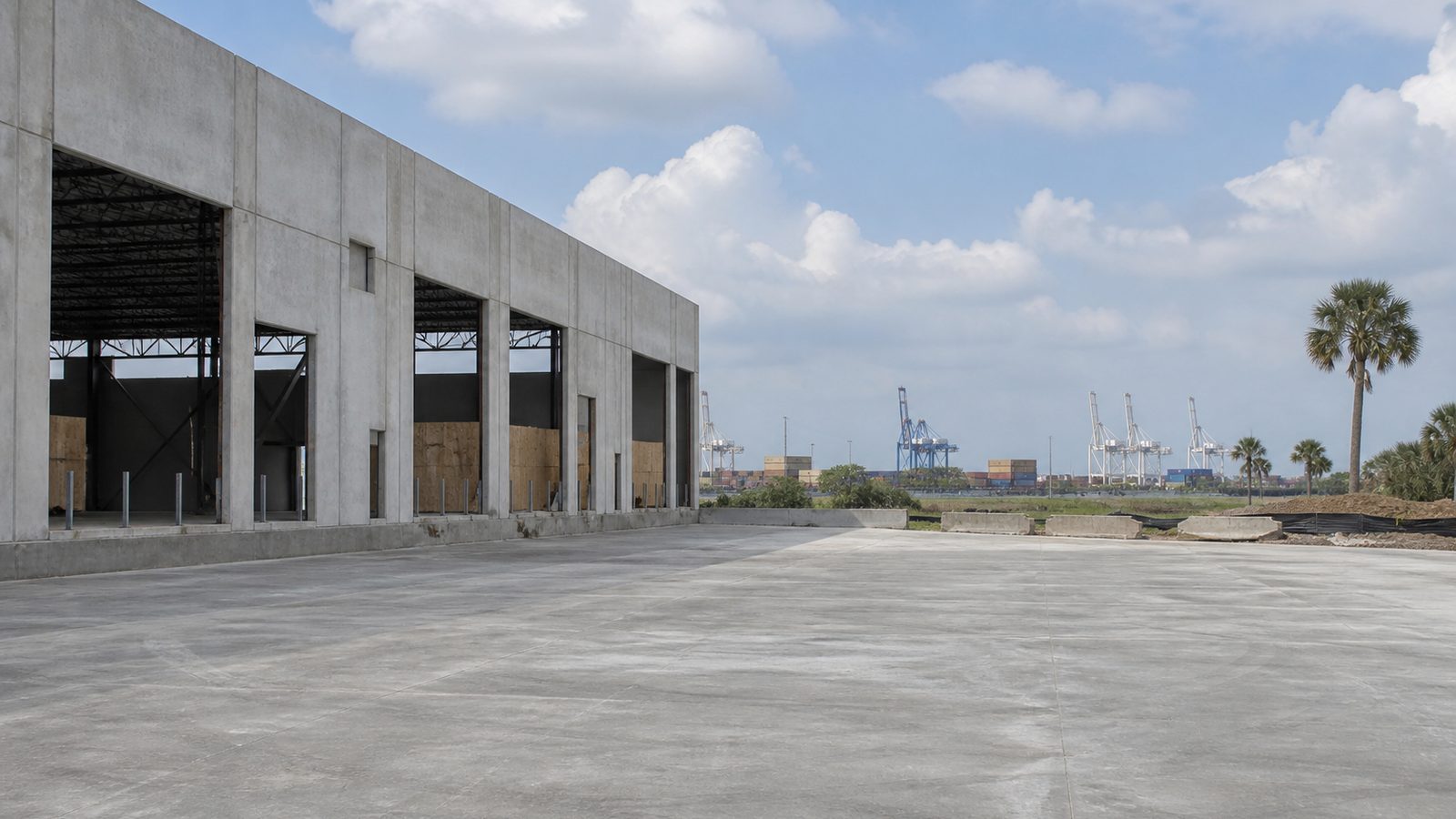
Jacksonville is not competing for industrial construction demand — it is absorbing it faster than it can be built. JAXPORT, the Jacksonville Port Authority, has invested over $1 billion in the last decade in port infrastructure, and the deepening of the St. Johns River channel to 47 feet — completed in phases through 2023 — now accommodates post-Panamax vessels that previously bypassed Jacksonville for Savannah, Charleston, and Baltimore.
That physical infrastructure shift has cascading consequences for industrial real estate and construction in NE Florida. The warehouse and distribution center pipeline in Duval and Nassau Counties in 2025 is among the strongest it has been in the Jacksonville market's recent history, and the GC capacity to deliver it at the pace the market demands is stretched.
What Is Happening at JAXPORT
Container volume growth
JAXPORT handles approximately 1.4 million TEUs (twenty-foot equivalent units) of container cargo annually, with volume growing steadily as deeper channel access attracts larger vessels. The expanded ability to handle Neo-Panamax container ships — vessels that carry two to three times the cargo of the older Panama Canal-era ships — creates throughput capacity that attracts new shipping line calls and redirects existing cargo lanes to Jacksonville.
More containers moving through JAXPORT means more container contents need to go somewhere immediately after port clearance. That "somewhere" is the industrial real estate ecosystem surrounding the port — distribution centers, cross-dock facilities, and container storage yards in Duval and adjacent counties.
Ro-ro vehicle infrastructure
Jacksonville is one of the largest vehicle processing ports in the United States. Roll-on/roll-off (ro-ro) vehicle imports — primarily automobiles from European and Asian manufacturers — move through Jacksonville's Blount Island and Dames Point terminals at volume that requires significant supporting logistics infrastructure: vehicle processing centers, pre-delivery inspection facilities, and rail connections.
The vehicle logistics sector is a significant driver of industrial facility construction in Jacksonville that is often overlooked relative to the e-commerce distribution center narrative. Vehicle processing facilities have specific site and building requirements — long clear-span spaces, outdoor staging capacity measured in acres, specialized lighting and drainage for vehicle handling — that represent a distinct category of industrial construction.
Cold storage growth
JAXPORT's expanded vessel capacity includes growing perishables volume. Cold storage construction in the Jacksonville market has been one of the most active subsectors in industrial real estate since 2022, as refrigerated warehousing capacity trails demand driven by both port throughput and regional population growth.
Cold storage construction is technically demanding in ways that standard warehouse construction is not. Insulation systems for temperature-controlled spaces, ammonia and CO2 refrigeration system integration, specialized concrete floors with vapor management, and blast-freezer construction require GC experience specific to this building type.
The Industrial Construction Pipeline: What's Being Built and Where
I-10 Corridor West: Large-Format Distribution
The I-10 corridor west of downtown Jacksonville — from the Beltway interchange through Baldwin toward the Nassau County line — is absorbing the largest-footprint industrial development. Distribution centers in the 400,000 to 1,000,000 square foot range are the primary product type here.
E-commerce operators have driven a significant share of this demand. Amazon has multiple facilities in the Jacksonville metro. Chewy's 800,000+ square foot distribution center in the Westside industrial corridor has been followed by other e-commerce and direct-to-consumer brands seeking a Southeast logistics node. Wayfair and similar home goods retailers value Jacksonville's access to both the I-10 and I-95 corridors for East Coast distribution.
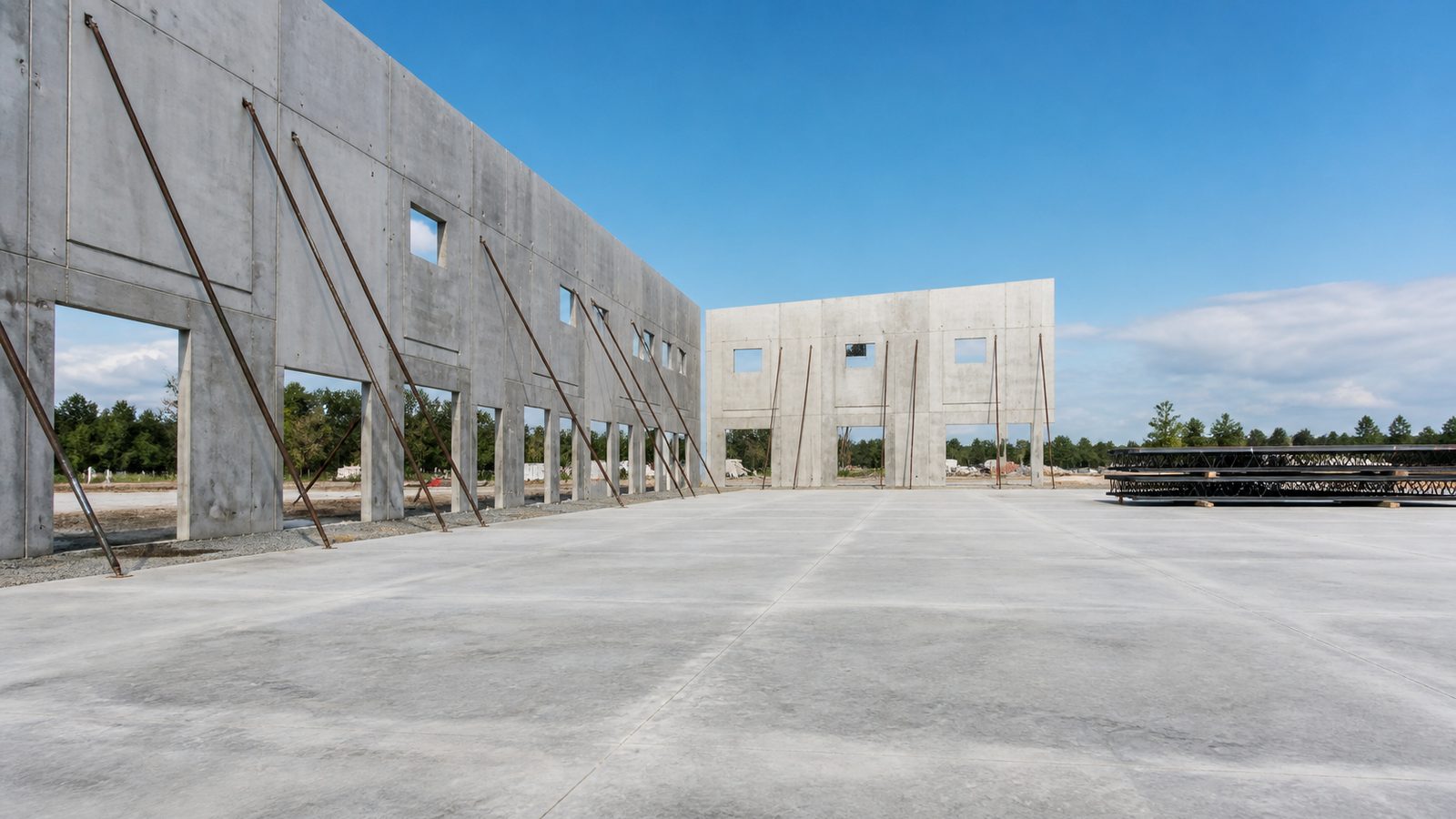
Tilt-up construction is the dominant building method for this product type: concrete panels cast on-site and tilted into position to form exterior walls, with steel framing and decking above. JK Prestige's warehouse and industrial construction expertise includes tilt-up shells and clear-span structural systems designed for the column grids that logistics operators require.
I-95 South Corridor: 3PL Regional Nodes and Flex Industrial
The I-95 south corridor between Jacksonville and St. Johns County has produced a different industrial product mix: smaller third-party logistics (3PL) providers building regional distribution nodes, flex industrial users serving the growing Southside and St. Johns County residential population, and some light manufacturing that has relocated to Florida from higher-cost states.
Building sizes in this corridor run 30,000 to 200,000 square feet — meaningful construction projects but not the mega-distribution centers of the I-10 corridor. This size range attracts different GC capacity: firms that can deliver the $5M-$20M project range efficiently, without the overhead structure of a national mega-project GC.
Nassau County: Port-Adjacent Industrial
Nassau County, north of Duval County along I-95, is producing industrial development driven by proximity to JAXPORT's Blount Island terminal and access to the container chassis and dray network that serves the port. Logistics users who need to be near the port without the land cost premium of Duval County are finding Nassau County's available sites attractive.
Nassau County's permitting and infrastructure capacity has been stretched by the pace of industrial development, creating review times that can exceed Duval County in some project categories. Early and complete permit submissions are critical here.
What Jacksonville's Industrial Construction Pipeline Means for GC Selection
Self-perform on the critical path
Tilt-up and clear-span warehouse construction concentrates schedule risk in two trades: concrete (for the tilt-up panels, slab, and truck aprons) and structural framing (for the roof deck steel and secondary framing). Both trades are on the critical path. A GC who brokers these out to whoever is available is exposed to subcontractor schedule risk at exactly the moment it matters most.
JK Prestige self-performs concrete and framing with our own crews. When the tilt-up pour schedule calls for a Saturday start, our crew is there. We are not calling a sub and hoping they show up.
MEP coordination for logistics operations
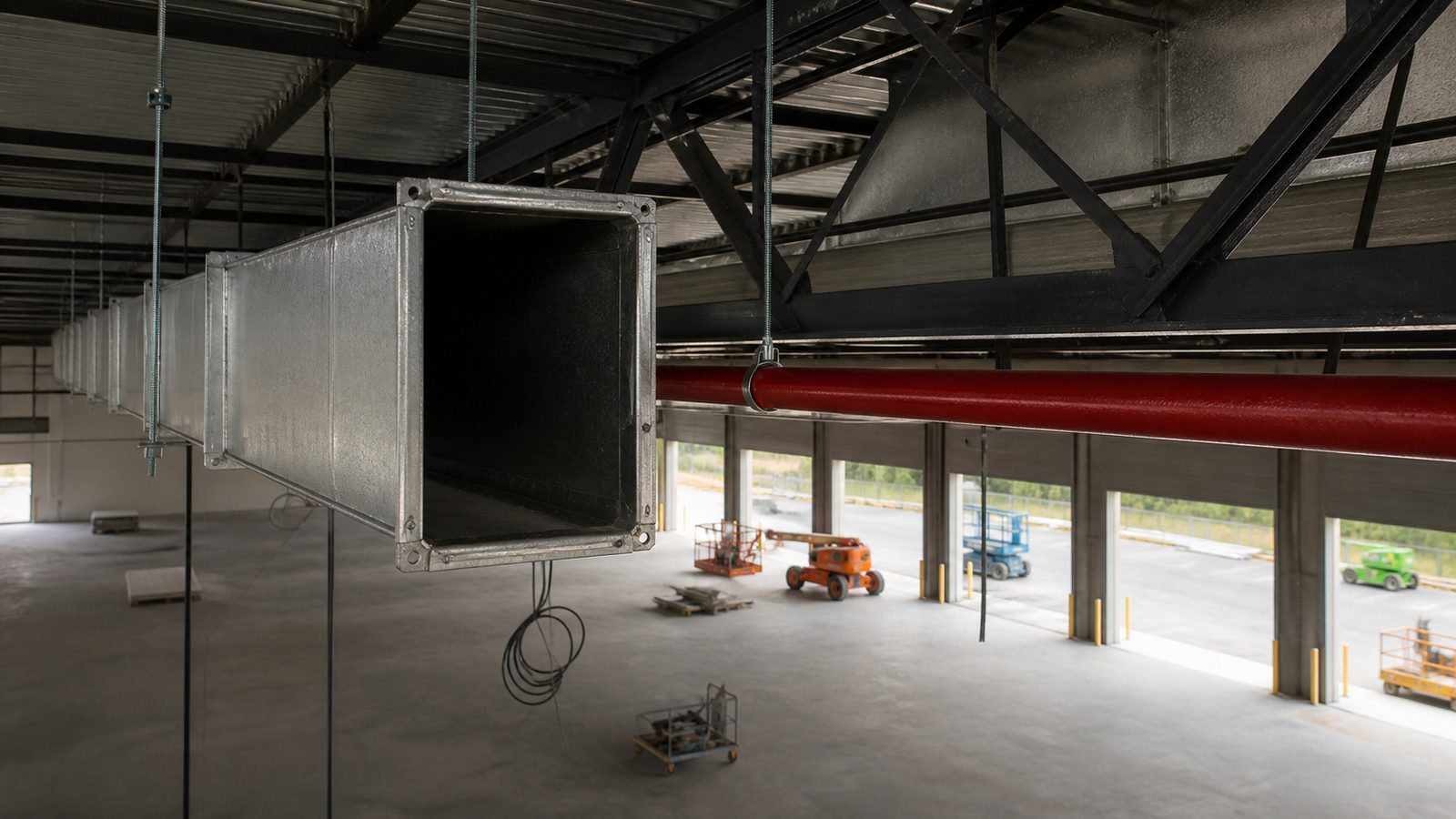
A distribution center is not a simple building from an MEP (Mechanical, Electrical, and Plumbing) standpoint. The specific MEP requirements vary by user but commonly include:
- Fire suppression systems designed for racking configurations that vary by product type (ESFR sprinkler systems for high-piled storage, for example)
- Electrical infrastructure for EV charging at loading docks — a requirement that many e-commerce operators are now including in new distribution center specs
- LED lighting at bay heights of 36 to 40 feet, designed for foot-candle levels that meet OSHA and insurance requirements for forklift operations
- Energy code compliance for large unconditioned or semi-conditioned spaces under Florida's current Energy Conservation Code
MEP coordination on industrial projects requires a GC that understands logistics operations, not just construction. A distribution center where the fire suppression system was designed for the wrong racking configuration is not a punch-list item — it requires a full system redesign.
Speed to occupancy
Industrial users measure the value of a new facility in the delay costs from not having it. An e-commerce distribution center that is three months late to occupancy represents three months of shipments routed through a less-efficient alternative facility. The cost of delay is real, specific, and often contractual.
GCs who deliver industrial projects on schedule in Jacksonville are those who lock the schedule in pre-construction — setting the baseline before ground breaks, identifying the critical path items that determine the occupancy date, and managing to that baseline rather than letting it drift.
See how The JK Way structures industrial project delivery: fixed-price or GMP contract, schedule baseline set in pre-construction, self-perform on the critical path.
What JK Prestige Brings to Industrial Construction in Jacksonville
JK Prestige has delivered warehouse and industrial projects in NE Florida's growing logistics corridor. Our capabilities in this sector:
- Tilt-up concrete panel construction
- Clear-span structural systems for open-floor logistics operations
- Loading dock and truck court construction
- MEP coordination for logistics operations including ESFR fire suppression, EV charging infrastructure, and high-bay lighting
- OSHA 30 certified crews on every industrial site — daily toolbox talks, written Job Safety Analysis (JSA) for non-routine tasks, third-party annual safety audits
- Total Recordable Incident Rate (TRIR) below one-third of the commercial GC industry average
For owners and developers planning industrial construction in Duval, Nassau, or St. Johns County, the booking window and project pipeline requires early GC engagement. Quality industrial GCs in Jacksonville are not readily available for projects starting in 30 days.
Get a written GMP or fixed-price estimate in 48 hours from a JK principal — warehouse, tilt-up, cold storage, or distribution center: jkprestigeconstruction.com/#/contact or call (904) 944-0278. A principal answers.
No call center. No coordinator. A JK principal reviews every inquiry and replies with a real number, not a range, not a follow-up form.
Request Free Estimate →