Managing a gut renovation from another state is not inherently riskier than managing one locally — provided the contractor you hired has the communication infrastructure to support it. The problem is that most contractors don't. They use a text thread, a spreadsheet, and a superintendent who is hard to reach after 3 p.m.
Out-of-state owners — people renovating a Florida investment property, a second home, or a property they've inherited — have the same need for project visibility as local owners, but with less ability to drop by and check in. That means the contractor's documentation and communication systems carry all the weight.
This post explains what an owner portal should provide, what JK Prestige's 48-hour response guarantee means in practice, how virtual site walks work, and — critically — how to tell whether the contractor you're evaluating actually uses their portal or just has one as a sales feature.
See how JK Prestige structures project communication for every renovation, including projects managed by out-of-state owners.
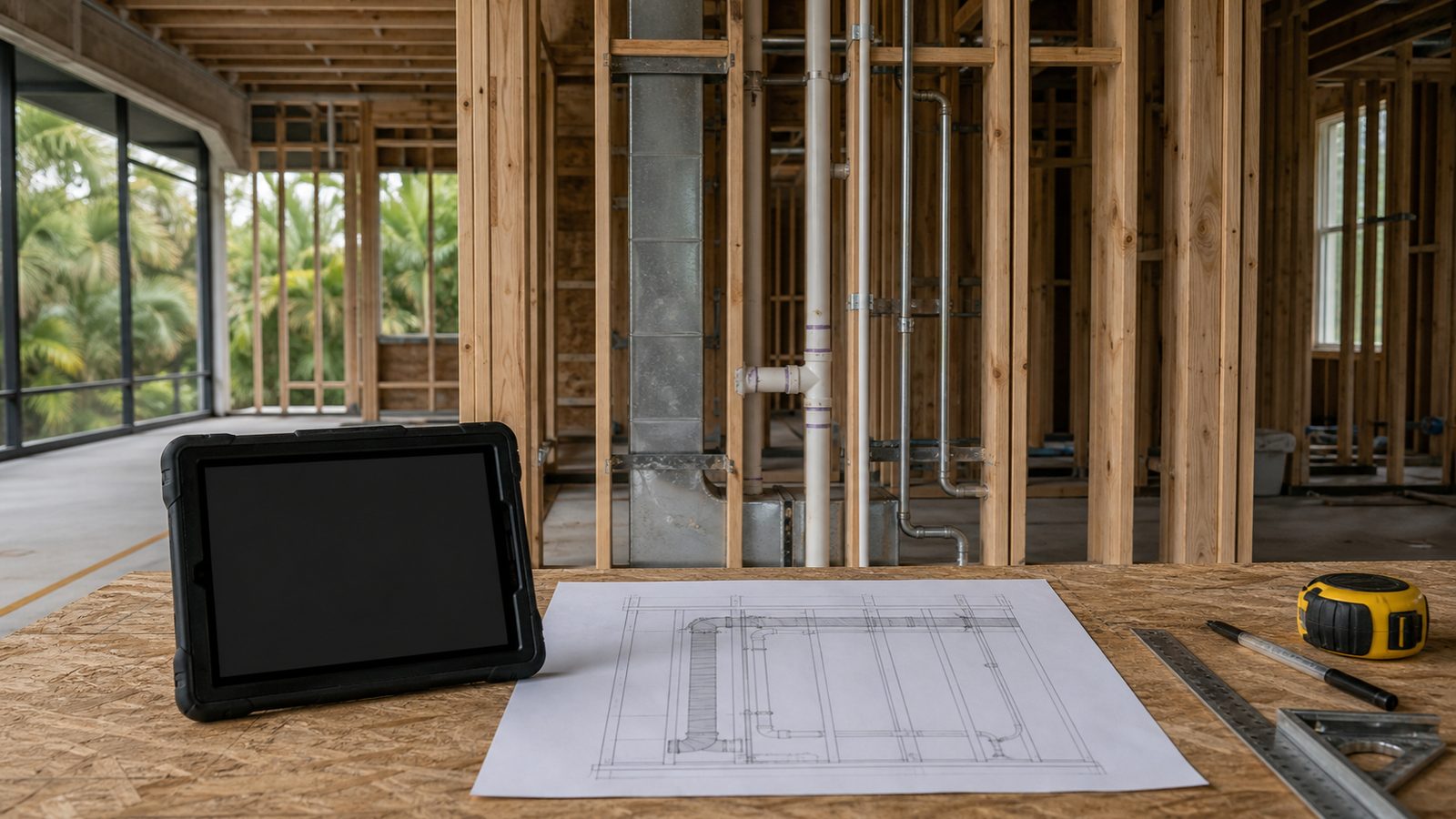
What an Owner Portal Should Provide
The term "owner portal" is used loosely. Some contractors call a shared Google Drive folder a portal. Others have purpose-built construction management platforms (Procore, Buildertrend, CoConstruct) with full project integration. The difference between them is significant for an out-of-state owner.
A functional owner portal for a gut renovation provides:
Live Schedule
Not a PDF schedule that was accurate the day it was made. A live schedule that shows today's status on every phase — what's in progress, what's complete, what's scheduled for next week. The schedule should be updated at least weekly, with a superintendent note explaining any changes.
For an out-of-state owner, the schedule is the primary indicator of whether the project is on track. If you have to call or email to find out what week it is in the construction sequence, the portal is decorative.
Photo Documentation
Minimum standard: daily photos of active work areas, uploaded with date and description. Better standard: milestone photos at inspection gates (framing complete, rough-in complete, drywall complete) with the photo tagged to the schedule milestone.
Photo documentation serves two purposes for the out-of-state owner: it confirms work is actually progressing, and it creates a permanent record of concealed conditions (what's inside the walls before drywall). If a leak occurs two years after the renovation and the question is whether the shower pan was properly waterproofed, those construction photos are the evidence.
JK Prestige uploads jobsite photos through the owner portal daily on active projects. The photo record stays accessible to the owner indefinitely.
RFI Log
A Request for Information (RFI) log tracks every question that arises during construction — typically related to unforeseen conditions, design clarifications, or material substitutions. For an out-of-state owner, the RFI log is important for two reasons:
- It shows you every decision point in the project in writing, with dates.
- It documents how quickly the contractor and design team responded to questions.
A stalled RFI is a stalled project. If the contractor raised an RFI seven days ago and has no response logged, there's a problem — and the out-of-state owner who isn't checking the log doesn't know.
Budget Variance Report
A live budget tracker showing what has been committed, what has been invoiced, what is pending, and what variance exists against the original fixed-price contract. Out-of-state owners are particularly vulnerable to budget scope creep that happens gradually — a fixture upgrade here, an unforeseen condition charge there — that adds up to a significant overage by the end.
The budget variance report in the owner portal makes every change visible in real time. With a fixed-price contract and proper change order documentation, there should be no budget variance unless the owner initiated a scope change.
Submittal Tracker
Submittals are the documentation of materials and equipment to be used on the project — manufacturer cut sheets, finish samples, shop drawings for custom elements. For a renovation with owner-selected finishes (tile, fixtures, appliances), the submittal tracker shows what has been ordered, what has been received on site, and what is still pending.
For an out-of-state owner who ordered a tile from a national supplier, the submittal tracker is how they verify it arrived before the tile sub is scheduled — instead of finding out after the tile sub shows up to an empty site.
What JK Prestige's 48-Hour Response Guarantee Means
JK Prestige commits to a 48-hour written response on any owner question, decision request, or concern. For an out-of-state owner, this is not a customer service promise — it's a schedule protection mechanism.
Here's why: renovation schedules create decision bottlenecks. The contractor needs an owner decision on a material substitution (the specified fixture is back-ordered; here are three alternatives). If the owner doesn't respond for five days, the trade is waiting. On a 12–16 week project with 50 trade-days, a five-day decision delay is a 10% schedule extension.
The 48-hour response guarantee means two things:
- JK Prestige will respond to any owner communication within 48 hours — not through a coordinator, but from the project principal.
- When JK Prestige needs an owner decision, they will communicate the deadline clearly and follow up before it lapses.
For the out-of-state owner to hold their side of this: check the portal three times per week, respond to decision requests within 48 hours, and flag concerns in writing through the portal rather than accumulating them for a monthly call.
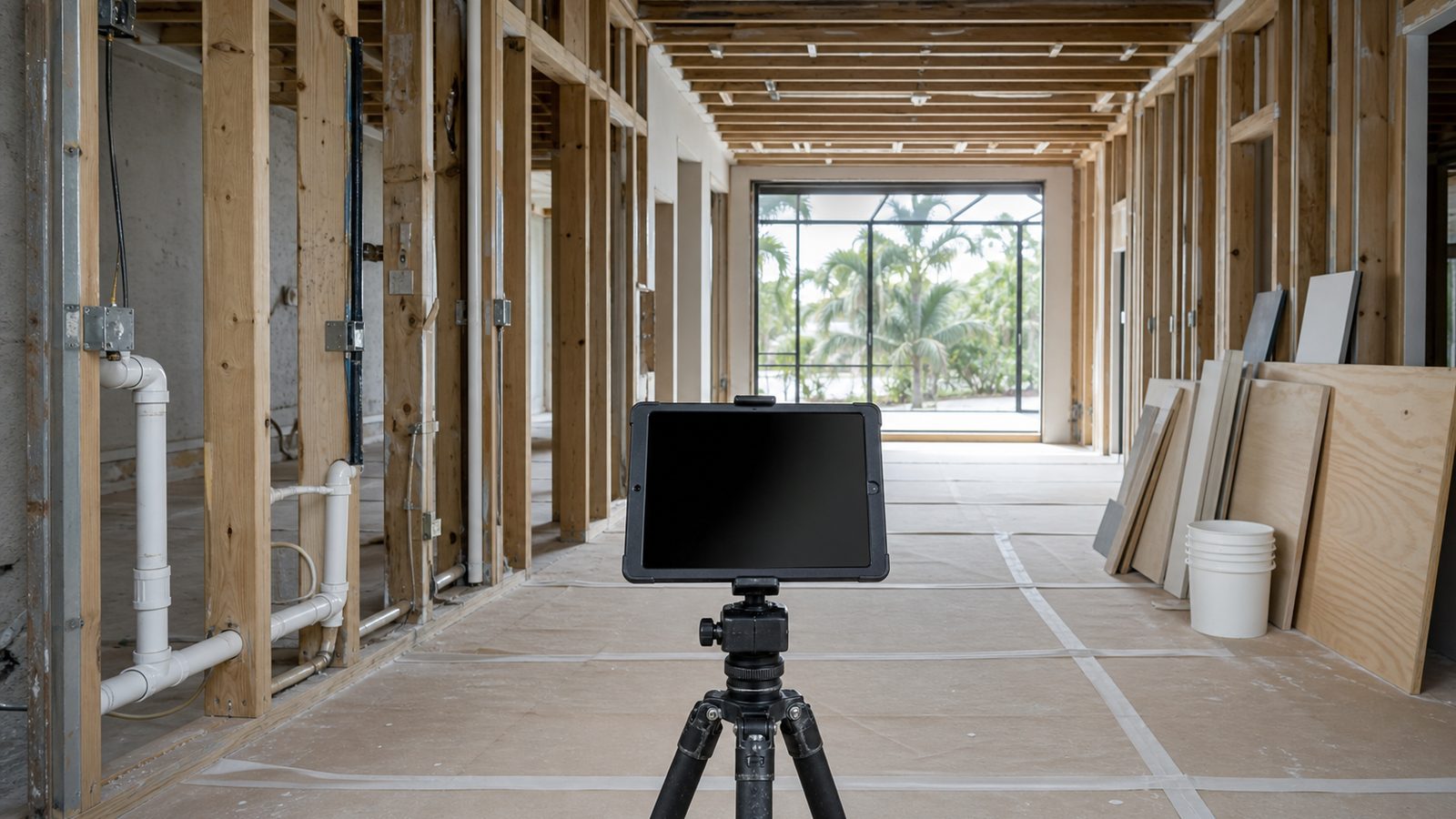
Virtual Site Walks: How They Work
JK Prestige provides virtual site walks at major project milestones for out-of-state owners. The format:
- Video call with live walkthrough: The superintendent or principal walks the jobsite on a video call with the owner, narrating the current status and walking each area. The owner can ask questions in real time.
- Pre-walkthrough summary: Before the call, JK uploads a written milestone summary to the portal — what was completed, what was inspected, what is scheduled next, and any open decisions.
- Milestone gates: Virtual site walks are scheduled at fixed milestones: framing complete, rough-in complete, drywall complete, tile and cabinet complete, substantial completion. The owner knows exactly when each call will occur because the schedule shows the milestone dates.
Virtual site walks do not replace the owner portal — they supplement it. The portal provides continuous visibility; virtual site walks provide contextual explanation at the points where the project changes character significantly.
Milestone-Gated Payments: Why They Matter for Remote Owners
JK Prestige structures renovation payment schedules around project milestones, not calendar dates. A typical milestone payment structure for a gut renovation:
- Contract signing: 10–15% deposit to cover permit fees, long-lead material deposits, and preconstruction mobilization.
- Framing complete / rough inspection passed: 20–25%
- Drywall complete: 20–25%
- Cabinet and tile complete: 15–20%
- Substantial completion: 15–20%
- Punchlist complete / final walkthrough: 5–10%
Milestone-gated payments protect the out-of-state owner in a specific way: no payment is released unless the milestone is actually complete and documented in the portal. You don't pay for drywall that isn't installed yet. The payment schedule gives you a financial checkpoint that aligns with project reality.
Beware of contractors who ask for large deposits upfront or request payments on calendar dates rather than milestones. A calendar payment schedule ("pay us the 15th of each month") has no relationship to actual progress.
How to Tell If a Contractor Actually Uses Their Portal
Every contractor who has a construction management platform will tell you they use it. Here's how to verify before signing:
Ask to see a live project example. Request a view (with client permission or anonymized) of an active project in their portal — not a demo environment, not screenshots. A portal that is actually in use on active projects has recent photo uploads, live RFI dates, and a schedule with current-week highlighted.
Ask how many photos were uploaded on last week's active projects. If the answer is vague, the portal isn't being used daily. A contractor who uses the portal correctly can tell you exactly how many uploads happened on each project last week.
Ask who updates the schedule. If the answer is "the office" rather than "the superintendent at end of each day," the schedule update is lagging field reality. Real portal use means field data flows in from the jobsite, not from a weekly office summary.
Ask how RFIs are handled. A contractor with a real RFI process can describe the last RFI on an active project — what the question was, what the response was, how many days it took. A contractor who uses the RFI field as a formality can't.
JK Prestige's portal is reviewed with every out-of-state owner during the preconstruction meeting — not as a sales demo, but as a training session on how the owner will use it throughout the project.
Learn more about how JK Prestige manages projects for out-of-state owners, then contact us for a free estimate. Fixed price, written scope, 48-hour turnaround. Call (904) 944-0278 — a principal answers, not a coordinator.
No call center. No coordinator. A JK principal reviews every inquiry and replies with a real number, not a range, not a follow-up form.
Request Free Estimate →