When a Jacksonville building owner needs to replace a flat roof, two systems come up most often: modified bitumen and polyvinyl chloride (PVC) membrane. Both are proven. Both meet Florida Building Code (FBC) requirements. But they perform differently under Florida heat, cost differently to install, and serve different applications. Choosing the wrong one means paying for a system that underperforms in your specific conditions.
This post breaks down both systems on cost, longevity, heat performance, and application fit. No vague claims — just the numbers and the reasoning behind the recommendation.
JK Prestige self-performs commercial roofing installations in Jacksonville and across northeast Florida. Our own crews do the work — not brokers — which means we have direct data on installation times, material behavior, and failure patterns across both systems.
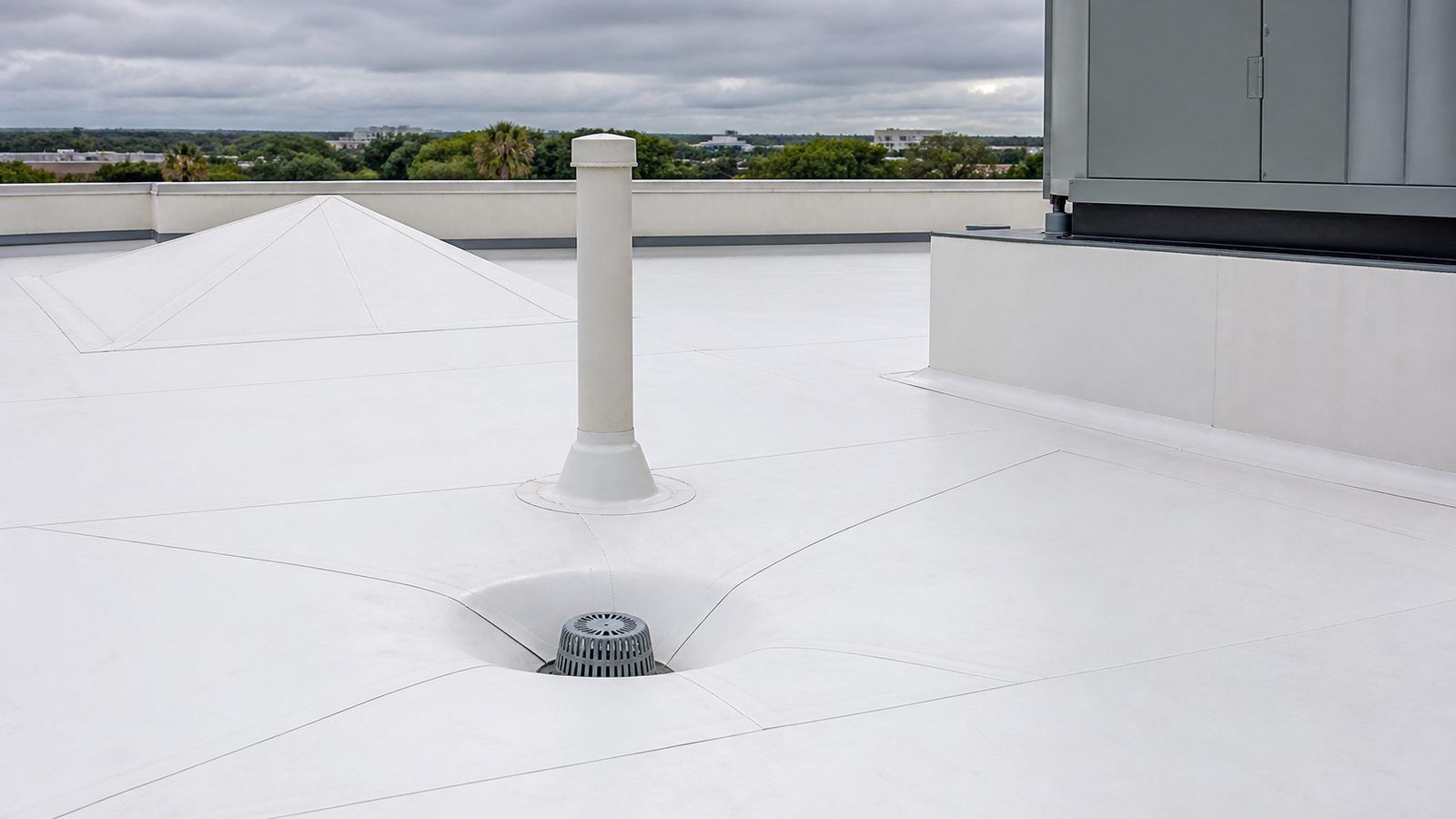
Modified Bitumen: What It Is and What It Costs in Florida
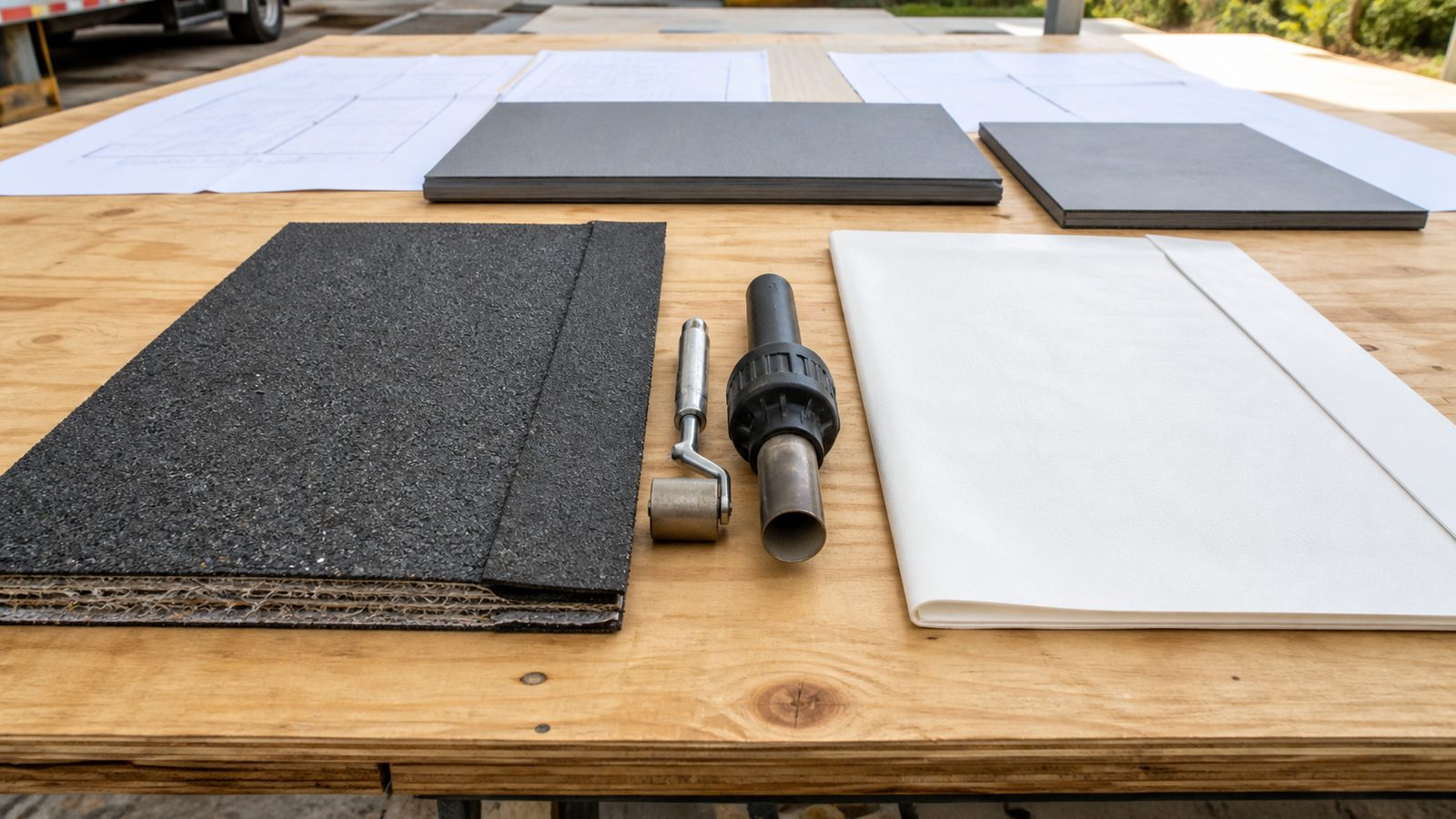
Modified bitumen is an asphalt-based membrane reinforced with polyester or fiberglass mat. Two chemical modifiers are used:
- APP (atactic polypropylene): Thermoplastic modifier. Best suited to torch-applied installation. Harder surface, more UV-resistant, but less flexible in cold.
- SBS (styrene-butadiene-styrene): Elastomeric modifier. Cold-applied or hot-mopped. More flexible, better crack resistance, but slightly softer surface.
Installation Methods
Torch-applied (APP): A propane torch melts the back of the membrane directly to the substrate. Fastest method when conditions allow. Not permitted over certain foam insulation types without a cover board.
Cold-applied (SBS): Adhesive rather than heat. Required in occupied facilities where open flame is a liability concern. Slightly longer installation window per square.
Self-adhered: Peel-and-stick. Lower installed cost, used primarily for smaller repairs or low-slope transitions.
Modified Bitumen Cost and Lifespan
Installed cost: $4–$6 per sqft for a two-ply system in the Jacksonville market (2025 pricing, including tear-off of one existing layer, new cover board, and membrane). Single-ply modified bitumen costs less but carries less redundancy.
Expected lifespan: 15–20 years on a properly installed two-ply system with annual maintenance. Florida UV exposure and thermal cycling accelerate surface oxidation on uncoated APP systems — budget for an elastomeric coating reapplication at year 10–12 to extend life toward the 20-year mark.
How Modified Bitumen Performs in Florida Heat
Florida's UV index, ambient temperatures, and thermal cycling put stress on any flat roof membrane. APP-modified bitumen holds up well to UV but becomes rigid in cold (not a major concern in Jacksonville). SBS performs better through temperature fluctuations. Both systems trap heat at the substrate level — reflective coatings significantly reduce this.
One limitation: seams are the primary failure point. Torch-applied seams done correctly are durable. But on roofs with high foot traffic or where seams weren't rolled sufficiently during installation, Florida's wet season drives water under overlaps.
PVC Membrane: What It Is and What It Costs
PVC (polyvinyl chloride) is a thermoplastic single-ply membrane. The defining characteristic is the seaming method: a heat-welded seam fuses two membrane edges into a single homogenous bond. When done correctly, a heat-welded PVC seam is stronger than the membrane itself — the seam is not the weak point.
PVC membranes are white or light gray by default, which provides meaningful solar reflectance. This reduces cooling loads in Florida's 8–9 month cooling season — a real cost benefit for building owners paying commercial electric rates.
PVC Cost and Lifespan
Installed cost: $7–$10 per sqft in the Jacksonville market (2025 pricing, mechanically fastened or fully adhered, including new insulation and cover board). The premium over modified bitumen reflects material cost, seam welding equipment time, and the higher skill requirement for heat-welding.
Expected lifespan: 20–30 years on a properly installed PVC system. Manufacturer warranties — Carlisle SynTec, Firestone — commonly issue 20-year NDL (no-dollar-limit) warranties on PVC when installed by a certified contractor.
JK Prestige holds Carlisle SynTec and Firestone manufacturer certifications, which is required to issue NDL warranties to building owners.
How PVC Performs in Florida Heat
PVC has two Florida-specific advantages over modified bitumen:
- Reflectivity: White PVC membranes reflect 70–80% of solar radiation. This reduces membrane surface temperature by 40–60°F compared to dark-surface modified bitumen on the same building. Lower surface temp means slower membrane degradation and lower HVAC load.
- Chemical resistance: PVC is impervious to grease, oils, and many industrial chemicals. This makes it the only correct choice for roofs above restaurant kitchens, food processing, or any facility with grease exhaust discharge.
One Florida-specific concern with PVC: plasticizer migration over time in extreme heat. Cheaper-grade PVC membranes lose flexibility as plasticizers leach out, leading to cracking at details and penetrations. Specifying 60-mil or 80-mil PVC from a major manufacturer (not generic import membrane) avoids this.
Which System Fits Which Application
This is where most roofing conversations fail — contractors recommend one system for everything. The honest answer is that application drives the decision.
Choose Modified Bitumen When:
- Budget is the primary constraint. At $4–$6/sqft vs. $7–$10/sqft, modified bitumen is the lower-cost path when the building doesn't have grease exposure or high reflectivity requirements.
- The building has low foot traffic. Modified bitumen handles occasional rooftop access fine. High-traffic roofs (HVAC maintenance-heavy) should have walkpads installed regardless of membrane type.
- The existing deck and insulation are in good condition. Modified bitumen is appropriate for a re-cover when code allows it (see note on re-cover rules below).
- Speed of installation matters. Torch-applied modified bitumen installs faster per square than fully adhered PVC on most commercial roofs.
Choose PVC When:
- The roof is above a restaurant kitchen or food processing area. Grease exhaust contaminates and degrades modified bitumen within a few years. PVC resists grease chemically. This is not a preference — it's a functional requirement.
- The building owner wants a 20-year NDL warranty. Most major manufacturers don't issue NDL warranties on modified bitumen without an extensive inspection program. PVC NDL warranties are standard.
- Cooling cost reduction is a priority. White PVC membrane on a large commercial roof can reduce peak cooling load meaningfully in Jacksonville's climate.
- The project is a ground-up build with a clean deck. When starting from a new substrate, PVC is the higher-value long-term choice if the budget supports it.
One Roof, Two Zones
On some commercial buildings, a hybrid approach makes sense: PVC over the kitchen exhaust zone, modified bitumen over the remainder. This is not standard practice at most roofing companies, but when JK crews self-perform the full roof, we can execute a zone change mid-installation without a seam coordination problem between two subcontractors.
What Florida Building Code Requires for Commercial Flat Roofs
Florida Building Code Chapter 15 governs low-slope roofing. Key requirements:
- All new commercial roofing must meet FBC wind uplift requirements for the applicable wind speed zone. Jacksonville (Duval County) is a 130–140 mph design wind zone. Both modified bitumen and PVC can be specified to meet these requirements; attachment method (mechanical fasteners vs. fully adhered) determines uplift performance.
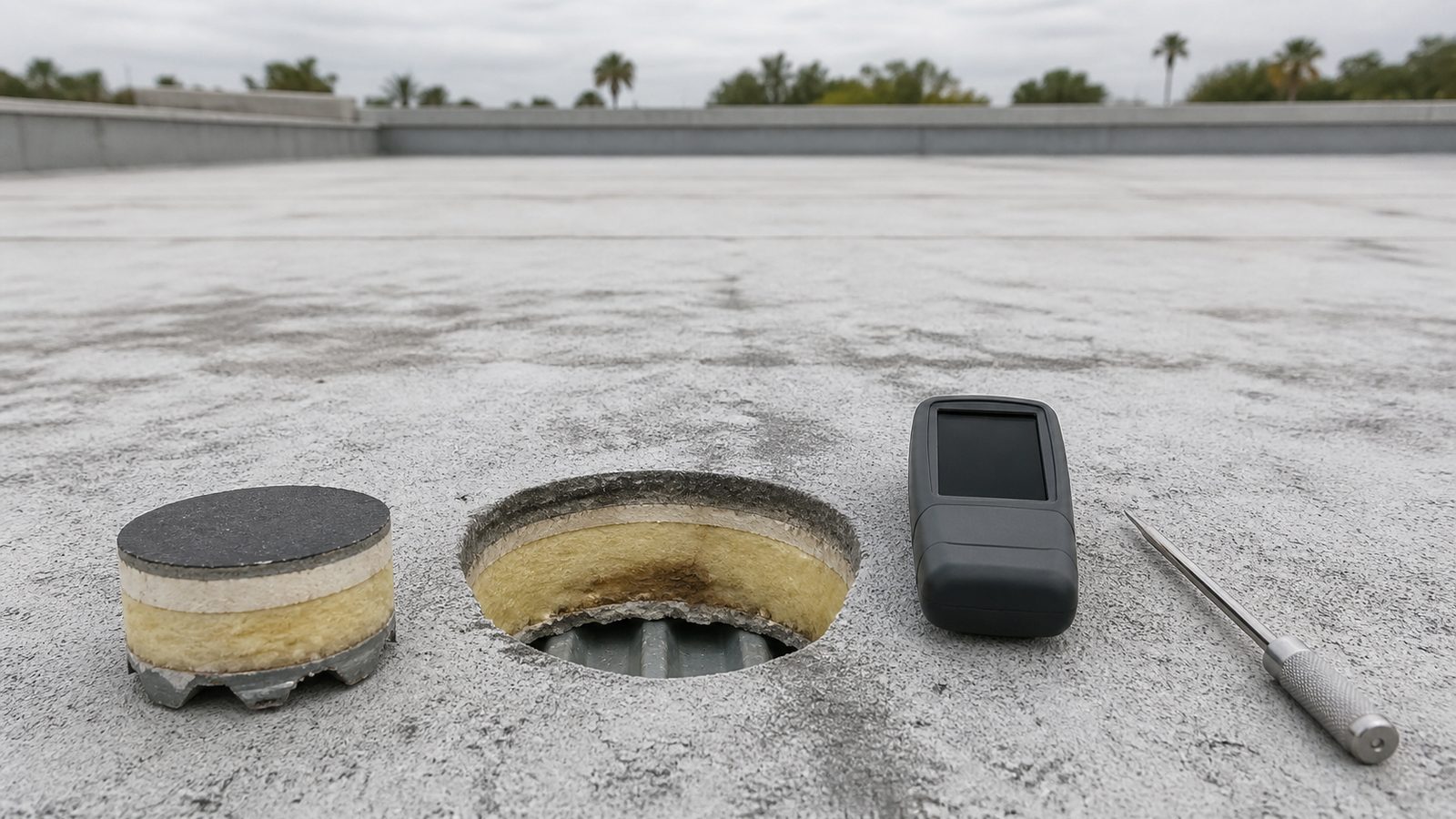
- Re-cover limitation: Florida allows one re-cover on a commercial roof before a full tear-off is required. If moisture is found in the existing insulation via core cuts or infrared scan, tear-off is mandatory regardless of layer count.
- Permit required: Any commercial re-roof in Duval County requires a permit and inspections. A roofing contractor who tells you a permit isn't needed for a commercial job is wrong.
JK Prestige pulls all permits before any work begins. See how we sequence the full commercial roofing process in our project portfolio.
The Inspection Before the Recommendation
No legitimate roofing contractor should recommend modified bitumen vs. PVC without first walking the roof and pulling core cuts to assess the existing insulation. A wet insulation board changes the cost calculation entirely — you're no longer comparing $4–6 vs. $7–10/sqft; you're comparing those numbers plus the cost of wet ISO removal and replacement.
JK Prestige provides a free 24-point commercial roof inspection before any recommendation. The written report documents existing layer count, moisture findings, deck condition, penetration condition, and drainage status. You get the full picture before any contract is signed.
Book your free commercial roof inspection or call (904) 944-0278. A principal answers.
No call center. No coordinator. A JK principal reviews every inquiry and replies with a real number, not a range, not a follow-up form.
Request Free Estimate →