OSHA 30 is not a checkbox. On an industrial construction site — tilt-up panels going up, steel erection underway, roofing crews at elevation — the gap between a trained supervisor and an untrained one is measured in incidents. In Florida, where summer heat adds a separate physiological hazard, site safety requires both the regulatory knowledge to comply with OSHA 1926 and the operational discipline to implement it in 95°F heat with 80% humidity.
This article covers which OSHA 1926 subparts apply to a warehouse construction site, what OSHA 30 supervisory training actually covers versus OSHA 10, the specific fall hazards in industrial construction, and JK Prestige's heat illness prevention protocol for Florida jobsites.
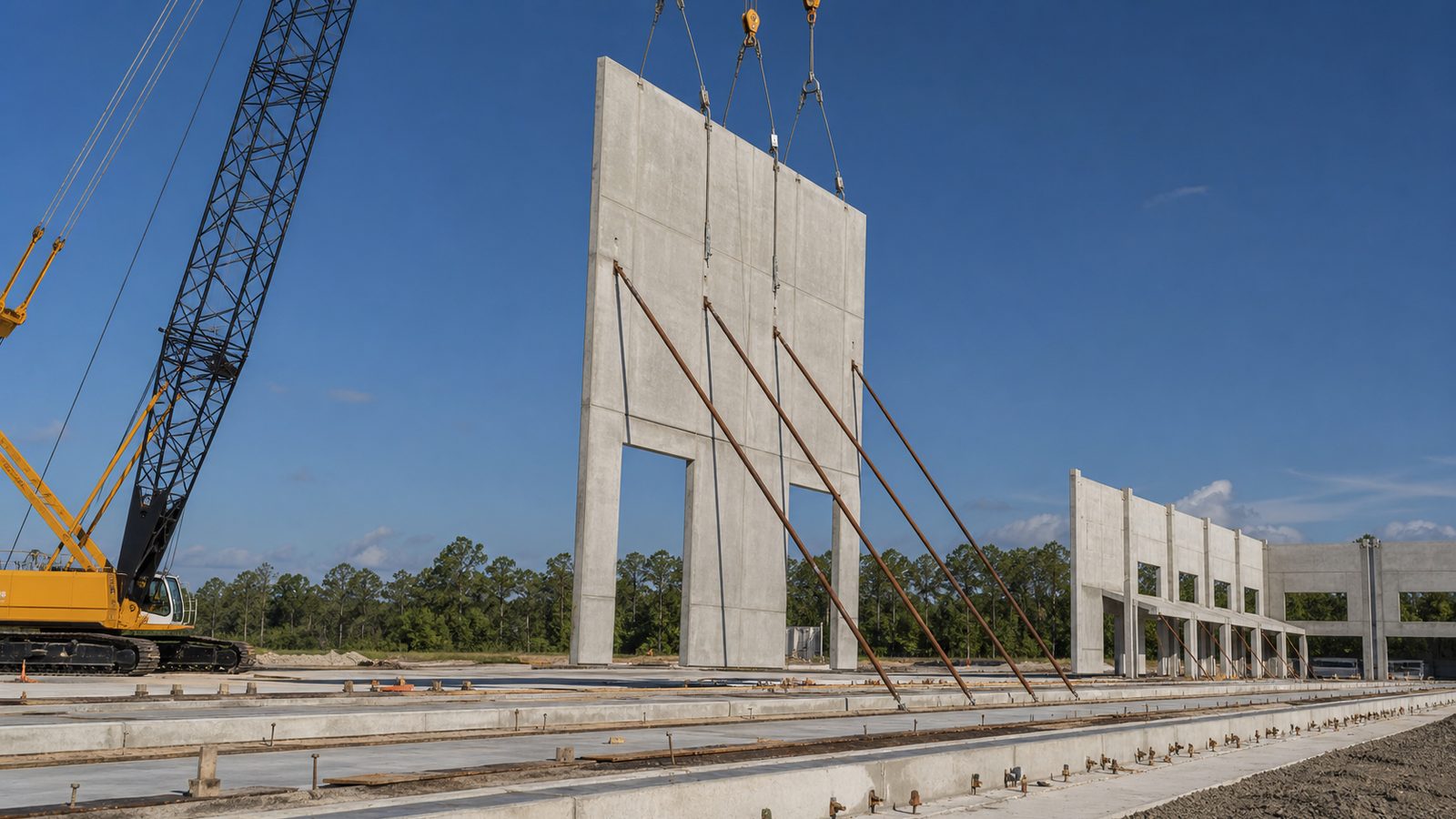
OSHA 1926: Which Subparts Apply to an Industrial Construction Site
OSHA 1926 is the primary construction safety standard. It runs from Subpart A (general provisions) through Subpart Z (toxic and hazardous substances), and nearly every subpart has application on a warehouse construction site. The most operationally significant are:
Subpart C — General Safety and Health Provisions (1926.20–1926.35) This is the baseline: accident prevention programs, safety training, first aid requirements, and the employer's general duty to maintain safe conditions. Subpart C applies from day one of site mobilization.
Subpart E — Personal Protective and Life Saving Equipment (1926.95–1926.107) Hard hats, safety glasses, high-visibility vests, gloves, and hearing protection requirements. On industrial sites, Subpart E also covers respiratory protection when cutting concrete panels or working near silica-generating operations.
Subpart M — Fall Protection (1926.500–1926.503) On a warehouse project, fall protection requirements apply at heights of six feet or more (the construction industry threshold). Key applications:
- Roof installation on metal deck before roofing membrane is applied
- Steel erection on open-web joists before decking is complete
- Tilt-up panel crane picks (workers on the slab who could be struck by a falling panel)
- Leading edge work on concrete decks with open penetrations
Subpart N — Cranes, Derricks, Hoists, Elevators, and Conveyors (1926.1400–1926.1442) The 2010 crane rule revision significantly expanded requirements for crane inspections, operator qualification, and assembly/disassembly planning. A tilt-up panel pick requires a pre-lift plan — weight calculations, radius, crane position, rigging configuration — and a designated signal person. This subpart has more enforcement citations on Florida construction sites than most owners realize.
Subpart Q — Concrete and Masonry Construction (1926.700–1926.706) Applies directly to tilt-up construction: formwork, shoring, lift-slab operations, and the specific tilt-up requirements in 1926.706. Requires that tilt panels be braced per a licensed engineer's bracing plan before crane rigging is released.
Subpart R — Steel Erection (1926.750–1926.761) Steel erection has its own subpart for a reason. Key requirements: controlled decking zones (CDZ) with access control while decking is in progress, fall protection for connectors at two stories or 30 feet (whichever is less), column anchor bolt requirements, and written fall protection plans for some operations.
Subpart X — Stairways and Ladders (1926.1050–1926.1060) Access to elevated areas during construction — roof level, mezzanine framing — requires compliant ladders or stairways. Extension ladder setup angles (75 degrees), top-of-ladder tie-off requirements, and stairway rail requirements apply from the first week of work.
OSHA 30 vs. OSHA 10: What Each Requires
OSHA 10 is a 10-hour course designed for entry-level workers. It covers general awareness of common hazards: fall protection basics, electrical safety, struck-by and caught-in hazards, and personal protective equipment (PPE). Workers who complete OSHA 10 understand that hazards exist and what general precautions apply.
OSHA 30 is a 30-hour course required for supervisors and site management. The coverage is significantly deeper:
- Detailed treatment of OSHA 1926 subparts, not just overview
- Recordkeeping requirements (OSHA 300 log, incident investigation)
- Regulatory inspection procedures — what to do when an OSHA inspector arrives on site
- Competent person duties: who can identify and correct hazards, who must be present during specific operations (excavation, scaffolding, fall protection)
- Written safety program requirements: hazard communication, fall protection plans, Job Safety Analysis (JSA) documentation
On a JK Prestige warehouse jobsite, all supervisors hold OSHA 30 certification. This is not a client preference — it is a JK operating standard. A superintendent who cannot act as a competent person under OSHA 1926.32 is not running a JK site.
The practical difference between an OSHA 10 crew and an OSHA 30 supervisor: the OSHA 10 worker knows to tie off at six feet. The OSHA 30 supervisor knows the specific anchor point load requirements (5,000 lbs per worker, or system-rated equivalent), the inspection frequency for self-retracting lifelines, and the documentation required after a fall protection system is deployed.
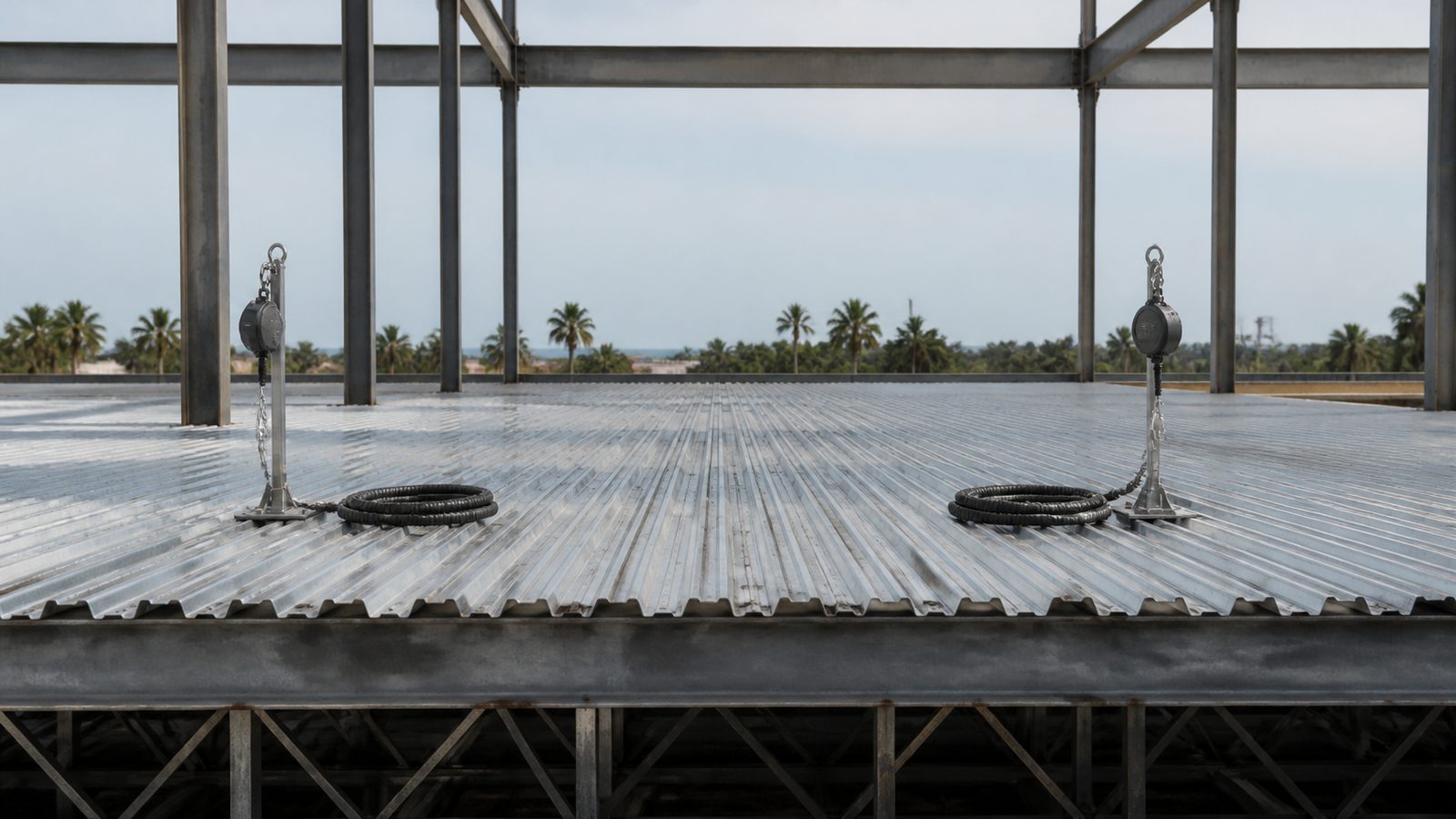
Fall Hazards Specific to Warehouse Construction
Three operations on a warehouse project create elevated fall exposure that demands specific planning:
Roof Installation
Metal deck on open-web joists is a leading-edge fall hazard. Until the deck is fully welded and sheets overlapped, the roof plane is not a continuous walking surface. OSHA Subpart M requires a written fall protection plan for leading-edge work when conventional fall protection (guardrails or personal fall arrest) is infeasible. The plan must be prepared by a qualified person and available on site.
On a 50,000 sqft warehouse, roofing crew exposure spans two to four weeks. The roofing membrane phase — TPO or EPDM heat-welded to the deck — also requires sustained work at elevation, often without permanent guardrails in place.
Steel Erection
Steel connectors working at two or more stories face the highest fall exposure on an industrial site. OSHA 1926.760 specifies fall protection requirements for connectors by height tier: at heights below two stories, positioning devices; at two stories and above, personal fall arrest. Connectors must be provided with a fall protection system even during the brief interval between setting a beam and making connections.
The decking crew following the connector crew operates in a controlled decking zone — an area where access is restricted to the minimum number of workers actively installing deck. CDZ requirements limit the height at which CDZ operations are permitted and require specific edge protection configurations.
Tilt-Up Panel Crane Picks
When a crane picks a tilt-up panel, workers on the slab face two distinct hazards: struck-by from a panel that shifts during the pick, and tip-over if a brace fails during initial set. OSHA 1926.706 and the Tilt-Up Concrete Association's engineering guidelines require:
- Panel brace design by a licensed engineer before first pick
- Minimum two braces per panel, attached before the crane releases
- Exclusion zone below and around the panel during the pick
- Signal person with direct communication to the crane operator
JK's tilt-up crews follow a pre-lift checklist for every panel — rigging inspection, brace hardware verification, exclusion zone establishment, and communication confirmation before the pick begins.
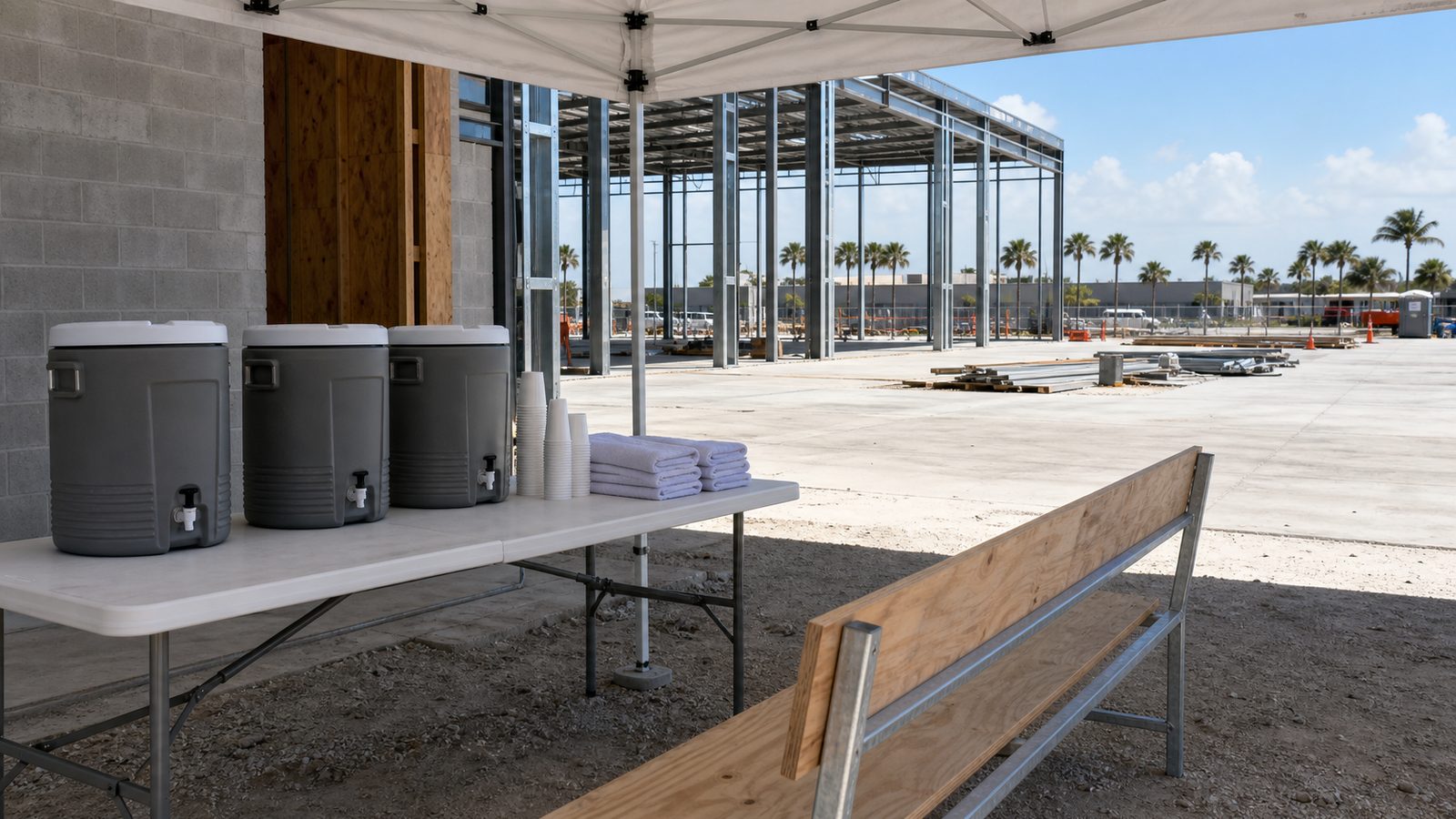
Heat Illness Prevention for Florida Industrial Sites
OSHA does not have a specific heat standard for construction (one was proposed in 2021 and is still in rulemaking as of 2025), but the General Duty Clause of the OSH Act requires employers to protect workers from recognized hazards — including heat illness. In Florida, heat illness is a recognized hazard from May through October, and OSHA's enforcement activity on heat illness has increased significantly since 2022.
Temperature Thresholds and Action Levels
OSHA's Heat Safety Tool classifies risk by Heat Index (the combination of air temperature and relative humidity):
- Caution (80–90°F Heat Index): Awareness; basic hydration
- Moderate Risk (91–103°F): Rest breaks every hour, shade access, acclimatization monitoring for new workers
- High Risk (103–115°F): Mandatory buddy system, 15-minute rest breaks every hour minimum, on-site medical contact identified
- Very High / Danger (>115°F): Reschedule non-essential outdoor work; limit exposure
Jacksonville Heat Index values exceed 103°F regularly from June through September. A 90°F ambient temperature with 75% relative humidity produces a Heat Index of approximately 109°F — squarely in the high-risk category.
JK's Florida Heat Protocol
JK Prestige requires the following on all Florida jobsites from May 1 through October 31:
- Water: One quart per worker per hour minimum, positioned at the work location — not at the trailer. Workers should not walk 200 feet for water.
- Shade: A shaded rest area must be within 100 feet of all outdoor work zones. Tent canopies or trailer shade are acceptable.
- Acclimatization: New workers and workers returning after five or more days off begin at 20% of normal outdoor heat exposure on day one, increasing 20% each subsequent day over five days. Full acclimatization takes approximately 7–14 days.
- Buddy system: Workers check on each other during high-risk heat index periods. Supervisors conduct visual checks every 30 minutes.
- Early scheduling: High-heat-exposure tasks (roofing, concrete finishing, panel bracing) are scheduled for the 6–10 am window where possible.
Heat stroke is a medical emergency. A worker who stops sweating, becomes confused, or loses consciousness in heat requires immediate 911 contact and cooling — not rest and water.
No call center. No coordinator. A JK principal reviews every inquiry and replies with a real number, not a range, not a follow-up form.
Request Free Estimate →