In a typical brokered gut renovation — the kind where the general contractor (GC) coordinates multiple subcontractors but self-performs nothing — framing and drywall are two separate subcontracts. That sounds like a minor detail. In practice, it's where renovations gain two to three weeks of schedule drift without anyone being technically at fault.
When JK Prestige self-performs framing, drywall, and finish carpentry with our own crews, a single superintendent manages the transition between trades. No scheduling gap between subs. No dispute about whose work caused whose defect. No week lost waiting for a drywall sub's calendar to open up.
This post explains exactly how that schedule impact works, what defect responsibility looks like when one GC owns the full sequence, and what it means for a homeowner managing a gut-reno budget.
Learn how JK Prestige structures renovation projects from framing through finish carpentry — all with our own crews.
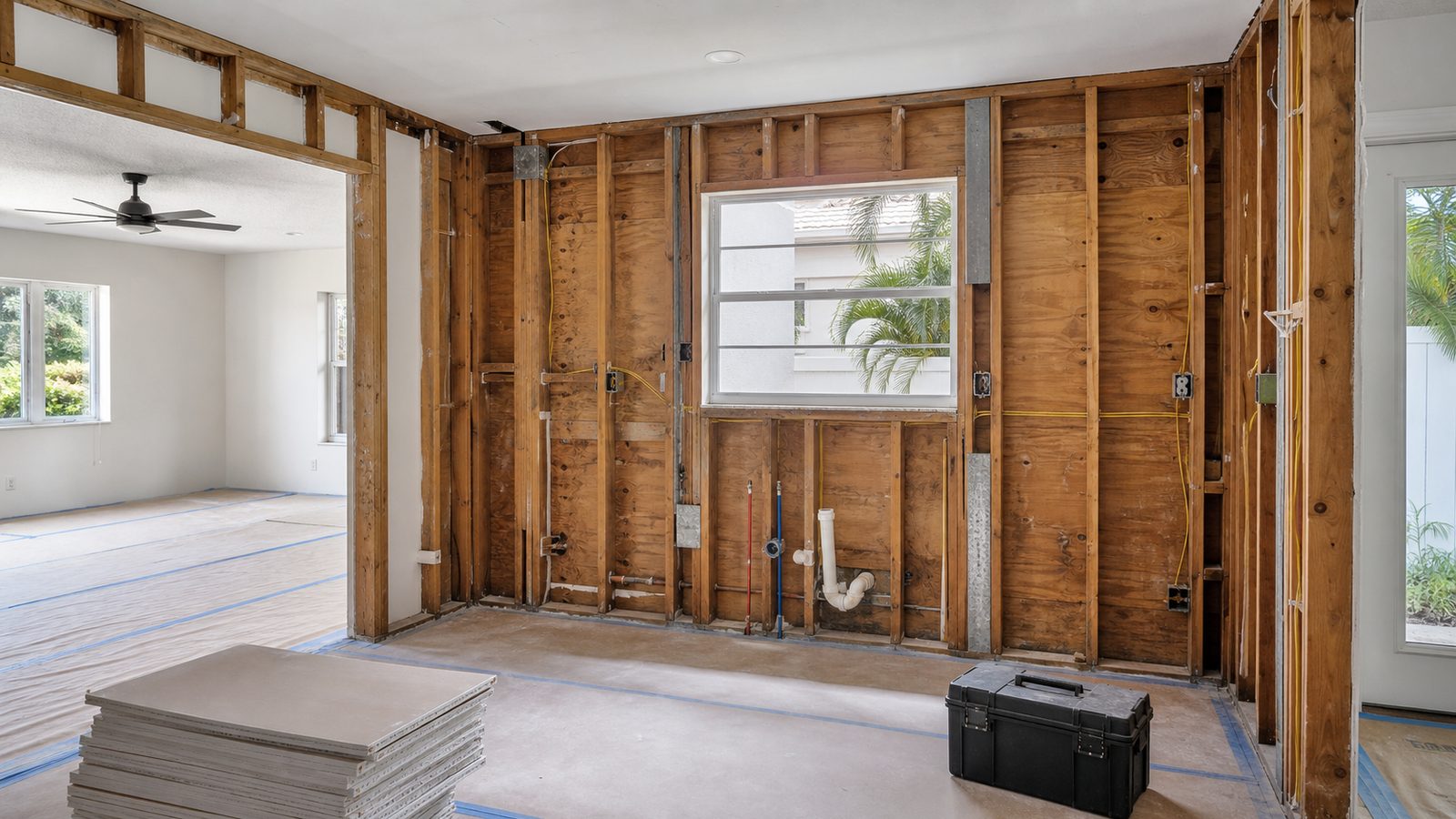
How a Brokered Gut-Reno Creates Schedule Gaps
Most GCs in Jacksonville and across Florida operate as coordinators. They hold the contract with the homeowner, pull permits, and manage a network of subcontractors who do the actual trade work. For many trades — plumbing, electrical, HVAC — subcontracting is the industry norm and works fine. These are licensed specialty trades with their own inspection gates.
The problem is when framing and drywall are also brokered out.
Here's what happens in practice on a typical brokered gut-reno:
- Framing sub finishes rough work. The framing crew completes wall framing, ceiling joists, and any structural modifications. They submit for rough framing inspection.
- Rough inspection pass. Inspector approves. This is the trigger for mechanical rough-in (plumbing, electrical, HVAC). Mechanical rough-in runs 2–4 weeks on a typical kitchen/bath scope.
- Mechanical rough-ins complete. Now the drywall sub can begin. But the drywall sub wasn't standing by waiting — they have their own project queue. The GC calls them to schedule. The earliest available date is 5–10 business days out.
- Drywall begins 1–2 weeks after mechanical rough-in.
That 1–2 week gap is not because the work required it. It happened because the framing crew and the drywall crew are separate businesses with separate schedules, and no one owns the transition except the GC coordinator who has no lever to pull other than a phone call.
On a renovation where the total schedule is 12–16 weeks, a 1–2 week gap between framing completion and drywall start is 6–12% schedule extension — for nothing. No work got done. No inspections occurred. The homeowner was paying carrying costs (rent elsewhere, mortgage on the property being renovated) for an empty week.
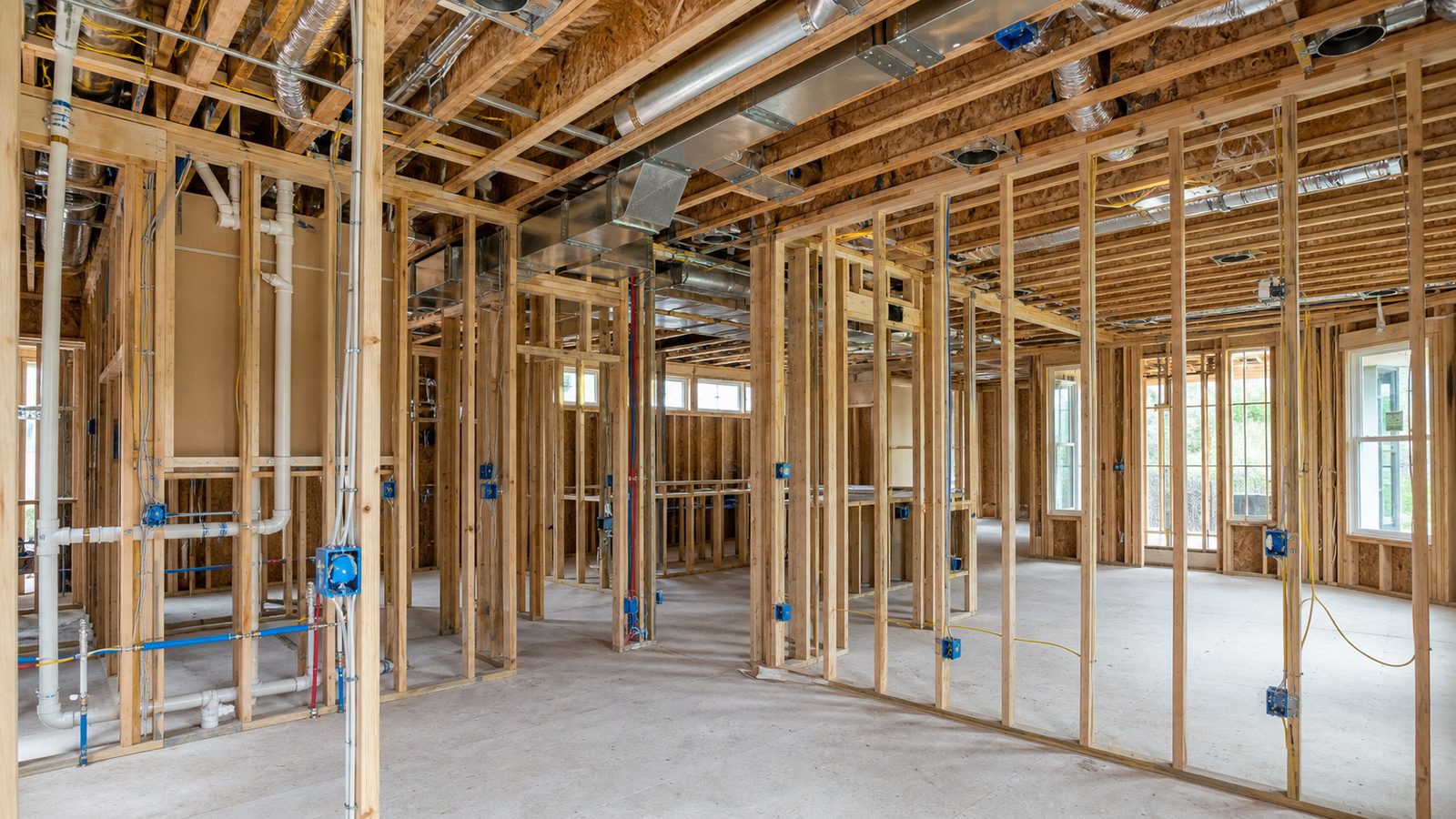
What Changes When JK Self-Performs Both Trades
When JK Prestige self-performs framing and drywall with our own crews, the transition works differently:
The same superintendent owns both phases. Our superintendent schedules the drywall crew to begin as soon as the mechanical rough-in inspections pass — sometimes the next morning. There is no phone call to a sub asking for their availability. There is no week of calendar coordination. The JK drywall crew is working the same job, under the same superintendent, as the framing crew that just finished.
Handoff documentation is internal. On a brokered job, when the framing sub says "we're done" and the drywall sub shows up to find a wall that's out of square or a ceiling joist that's undersized, neither party accepts responsibility — the framing sub says it was built to plan, the drywall sub says they can't work with it. The GC is stuck negotiating between two businesses.
When JK frames and drywalls with our own crews, the defect is caught internally at the transition. Our superintendent identifies the out-of-square wall before the drywall crew begins. It's corrected by the same crew that built it, in the same day, under our fixed-price contract. The homeowner is not billed for the correction — it's our scope, our responsibility.
The punchlist is cleaner at the end. Defect disputes between framing and drywall subcontractors — "that nail pop is from settlement of their framing, not our board" — don't exist when one company does both trades. Every nail pop, every corner bead crack, every joint problem is JK's responsibility to fix. One call, one number, one principal.
Real Impact: 2–3 Weeks on a Typical Gut-Reno
On a typical Jacksonville gut renovation of a kitchen and primary bath — the scope covered in detail in JK Prestige's kitchen and bath renovation timeline guide — the self-perform advantage compresses the schedule at two specific points:
Compression Point 1: Framing to Drywall Transition Brokered: 5–10 business day gap while drywall sub is scheduled. JK self-perform: zero gap. Drywall crew mobilizes day after rough-in inspection passes. Time saved: 1–2 weeks.
Compression Point 2: Drywall to Finish Carpentry Transition Brokered: additional sub-scheduling gap, plus potential dispute about drywall readiness for paint and finish carpentry. JK self-perform: finish carpentry crew is the same company. Superintendent confirms drywall is ready; trim crew begins. Time saved: 3–7 business days.
Total compression: 2–3 weeks on a 12–16 week scope. For a homeowner paying $4,000–$6,000/month in displaced living expenses (rent plus mortgage), two weeks equals $2,000–$3,000 in direct carrying cost savings — separate from any schedule premium they might be paying.
What "No Change Orders" Actually Requires
The phrase "no surprise change orders" gets used loosely in renovation marketing. Here's what it actually requires — and why self-perform framing and drywall is part of the answer.
Change orders originate from three sources:
- Owner-initiated scope changes: Homeowner decides mid-project to add a window or change a wall location. These are legitimate changes that affect scope and price. A fixed-price contract handles these with a written scope change and a written price before work begins.
- Unforeseen conditions: The wall that was supposed to be non-structural turns out to contain a load-bearing member. Hidden rot, old plumbing, asbestos-containing materials. These are genuinely unforeseen and affect scope. The difference between a legitimate unforeseen condition and a manufactured one is documentation — JK photographs and documents what was found before any additional work begins.
- Sub-to-sub defect disputes settled with owner change orders: This is the version that shouldn't happen but does in brokered renovations. The framing was done poorly; the drywall sub charges extra to work around it; the GC passes that cost to the owner as an "unforeseen framing condition." This is not an unforeseen condition — it's a consequence of the GC not controlling quality at the framing phase.
When JK self-performs framing and drywall, category three doesn't exist. The quality at each phase is ours to control and ours to fix.
See how JK Prestige structures fixed-price contracts and scope documentation before any renovation begins.
What to Ask Any GC Before Signing a Gut-Reno Contract
Before signing with any GC for a gut renovation, ask these questions specifically about the framing-to-drywall transition:
"Who will perform the framing?" If the answer is "our framing sub," ask who coordinates the drywall schedule and what happens if there's a dispute about framing quality when the drywall crew arrives.
"Who will perform the drywall?" Same line of questioning. If framing and drywall are separate subs, ask the GC how many days the last project lost between framing completion and drywall start.
"What happens if a defect at the framing-drywall transition is found after the framing sub has left the job?" The answer tells you a lot about how the GC handles the gap.
"Is the schedule commitment in the contract?" A fixed-price contract without a schedule commitment is only half-fixed. If the GC can't commit to a project completion date, the schedule risk is entirely yours.
JK Prestige puts both the price and the schedule baseline in writing before ground breaks. If the scope doesn't change, the price doesn't change and the schedule doesn't slip for reasons within our control.
Get a Fixed-Price Gut-Reno Estimate in 48 Hours
If you're evaluating gut renovation contractors in Jacksonville, get a written estimate with a scope document and schedule baseline — not just a price. The 48-hour turnaround on estimates is a JK Prestige standard.
Contact us for a free estimate or call (904) 944-0278. A principal answers — the same person who will be on your jobsite.
No call center. No coordinator. A JK principal reviews every inquiry and replies with a real number, not a range, not a follow-up form.
Request Free Estimate →