Most homeowners don't think about framing until something is wrong with it. By then, it's behind drywall. Self-perform framing — meaning a general contractor (GC) runs the framing crew directly rather than brokering the work to an outside company — is rare in Jacksonville's custom home market. JK Prestige Constructor does it. This post explains what framing actually is, why it matters more than most people realize, and what changes when the GC's own crew does the work versus a brokered sub who moves on to the next project the day your frame is closed in.
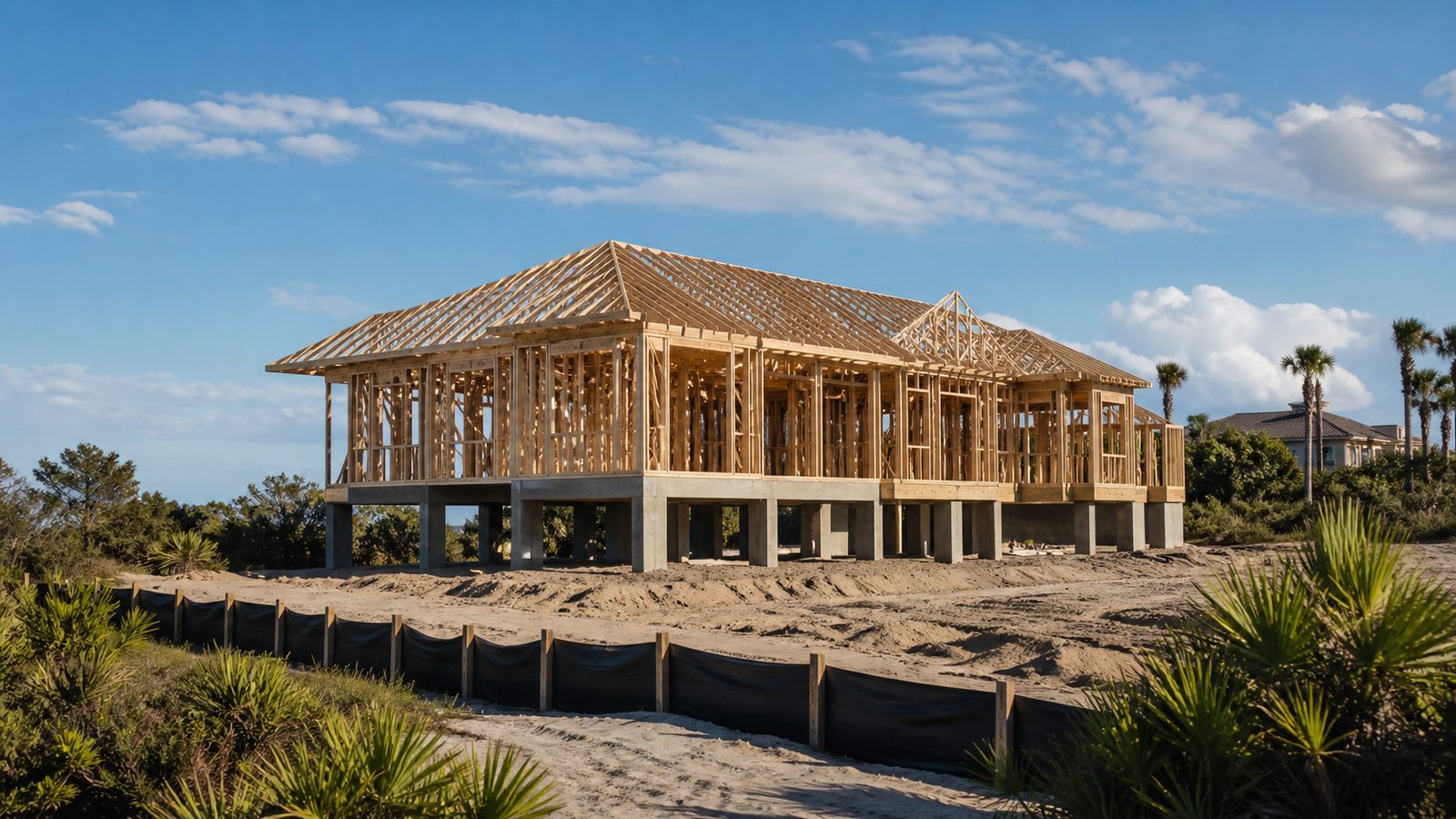
Why Framing Is the Critical Path in a Custom Home Build
Framing is the structural skeleton of a wood-frame home: the wall studs, floor joists, roof rafters or trusses, headers over openings, and sheathing that ties the structure together. In Northeast Florida, wood-frame construction dominates residential builds. The Florida Building Code requires framing to meet specific wind-load uplift requirements — 130 mph design wind speed in most of Duval County, higher in coastal flood zones.
Framing is the first major trade on a custom home after foundation. It's also the trade that every other trade installs around. Electricians chase framing cavities. Plumbers route supply and drain lines through framed bays. HVAC ducts run through framed chases. Insulation fills framed walls. Drywall covers framed surfaces. Cabinets anchor to framed walls. Finish trim wraps framed openings.
If the framing is plumb (perfectly vertical), square (90-degree corners true), and level (horizontal planes flat), every downstream trade installs cleanly. If it's not, every downstream trade compensates — and the compensations show up in the finished product.
What "Out of Tolerance" Framing Costs You
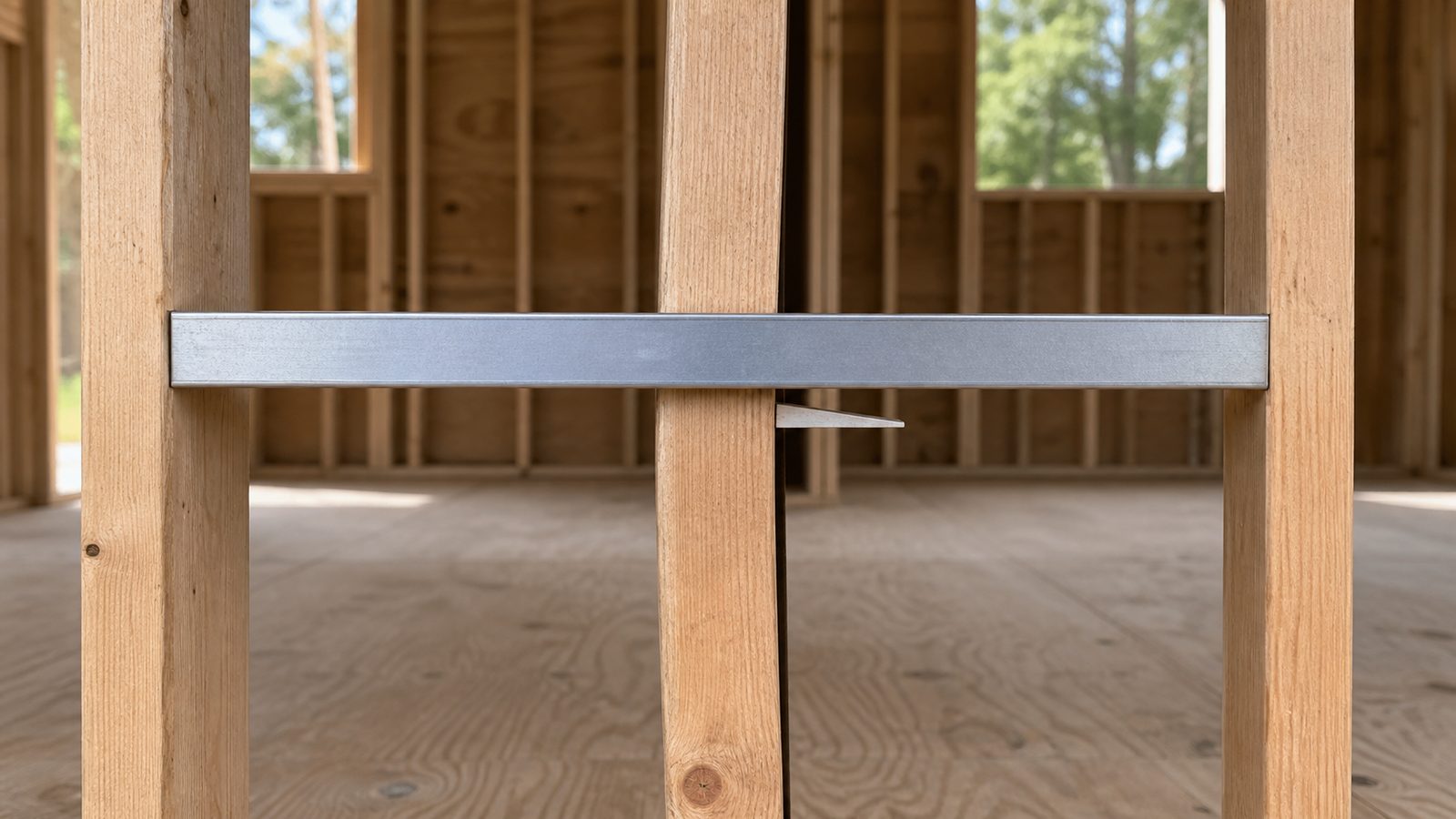
A wall stud that bows a half inch mid-span pushes the drywall surface out. The taper fixes it with extra mud, which cracks differently as the home settles. Cabinet installers shim to hit a wall that isn't flat, which puts cabinet faces out of plane. Tile setters fight a floor that isn't level across the span. Doors and windows bind in frames that aren't square.
None of this is catastrophic — houses get built with tolerance issues all the time. But every compensation adds labor, adds material, and adds time. In a fixed-price contract, those compensations are the builder's problem. In a cost-plus or allowance contract, they become the owner's problem through change orders.
Why Most GCs Broker Framing Out
The economics of custom home construction in Jacksonville push most GCs toward brokered framing. A framing crew is a significant labor and equipment commitment. Maintaining one full-time means payroll, workers' compensation insurance, tool inventory, and scheduling continuity between projects. It's easier and cheaper — at the GC level — to call a framing subcontractor when needed and release them when the frame is closed in.
The problem isn't that subcontracted framers are unskilled. Many are excellent. The problem is accountability structure. A brokered framing crew answers to their own company, not to the GC. Their incentive is to move fast and get to the next job. The GC's superintendent can flag deficiencies, but they have limited leverage over an outside company's workforce. And once the frame is closed in — once drywall is hung — there is no going back.
At JK Prestige, our framing crew answers to a JK principal. Daily. They know the frame will be inspected by the same person who signed the contract with the homeowner. That accountability structure produces different behavior on the jobsite — not because our crews are different people, but because the incentive is aligned differently.
What OSHA 30 Means on a Framing Crew
All JK supervisors carry OSHA 30 certification. OSHA 30 is a 30-hour training program covering hazard recognition, fall protection, scaffolding, electrical safety, and struck-by hazards — the leading causes of construction fatalities.
For a framing crew specifically, fall protection matters. Framing involves working at elevation: setting ridge beams, installing roof sheathing, walking top plates. OSHA 30-trained supervisors run documented toolbox talks, require fall arrest systems at the appropriate heights, and maintain written Job Safety Analyses (JSA) for non-routine tasks.
This isn't just about safety records. It's about who you're letting build your home. An OSHA 30 supervisor documents what happens on the jobsite. That documentation is part of the project record.
How Self-Perform Framing Affects Schedule
Brokered framing crews are scheduled around their own backlog. If another GC needs them for a larger job the week your frame is scheduled to start, you're waiting. That's not unusual — it's how the subcontract market works.
When JK Prestige schedules a frame start, our crew is allocated. The schedule doesn't depend on a subcontractor's availability or their competing commitments. That matters in Jacksonville's construction market, where trade labor is genuinely constrained. See our project portfolio — schedule reliability across complex projects starts with controlling the critical path.
The Relationship Between Framing and Finish Carpentry
At JK Prestige, the same trade accountability extends to finish carpentry — the trim, millwork, built-ins, and architectural details that are visible in a finished home. We self-perform finish carpentry as well as framing. That matters because finish carpentry installs against the framed surfaces. When the same company does both, the finish carpenter knows what the framing crew did. They're not inheriting a mystery.
Most GCs broker finish carpentry the same way they broker framing. JK doesn't. The connection between structural accuracy and finish quality is direct, and it shows in the finished product.
What to Ask Your Builder About Framing
Before signing a contract with any custom home builder in Jacksonville, these questions produce useful information:
- Who frames the house — your own crew or a subcontractor?
- If a sub, who manages their daily schedule and quality?
- What is the GC's process if framing deficiencies are identified after close-in?
- Are framing supervisors OSHA 30 certified?
- Can you provide references for a completed custom home where the frame can be inspected or discussed?
The answers tell you a lot about how the rest of the project will run. A builder who brokers framing will also broker the trades that install around the frame. Each handoff is another point where accountability diffuses.
The JK Way documents how principal-led project management and self-perform trades work together on a JK project. It's not a marketing document — it's the operating model.
What This Looks Like on a JK Prestige Custom Home
On a JK Prestige custom home in Jacksonville, the framing crew mobilizes on JK's schedule. A JK principal walks the frame at each stage — sill plate, first-floor wall framing, second-floor deck, second-floor framing, roof structure. Deficiencies are corrected before the next stage begins, not after the house is framed out.
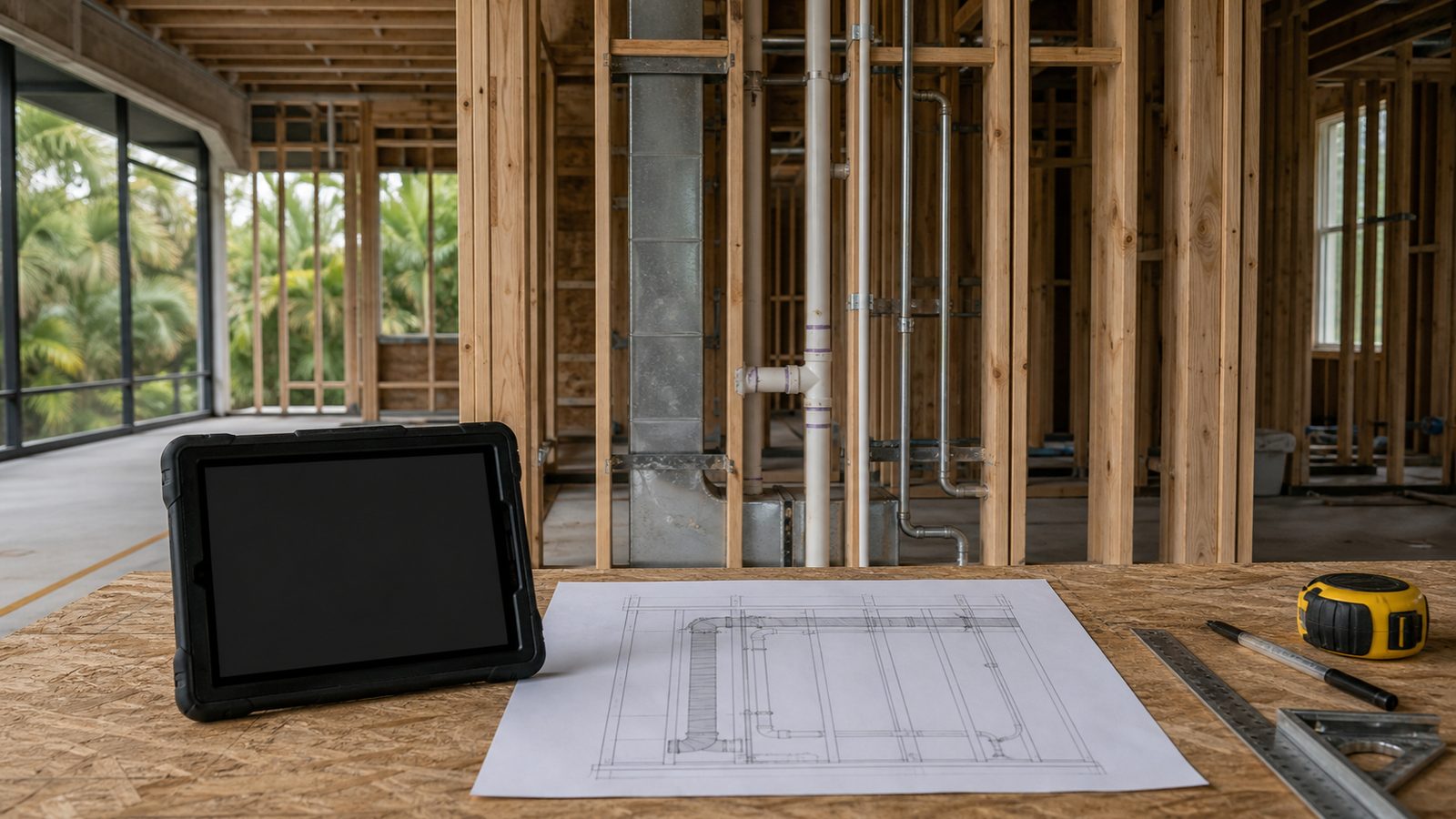
Building Information Modeling (BIM) is used on all projects over $2M. The framing crew arrives with model-to-field tablets showing exactly what goes where. There is no ambiguity about header sizing, beam pockets, or backing requirements for plumbing and electrical. The model coordination happens before the wood is cut.
For a custom home in Jacksonville, this level of framing control is the foundation — literally and structurally — for everything that follows.
Get a written custom home estimate in 48 hours. contact JK Prestige Constructor. A principal answers, not a coordinator.
No call center. No coordinator. A JK principal reviews every inquiry and replies with a real number, not a range, not a follow-up form.
Request Free Estimate →