Replacing a Florida roof is a $15,000 to $40,000 decision depending on the square footage, pitch, and material. The most common pivot point is this: do you replace like-for-like with asphalt shingles, or do you step up to metal?
Both are valid answers. Neither is universally correct. What is incorrect is making the decision based on upfront cost alone — or based on the assumption that shingles are the default and metal is the upgrade. In Jacksonville's climate, the performance profiles of the two materials diverge significantly over time, and the economics of that divergence need to be part of the conversation.
JK Prestige installs both. This is an honest comparison of what each system actually delivers in NE Florida's heat, humidity, and hurricane season.
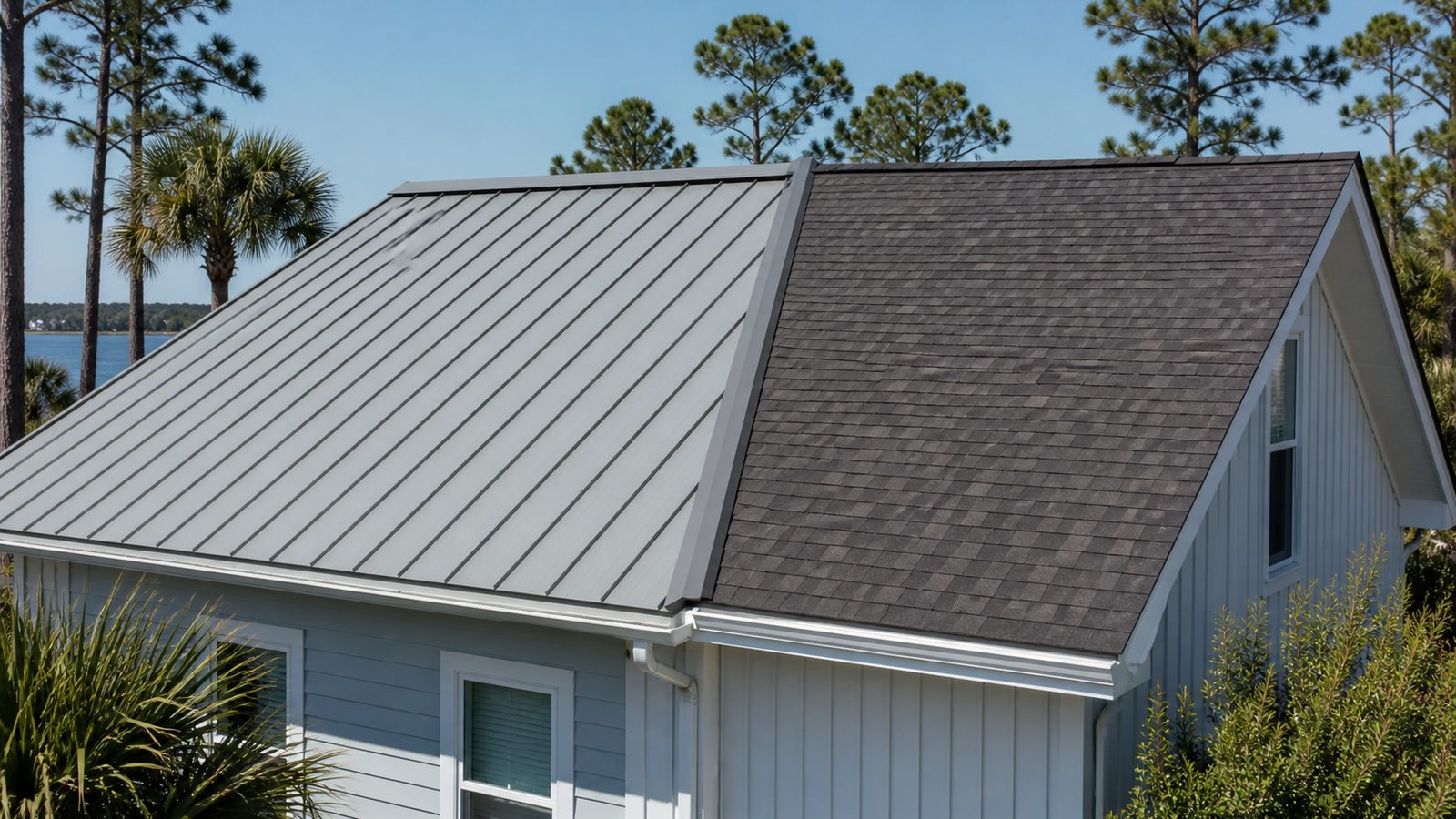
Lifespan: The Foundational Difference
The most important variable in any roofing decision is how long the material lasts in your specific climate — not the manufacturer's marketing claim, but realistic field performance under Florida conditions.
Asphalt Shingles in Florida
GAF Timberline HDZ — the dominant premium asphalt shingle in the residential market — carries a Lifetime limited warranty for the original owner on a GAF-certified installation. That warranty covers manufacturing defects. Florida's climate will not honor it.
Here is the practical reality: asphalt shingles in Florida degrade faster than in northern climates because UV exposure is more intense, temperatures cycle between 45°F winter nights and 95°F summer days, and humidity accelerates granule adhesive degradation. A well-installed 30-year architectural shingle (the old classification for what is now marketed as Lifetime) realistically delivers 20 to 25 years in Jacksonville before it requires replacement — not a defect warranty claim, but functional end-of-life.
At 15 years, a quality asphalt roof in good condition shows granule loss in high-traffic areas (valleys, ridgelines), some brittleness in the older shingles, and sealant that is beginning to harden. It is not failing, but it is in its second half.
Metal Roofing in Florida
Standing seam metal — the system JK installs for residential metal roofing — has a realistic service life of 40 to 70 years in Florida's climate. The durability drivers are straightforward: metal does not absorb moisture, does not granule-shed, and does not become brittle with UV exposure. Galvalume-coated steel and aluminum standing seam panels are the two primary substrate choices; aluminum costs more but eliminates any corrosion risk in coastal environments.
A metal roof installed on a Jacksonville home today will outlast the homeowner's likely ownership period. At 15 years, a well-installed standing seam metal roof is in its early middle age — no material deterioration, same wind resistance as day one, paint fading that is aesthetic rather than functional.
The lifespan comparison is not subtle: 20-25 years vs. 40-70 years. On a home that the owner intends to hold for 30 years, that means one shingle replacement cycle vs. zero metal replacement cycles over the same period.
Wind Resistance: Florida Building Code and Real-World Performance
Florida Building Code Requirements
Florida Building Code (FBC) sets minimum wind resistance requirements by jurisdiction and wind zone. Jacksonville (Duval County) falls in the 130-mph design speed zone under ASCE 7-22 for most residential applications. Both asphalt shingles and metal roofing can meet this requirement — but they do so differently.
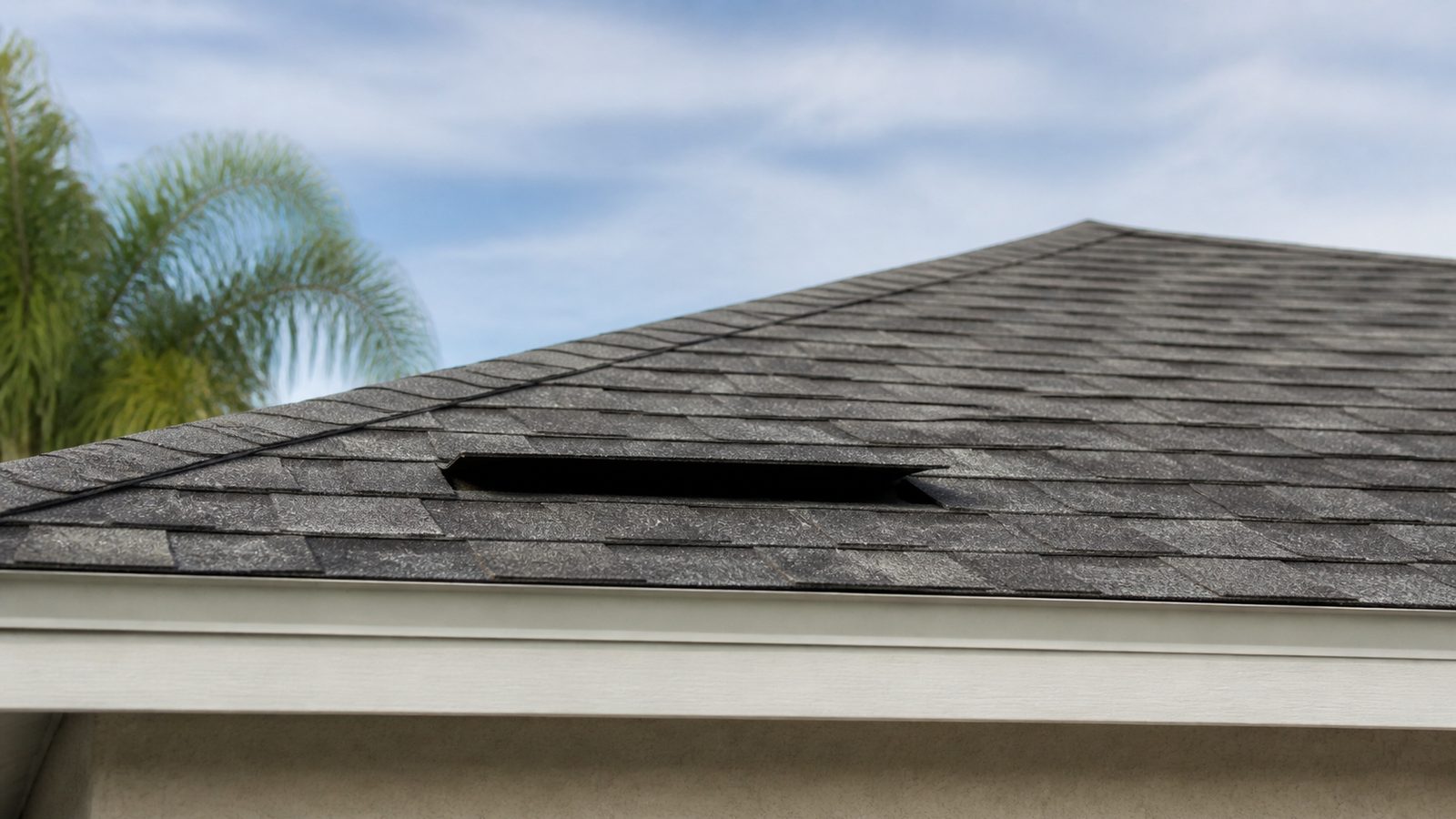
Asphalt shingles: Wind resistance is achieved through the adhesive strip on each shingle's underside plus the fastener pattern. GAF Timberline HDZ carries a Class F wind rating at 110 mph under standard installation, and 130 mph under the High Wind installation specification (six nails per shingle, enhanced starter strip). To achieve the enhanced rating, the installer must follow GAF's specific enhanced fastening pattern — many do not, which means the installed wind resistance is lower than the product's rated capacity.
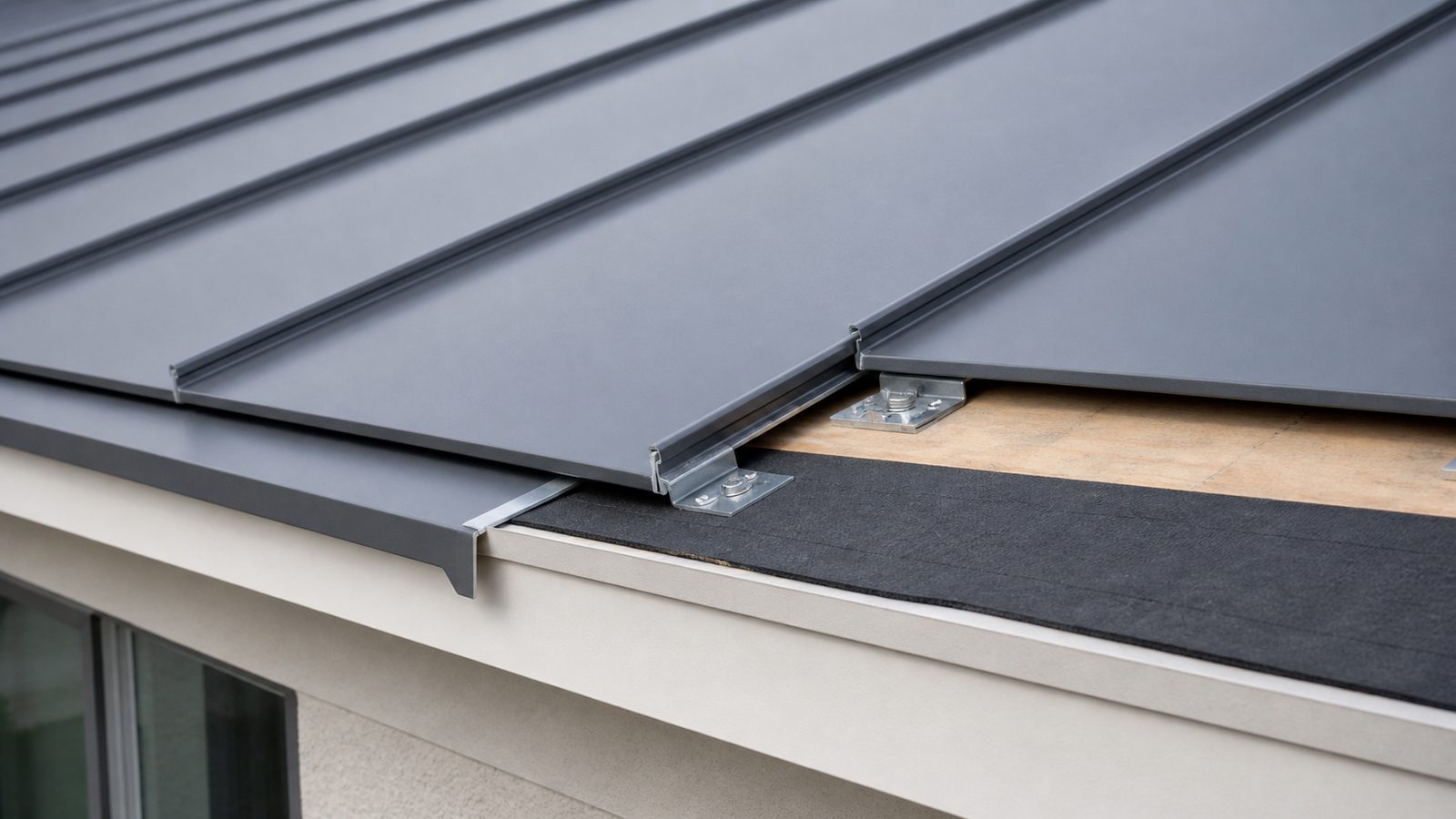
Standing seam metal: Wind resistance is structural. The panel lock — the mechanical seam between adjacent panels — creates a continuous structural connection across the full roof plane. Standing seam systems rated for hurricane zones are tested under Florida Product Approval (FPA) at 160 mph and above. The panels are not relying on adhesive strips that age and harden. JK installs standing seam systems with documented FPA listings for Jacksonville's wind zone.
At 15 years, the shingle adhesive has degraded. The metal seam has not.
Heat Reflectivity and Energy Impact
Florida has a critical energy code requirement for residential roofing: roofs must meet minimum Solar Reflectance Index (SRI) or prescriptive R-value requirements under Florida Building Code, Energy section.
Asphalt shingles: Standard architectural shingles absorb a significant portion of solar radiation. Dark-colored shingles can reach surface temperatures of 160°F to 190°F on a Jacksonville summer afternoon. Some manufacturers offer "Cool Roof" rated shingles — GAF's Timberline Cool Series — with higher initial reflectance, but reflectance degrades as granules wear and algae establishes. Florida requires regular energy testing; aged shingles often fall below rated performance.
Metal roofing: Bare galvalume or factory-applied Kynar paint finishes maintain reflectance well over time because the surface chemistry does not degrade the same way asphalt granule adhesive does. Metal roofs with light-colored finishes reflect 65-75% of solar radiation. The air gap in a standing seam installation (panels are not directly adhered to the deck) provides an additional thermal barrier. Homeowners with standing seam metal roofs in Jacksonville consistently report cooling energy reductions of 20-25% versus their prior asphalt roofs. Those are real numbers from real utility comparisons, not manufacturer claims.
Florida Code Requirements Specific to Metal Roofing
Metal roofing in Florida requires Florida Product Approval (FPA) for the specific panel, fastener system, and substrate combination. This is not a generic material approval — it is product-specific and installation-specific. JK Prestige installs only FPA-listed metal roofing systems, and all installations are permitted and inspected by Duval County Building Inspection.
Key code considerations:
- Panel gauge and substrate: Minimum 26-gauge Galvalume or equivalent. Aluminum must be minimum .032-inch thickness.
- Fastener spacing: FPA listing specifies fastener schedule for the designated wind zone. Do not accept a metal roof installation that deviates from the FPA-listed schedule.
- Drip edge and underlayment: Florida requires specific underlayment systems under metal — self-adhering modified bitumen (peel-and-stick) at eaves and valleys, synthetic underlayment or additional modified bitumen over the full field.
- Expansion and contraction detailing: Metal expands and contracts with temperature. Improperly designed flashings and terminations will open gaps as panels move. JK uses FPA-listed trim and flashing systems that accommodate the thermal movement specified for Florida's temperature range.
Cost Comparison: Upfront vs. Lifetime
On a 2,000-square-foot Jacksonville home with a simple gable roof:
Asphalt shingle replacement (GAF Timberline HDZ, Master Elite installation):
- $15,000 to $22,000 installed
- Expected next replacement: 20 to 25 years
Standing seam metal installation:
- $28,000 to $42,000 installed (varies by panel type, aluminum vs. steel, complexity)
- Expected next replacement: 40 to 70 years (likely none within owner's horizon)
The metal premium over shingles is typically $13,000 to $20,000 on a simple residential roof. Over a 40-year ownership horizon, that premium eliminates one full shingle replacement cycle (valued at $20,000-$28,000 in today's dollars, higher in future dollars accounting for inflation). The lifecycle cost of metal is often lower than two rounds of asphalt shingles, before energy savings are considered.
This is not a universal argument for metal. If the owner is selling in five years, the metal premium does not fully recover in resale. If the budget ceiling is $20,000, shingles are the answer. These are honest inputs, not upsells.
Insurance Discounts for Metal Roofing
Florida homeowners' insurance companies offer meaningful premium discounts for metal roofing in wind-rated applications. The logic is actuarial: metal roofs generate fewer claims after hurricanes. Discounts vary by carrier and policy, but Jacksonville homeowners with documented standing seam metal roofs and current Duval County permits have reported premium reductions of 20% to 35%.
To qualify, you typically need:
- A Florida Product Approval listing for your specific system
- A current roof permit and final inspection from Duval County
- The FPA number available for your carrier's underwriting review
JK Prestige provides all documentation needed for insurance discount applications as part of the standard project close-out package.
For context: on a $4,000-per-year homeowners' policy, a 25% premium reduction saves $1,000 per year, or $25,000 over 25 years. That more than closes the cost gap with asphalt shingles on many Jacksonville homes.
Which One Should You Choose?
If you are planning to own your Jacksonville home for more than 10 years: run the full lifecycle math, not just the installation quote. Metal costs more now and less over time.
If your budget is fixed at a shingle-comparable level: GAF Timberline HDZ, installed by a Master Elite contractor with the enhanced fastening pattern, is a solid roof. It is not a permanent roof. It is a 20-25-year roof in Florida's climate, and you should plan accordingly.
If your home is in a coastal or high-wind exposure area of Jacksonville: metal's structural wind resistance is a material advantage over adhesive-based shingle wind ratings, especially as the shingles age.
View past residential roofing work in the JK Prestige project portfolio — or learn more about how JK manages residential roofing projects from estimate through warranty.
Book Your Free 24-Point Roof Inspection
Not sure whether your current roof has another 5 years or needs replacement this season? JK Prestige's free 24-point roof inspection gives you a written condition report by section — ridge, valleys, field shingles, flashing, gutters, granule loss, penetrations — with no obligation and no pressure.
Book your free 24-point roof inspection or call (904) 944-0278. A principal answers.
No call center. No coordinator. A JK principal reviews every inquiry and replies with a real number, not a range, not a follow-up form.
Request Free Estimate →