Slate and cedar shake roofing represent the upper end of the residential roofing market in Jacksonville. Natural slate can last 75–150 years. Cedar shake carries a character that no synthetic product fully replicates. Both materials require knowledge that most roofing contractors in this market don't have — from structural implications to fire code compliance to HOA documentation.
If you're evaluating either system for a custom home, historic renovation, or premium replacement, this post gives you the real numbers on cost, lifespan, structural requirements, and what Florida Building Code actually says about each.
JK Prestige installs slate and cedar shake roofing in Jacksonville. Our own crews handle the installation — not a specialty subcontractor we've called in for one job.
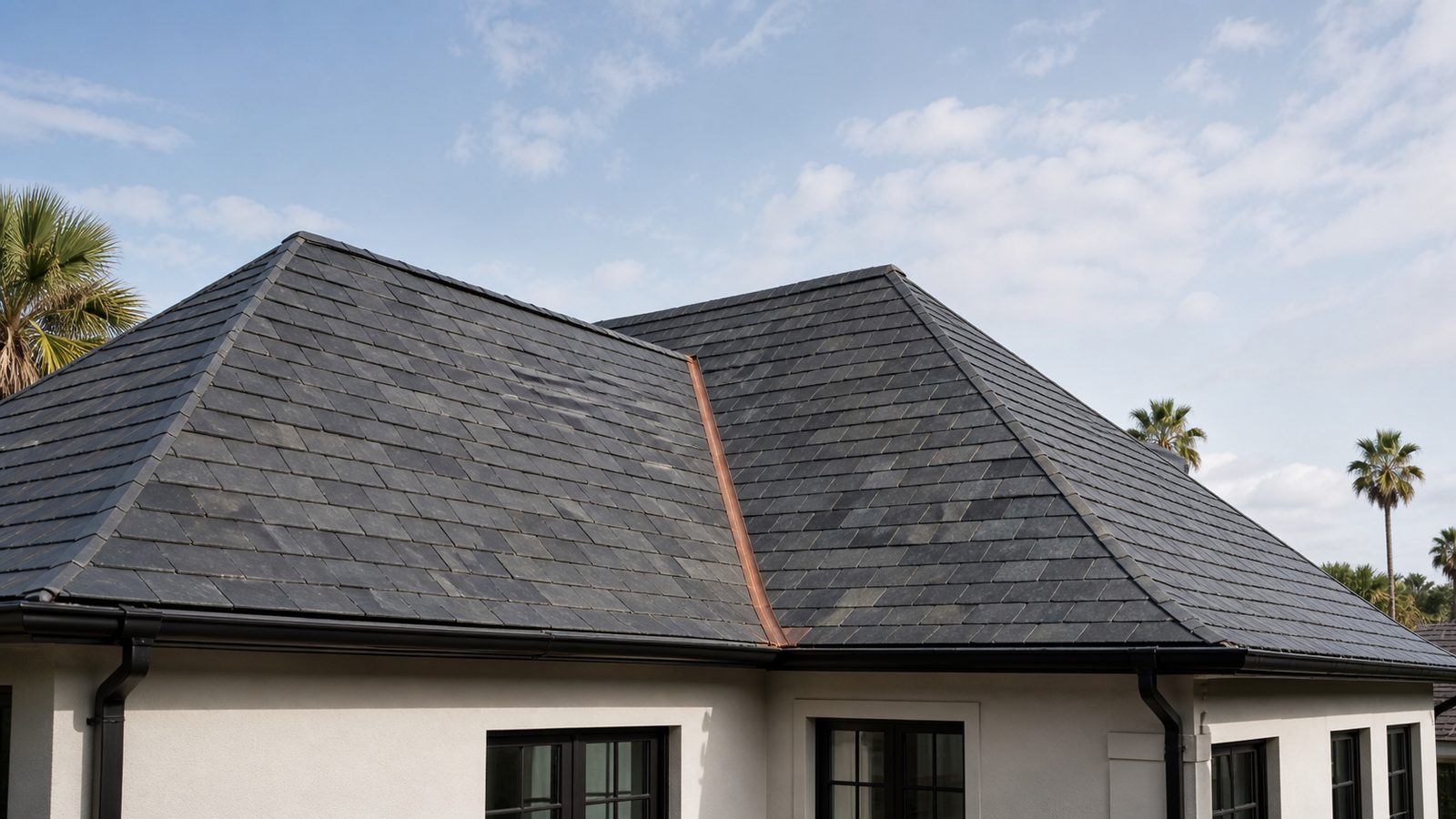
Natural Slate Roofing in Jacksonville
What Natural Slate Is
Natural slate is quarried stone, typically from Vermont, Pennsylvania, Virginia, or imported from Spain, Wales, or Brazil. It is split into shingles and installed on a steep-slope roof with copper or stainless steel nails (never galvanized — slate is acidic and galvanized fasteners corrode prematurely).
The primary distinction between natural slate products is hardness and expected lifespan:
- Soft slate (Virginia, New York): 50–125-year lifespan. Lower cost.
- Hard slate (Vermont, Pennsylvania): 75–150-year lifespan. Higher cost. More resistant to spalling.
In Jacksonville's subtropical climate, moisture cycling and occasional freeze events (rare but possible) are less of a concern than in northern markets. UV exposure and thermal expansion from Florida's heat are the primary weathering factors for slate here.
Natural Slate Cost in Jacksonville
Installed cost: $15–$30 per sqft, depending on slate origin, thickness, color, and pattern. The wide range reflects significant variables:
- Vermont hard slate commands $22–$30/sqft installed; soft Virginia slate runs $15–$20/sqft.
- Labor is a significant portion — slate installation is slow, requires specialized tools (slate hammer, ripper, stake cutter), and demands an experienced hand.
- Flashing must be copper or lead-coated copper on a natural slate roof. Galvanized or aluminum flashing has a significantly shorter lifespan than the slate itself, creating a maintenance problem within 20–30 years.
On a 2,500 sqft roof at $20/sqft average, a natural slate installation runs $50,000. That figure includes tear-off of existing roofing, structural modifications (see below), and copper flashing details. It does not include structural engineering fees if deck reinforcement is required.
Structural Implications: The Weight of Slate
This is the factor most homeowners don't anticipate until it's in writing from a structural engineer.
Natural slate weighs 8–10 lbs per sqft. Standard asphalt shingles weigh roughly 2–3 lbs per sqft. A 3,000 sqft slate roof installation adds 15,000–21,000 lbs of roofing material compared to shingles — roughly the weight of three to four pickup trucks distributed across the roof structure.
Before a natural slate quote is finalized, a structural engineer must assess:
- Rafter size and spacing
- Ridge beam capacity
- Wall top plate and header capacity at gable ends
On a custom home designed for slate from the ground up, this is already accounted for. On a renovation of an existing home, structural upgrades add $3,000–$15,000 depending on the scope of reinforcement required.
JK Prestige requires a structural engineering review as part of every slate roofing scope. We will not install natural slate without it — the liability and safety implications are straightforward.
Florida Building Code Requirements for Slate
FBC Chapter 15 treats slate as a Class A fire-rated material — no treatment required. Steep-slope requirements for Duval County apply:
- Minimum 4:12 pitch for most natural slate products (check manufacturer's installation instructions; some soft slates require 6:12 minimum)
- Underlayment: 30-pound felt or heavier; many slate manufacturers require a 40-lb felt or synthetic equivalent
- FBC wind uplift requirements apply; fastener specification and head lap must be designed for the wind zone
Hail resistance: Natural slate performs well against hail. Hard Vermont slate carries a Class 4 impact resistance rating under UL 2218. Hail damage on slate typically manifests as spalling or pitting rather than penetration — a damaged slate shingle can be replaced individually without disturbing adjacent shingles.
Synthetic Slate: An Alternative Worth Considering
Synthetic slate (polymer or composite) costs $8–$14 per sqft installed — roughly half the cost of natural slate. Products like DaVinci Roofscapes Bellaforte or CertainTeed Landmark Solaris are designed to replicate the visual profile of natural slate.
Key difference: synthetic slate weighs 1.5–3 lbs/sqft (comparable to asphalt shingles), which eliminates the structural reinforcement issue. Expected lifespan is 30–50 years — shorter than hard natural slate but longer than a standard architectural shingle installation.
For homeowners who want the look of slate without the structural and cost implications of natural stone, synthetic slate is a legitimate option. For a historic property where material authenticity matters, it isn't a substitute.
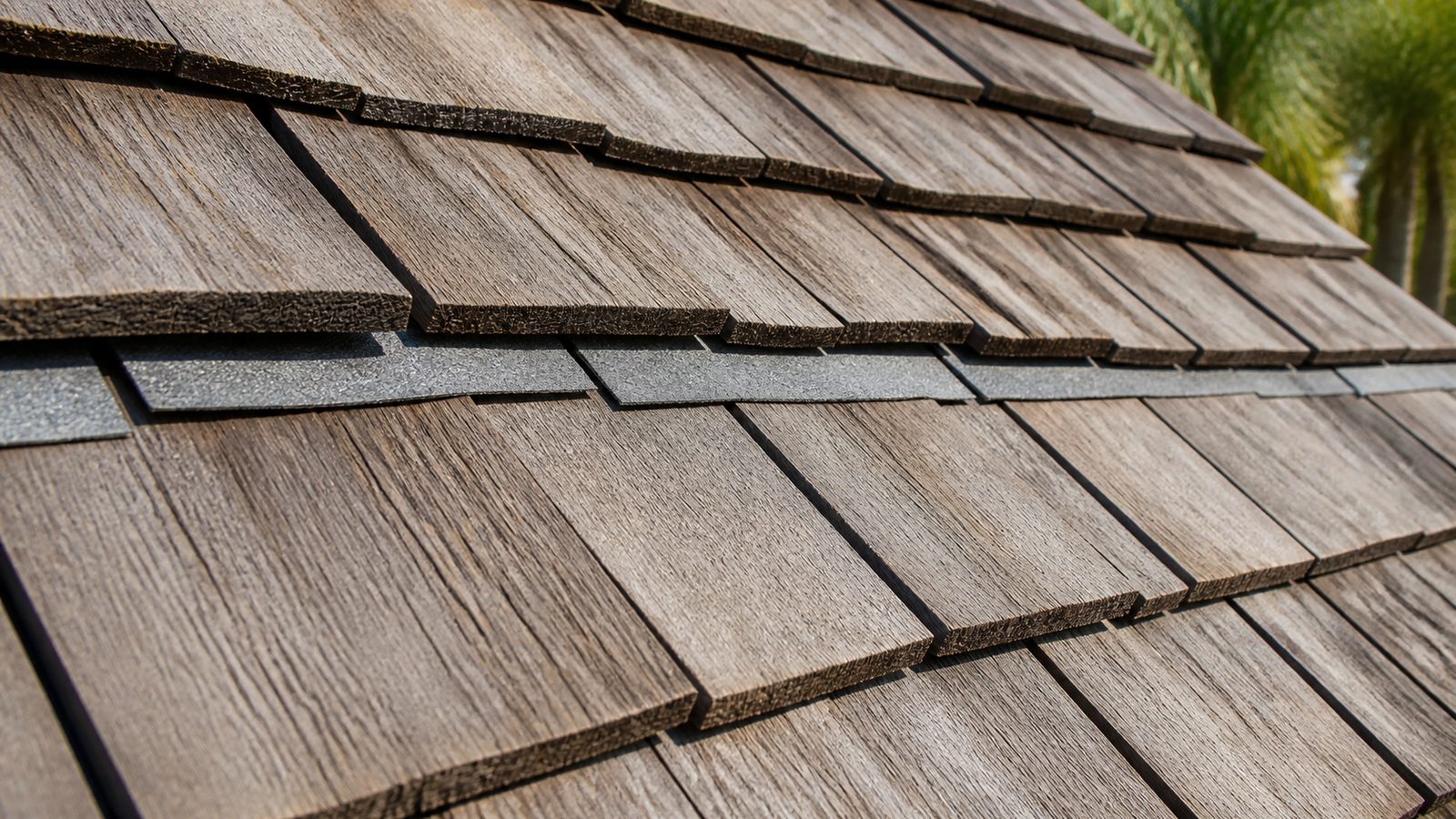
Cedar Shake Roofing in Jacksonville
What Cedar Shake Is
Cedar shake is split or sawn western red cedar installed as individual shingles on a steep-slope roof. The texture is rougher than a smooth cedar shingle — most shake is hand-split on the face with a sawn back, which creates the characteristic layered appearance.
Cedar shake has been used in residential construction for over a century. The natural oils in western red cedar provide inherent resistance to decay and insect damage. The material is visually distinctive in a way that no composite product fully replicates.
Florida Fire Code: Cedar Shake Requirements
Here is what most homeowners in Jacksonville don't know: untreated natural cedar shake is not permitted on new construction or replacement roofing in most Florida jurisdictions without fire retardant treatment.
Florida Building Code requires roofing materials on residential structures to meet Class B or Class A fire rating depending on the occupancy type. Untreated cedar shake is a Class C material by default. To use cedar shake in Florida, one of the following is required:
- Pressure-impregnated fire retardant treatment (FRTW — Fire Retardant Treated Wood): Treatment is applied at the mill, not in the field. The treatment is permanent and rated to meet Class A or Class B requirements. Look for ICC-Evaluation Service reports for the specific product.
- Class A fire-rated underlayment system: Some cedar shake products can achieve a Class A assembly rating when combined with a specific underlayment system (e.g., fire-rated foam, mineral-surface base sheet). This requires verification against the FBC and local AHJ (Authority Having Jurisdiction) approval.
JK Prestige specifies only FRTW cedar shake on Jacksonville installations. Field-applied fire retardant coatings are not an equivalent substitution and are not approved under FBC for meeting fire rating requirements.
Cedar Shake Cost in Jacksonville
Natural cedar shake (FRTW-treated): $10–$18 per sqft installed, depending on shake grade (No. 1 Blue Label hand-split is the premium specification), panel thickness, and installation complexity.
Synthetic cedar shake (composite or polymer): $7–$13 per sqft installed. Products like DaVinci Roofscapes or Brava Cedar Shake replicate the visual profile with 50-year lifespan ratings, Class A fire rating without treatment, and no maintenance concerns from organic decay. For homeowners in HOA communities where shake appearance is required but natural material maintenance is a concern, synthetic is often the practical choice.
Expected lifespan: Natural FRTW cedar shake: 20–30 years in Florida's climate. The fire retardant treatment slightly accelerates the weathering compared to untreated shake — UV and moisture cycling affect treated wood more than virgin cedar. Annual cleaning (no pressure washing) and periodic inspection of starter course and valley areas extend life toward 30 years.
HOA Considerations for Cedar Shake in Jacksonville
Several Jacksonville communities — particularly historic districts and higher-end planned communities — specify cedar shake (or cedar shake appearance) in their deed restrictions or architectural standards.
If your HOA requires cedar shake, get the specific language in writing before selecting material. Some restrictions specify "cedar shake or approved equivalent" — which may allow synthetic products that meet the visual standard. Others specify "natural cedar shake" explicitly.
JK Prestige can provide documentation for HOA architectural review committees — product samples, manufacturer specifications, fire rating certifications, and installation drawings. We carry this documentation as a standard part of our roofing scope package.
Slate vs. Cedar Shake: Side-by-Side
| Factor | Natural Slate | Cedar Shake (FRTW) |
|---|---|---|
| Installed cost | $15–$30/sqft | $10–$18/sqft |
| Expected lifespan | 75–150 years | 20–30 years |
| Weight | 8–10 lbs/sqft | 2–3 lbs/sqft |
| Fire rating | Class A (inherent) | Class A (requires FRTW treatment) |
| Maintenance | Low (individual tile replacement) | Moderate (cleaning, inspection) |
| Structural requirement | Engineering review required | Standard framing typically adequate |
| HOA appeal | High (historic authenticity) | High (visual texture) |
What to Verify Before Hiring a Roofing Contractor for Either Material
Slate and cedar shake require specific skills that most Jacksonville roofing contractors don't maintain. Before hiring:
- Ask for specific project references — not general references, but slate or shake references from the past three years.
- Verify FRTW compliance — ask for the mill certificate from the cedar shake supplier showing the fire retardant treatment classification.
- Confirm structural review process — any contractor quoting natural slate without a structural review is skipping a critical step.
- Verify fastener specification — copper or stainless steel only on natural slate. Hot-dipped galvanized on shake.
- Review flashing material specification — copper flashing on slate; at minimum galvanized step flashing on shake (though copper is preferred).
See completed JK Prestige roofing projects before committing to a contractor selection.
Book a Free Inspection and Estimate
JK Prestige provides a free 24-point roof inspection for slate and cedar shake evaluations. The inspection includes structural assessment, material recommendation, and a written fixed-price estimate in 48 hours.
Book your free inspection or call (904) 944-0278. A principal answers — not a scheduling coordinator.
No call center. No coordinator. A JK principal reviews every inquiry and replies with a real number, not a range, not a follow-up form.
Request Free Estimate →