Most business owners signing a commercial lease in Jacksonville have never negotiated a tenant improvement (TI) allowance before. The landlord offers a dollar-per-square-foot number, the broker says it is market rate, and the tenant signs. Three months into construction, the owner discovers the TI allowance covers 60% of the actual build-out cost — and the balance is coming out of working capital.
This article explains what a tenant fit-out is, how TI allowances work, what the market rate looks like in Jacksonville in 2025, and how engaging a general contractor (GC) before you sign a lease protects you from the most common financial exposure in commercial construction.
What Is a Tenant Fit-Out?
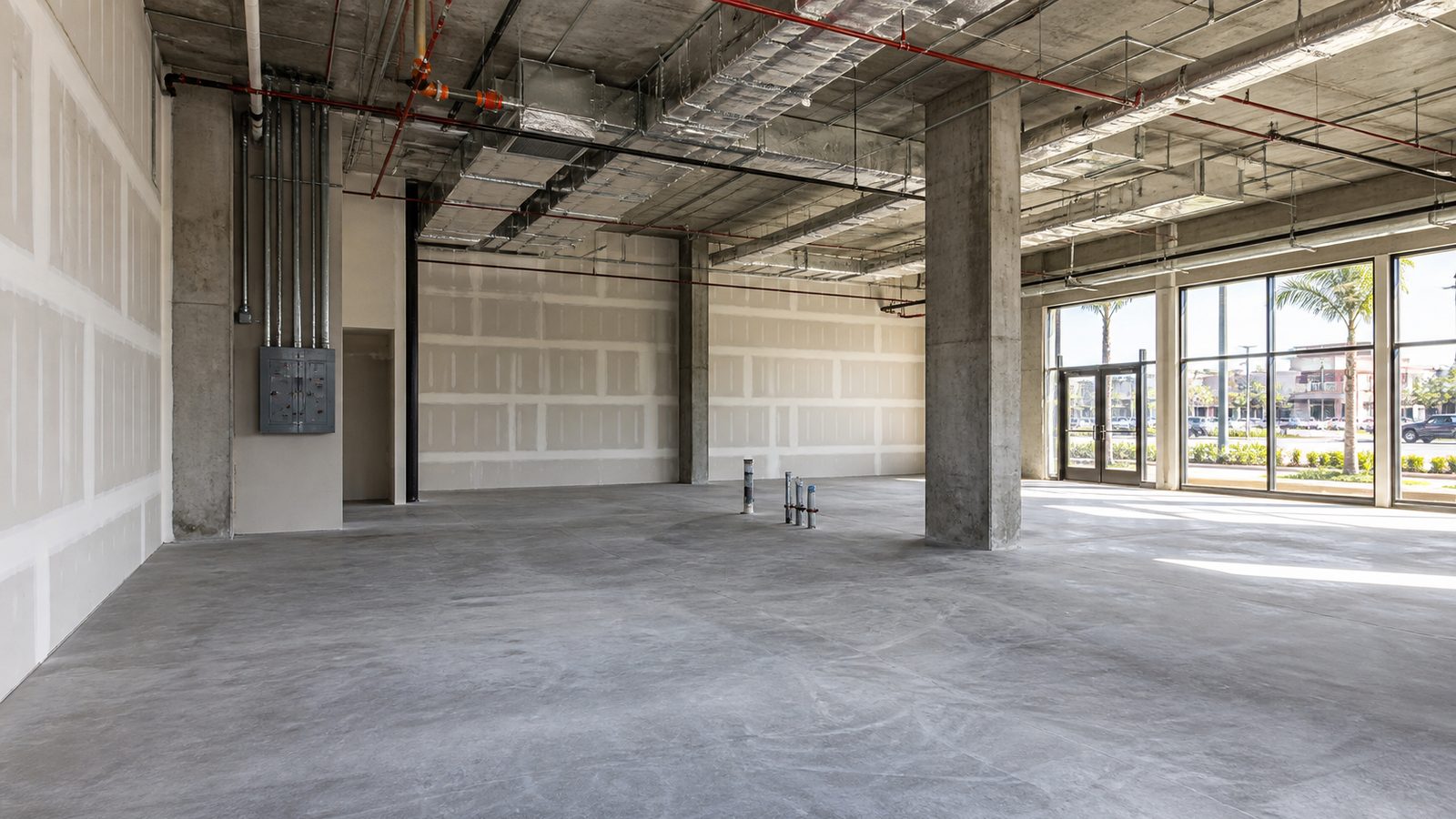
A tenant fit-out (also called a tenant improvement or TI) is the build-out of leased commercial space from its base condition to the tenant's operational standard. The space you are leasing is not the space you move into — there is a construction phase between them, and understanding who pays for that construction is the most important financial question in your lease.
The fit-out scope depends entirely on what condition the space is delivered in. Three delivery conditions are standard in Florida commercial real estate:
Shell Condition
A shell space is the building without interior finishes. You get:
- Concrete slab (or subflooring)
- Exterior walls and roof
- Rough MEP stubs at or near the space boundary — water, sewer, electrical panel location, HVAC supply and return rough-in to the floor or ceiling
- Unfinished interior (exposed structure, no partitions, no ceiling)
Shell delivery is common in new construction and in multi-tenant industrial or flex buildings. Moving from shell to finished tenant space requires framing, drywall, ceilings, MEP distribution, lighting, restrooms, finishes — the full construction sequence.
Vanilla Box
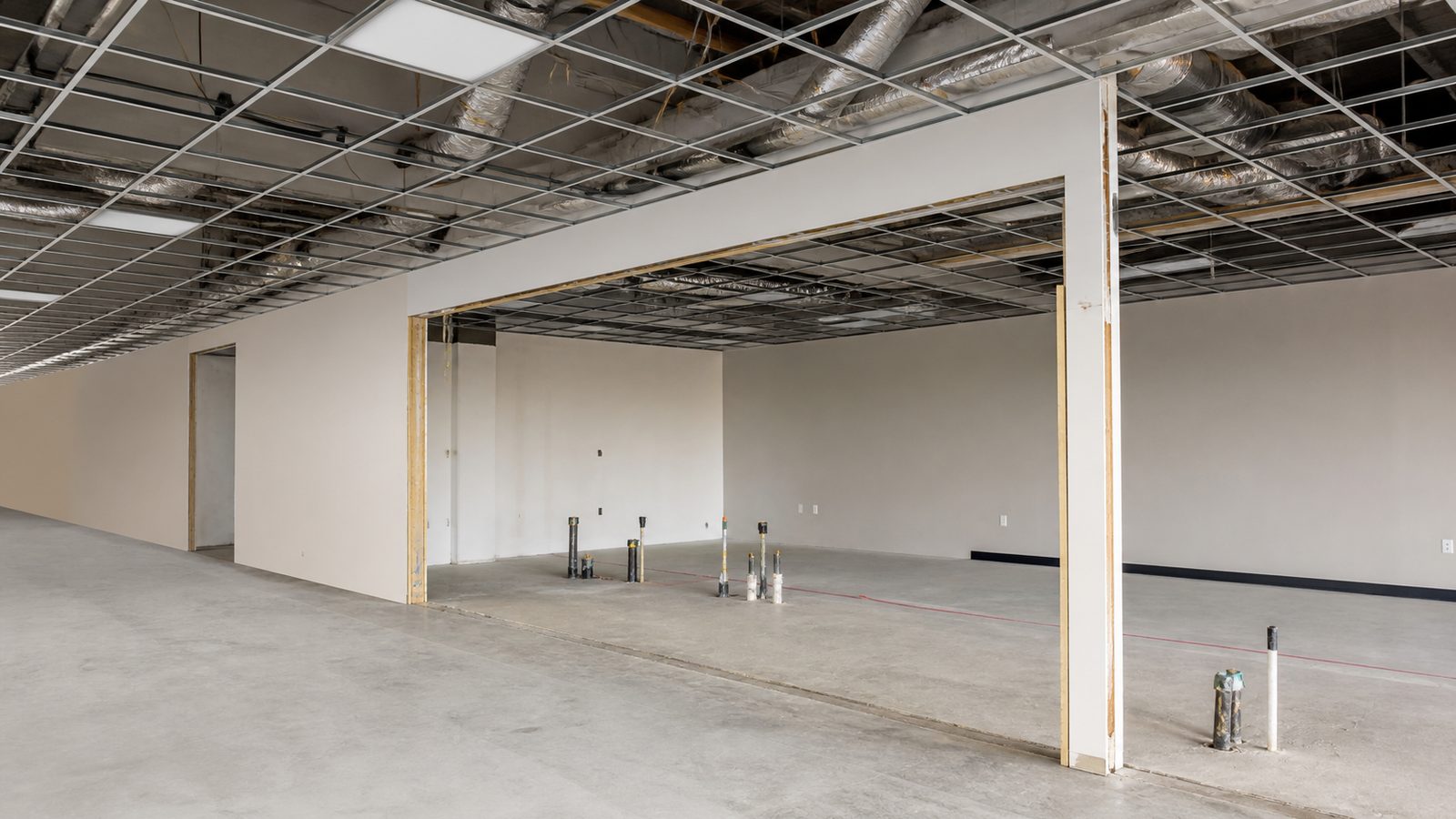
A vanilla box adds a layer of base improvements over shell:
- Interior partitions defining the demised space
- Suspended ceiling grid (typically with basic fluorescent or LED lighting)
- Finished concrete or basic tile flooring
- ADA-compliant restrooms
- HVAC distribution to a standard configuration
- Electrical panels energized with basic circuits
A vanilla box reduces the tenant's fit-out scope to tenant-specific improvements: specialty walls, branding, millwork, upgraded lighting, specialty MEP for kitchen or lab use, and the finishes that make the space reflect the tenant's operation.
Turnkey Delivery
A turnkey delivery means the landlord builds the space to a standard agreed with the tenant — the tenant receives a space they can occupy immediately. In practice, true turnkey delivery is uncommon except in strong tenant markets where landlords are competing aggressively for anchor tenants. When it does occur, the landlord's GC builds to a tenant-approved specification, and any deviation from that specification is either a landlord cost or a change order to the tenant.
How TI Allowances Work
A TI allowance is the landlord's contribution to the tenant's fit-out cost, expressed as a dollar amount per square foot of leased area. The landlord funds the allowance, typically by reimbursing the tenant (or paying the GC directly) for invoiced construction costs up to the agreed cap.
Example: a tenant leases 4,000 sqft in a Jacksonville office building with a $45/sqft TI allowance. The landlord funds up to $180,000 in construction costs. If the actual fit-out costs $220,000, the tenant pays the $40,000 overage.
What TI Allowances Cover (and What They Don't)
A TI allowance generally covers base building items: structural and MEP work that becomes part of the building, hard construction costs, GC fee, permit fees. Items typically excluded from TI allowance coverage:
- Furniture, fixtures, and equipment (FF&E)
- Signage
- Tenant's own security system
- Moving costs
- IT and data cabling (sometimes excluded; negotiate this explicitly)
- Specialty equipment (kitchen equipment, medical equipment)
Read your lease carefully — TI allowance coverage language varies. Some landlords limit the allowance to "hard costs only" or "structural improvements only." Others include all permit-ready construction. Negotiate the definition before you sign.
Jacksonville TI Allowance Market Rate in 2025
In Jacksonville, TI allowances for commercial office and retail space range from approximately $30–60 per sqft depending on:
- Lease term length: A five-year lease gets a lower allowance than a ten-year lease. Landlords amortize TI spend over the lease term.
- Tenant credit quality: A national credit tenant with a balance sheet the landlord can underwrite gets more TI than a startup.
- Space condition: A vanilla box starting point requires less TI than a shell.
- Market conditions: In a tight market (low vacancy), landlords negotiate harder. In a soft market, TI allowances increase.
A 4,000 sqft commercial office fit-out in Jacksonville currently runs $65–95 per sqft for a standard spec (good finishes, basic MEP, no specialty systems). At a $45/sqft TI allowance, the typical tenant is funding $20–50 per sqft out of pocket — $80,000–200,000 on a 4,000 sqft space.
What a GC Does for You Before You Sign
Engaging a GC before signing a lease is not standard practice. It should be. A GC who walks the space before lease execution can tell you:
Actual fit-out cost estimate: Not a broker's rule-of-thumb, but a line-item estimate based on the actual space condition, the landlord's delivery specification, and your program requirements. This tells you whether the TI allowance covers your actual cost — before you sign.
What the landlord's delivery standard leaves out: A vanilla box may look complete, but the HVAC distribution might not support your occupancy load, or the electrical panel might be too small for your equipment. A GC identifies the gaps between the landlord's stated delivery and what your operation actually requires.
Long-lead items that affect lease commencement: If your fit-out requires special MEP (commercial kitchen equipment, medical gas, dental chairs), lead times affect when you can open. A GC can advise on whether the proposed lease commencement date is realistic given construction and permit timelines.
Negotiation leverage: Walking into a TI allowance negotiation with a GC's cost estimate gives you specific numbers — not the broker's generalizations. If the GC's estimate shows the allowance covers 70% of actual cost, you negotiate the allowance up or the landlord's delivery scope up. Either way, you're not discovering the gap after construction starts.
Learn more about JK Prestige's commercial construction approach and the JK Way fixed-price process.
Common TI Allowance Mistakes Florida Tenants Make
Signing without a GC estimate: The allowance sounds reasonable until construction is underway. A pre-lease GC estimate costs nothing and prevents a six-figure surprise.
Accepting landlord's contractor without a competing bid: Some leases require the tenant to use the landlord's approved GC. Others allow the tenant to select their own GC. If you can choose, get a competing bid. The landlord's GC has no incentive to control costs when the landlord is reimbursing them.
Not negotiating what happens to unused TI allowance: If your actual fit-out comes in under the TI allowance, what happens to the balance? Many leases let the landlord keep it. Negotiate to apply unused TI to first months' rent or receive it as a cash credit.
Not accounting for permit timeline in lease commencement: Commercial permits in Jacksonville take 30–45 days. If your lease commencement is 60 days from signing and construction takes 10–14 weeks, you're paying rent on a space you can't occupy for six to eight weeks. Negotiate a rent abatement or delayed commencement tied to permit issuance.
No call center. No coordinator. A JK principal reviews every inquiry and replies with a real number, not a range, not a follow-up form.
Request Free Estimate →