Fire suppression is not a finish item. On a warehouse project, the sprinkler system design drives fire line sizing from the utility stub, affects roof deck and insulation sequencing, determines minimum clearance requirements above stored goods, and has to be inspected and tested before you can get a certificate of occupancy. Get it wrong at design and you are doing change orders at rough-in. Here is how JK approaches it.
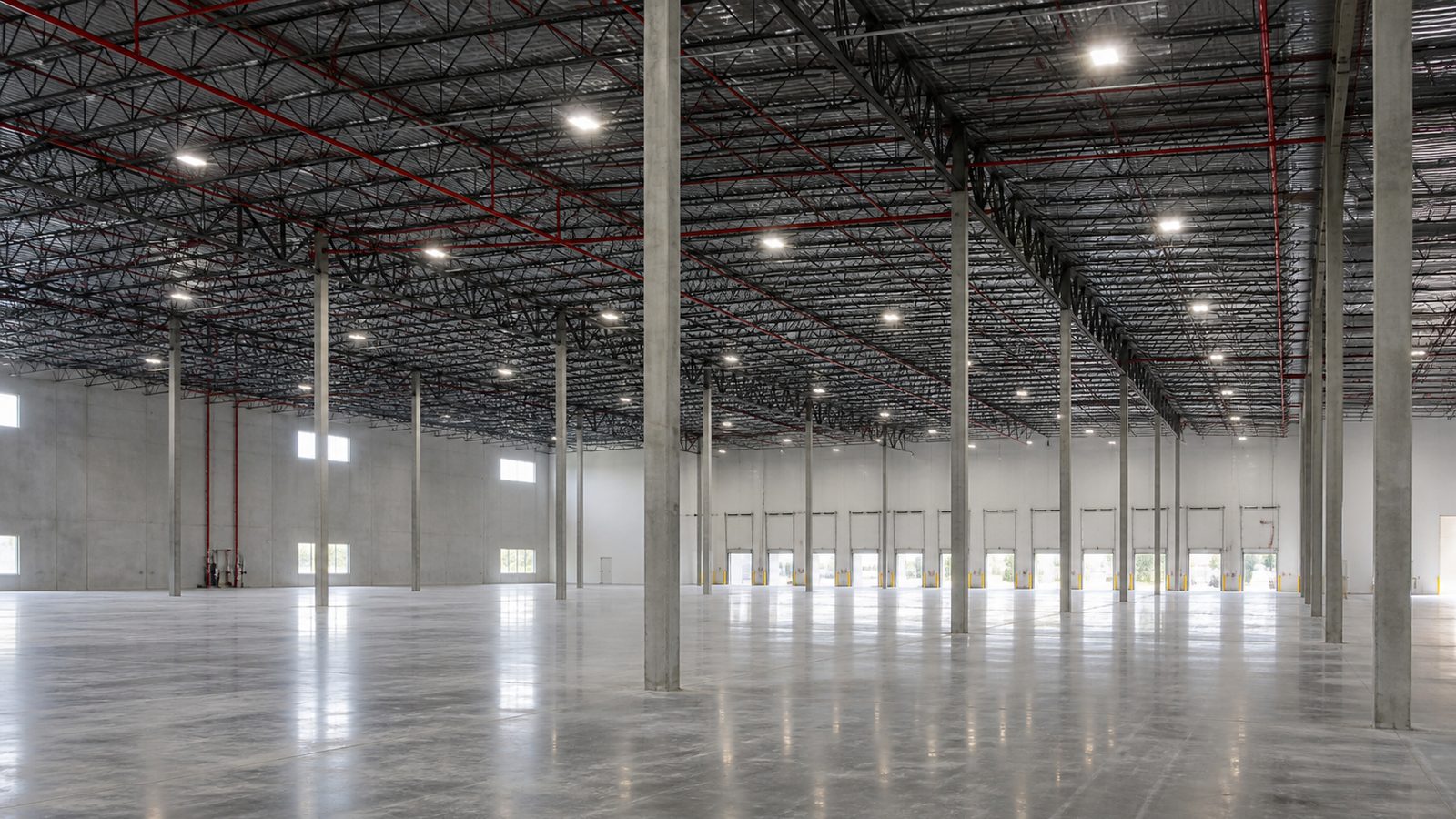
NFPA 13: The Standard That Governs Warehouse Sprinklers
NFPA 13 is the standard for installation of sprinkler systems. Florida adopts NFPA 13 by reference in the Florida Building Code. For warehouse occupancies, the critical question is commodity class and storage height — those two variables drive whether a standard wet-pipe system is adequate or whether you need ESFR or in-rack supplemental heads.
Commodity Classification
NFPA 13 classifies warehouse commodities from Class I through Class IV, plus plastics (cartoned, uncartoned, expanded). The classification determines the design density — gallons per minute per square foot — the system must deliver.
A distribution facility storing Class I goods (metal products, glass) at 20-foot storage height needs a different system than one storing Group A plastics (automotive parts, foam rubber) at the same height. Specifying the wrong commodity class at design leads to under-designed systems that fail AHJ approval.
Storage Height and Mode
NFPA 13 Table 17.3.2.1 (or equivalent depending on edition adopted) ties storage height to minimum sprinkler discharge density. Storage mode also matters:
- Solid pile or palletized storage — more forgiving of in-ceiling-only systems at lower heights
- Rack storage — once rack storage exceeds 12 feet, in-rack heads or ESFR may be required
Most modern distribution facilities use rack storage. That means ESFR in most Jacksonville spec warehouse projects.
ESFR Sprinkler Systems: How They Work
Early Suppression Fast Response (ESFR) sprinklers are k-factor 14 or k-factor 25 heads designed to suppress a fire at high rack storage heights — typically up to 35 feet of rack storage — using ceiling-level heads only. The advantage: no in-rack heads to damage with forklifts or replace when rack configurations change.
ESFR systems operate at higher pressure than standard wet-pipe — typically 50-75 psi at the head. That pressure requirement drives fire line sizing from the utility.
Fire Line Sizing: Where Most Projects Go Wrong
To achieve the required ESFR discharge pressure, the water supply must be adequate. The fire protection engineer performs a hydraulic analysis using the local utility's flow test data. If the available pressure and flow at the property line are insufficient, options include:
- Larger fire line from the utility main (cost: $40,000-120,000 depending on distance)
- On-site fire pump (cost: $80,000-180,000 installed including controller and test header)
- System redesign to reduce demand
This analysis happens at civil/site design phase, not during sprinkler rough-in. JK requires fire protection engineer involvement before permit submission so the fire line is sized correctly on the civil drawings.
In-Rack Sprinkler Systems
For facilities storing commodities that exceed ESFR system limits — high-challenge plastics, high-piled storage over 35 feet — in-rack supplemental heads are required. In-rack systems have advantages in some contexts:
- Lower ceiling-level demand, which may allow smaller fire line
- More precise suppression for specific rack configurations
Disadvantages:
- Must be coordinated with rack layout — changes to rack configuration may require sprinkler relocation and permit revision
- More heads, more piping, more maintenance
- Forklift damage to in-rack heads is a recurring maintenance cost
For spec warehouse buildings where the tenant's rack layout is unknown, ESFR ceiling-only systems are strongly preferred.

Coordination Points Between GC and Fire Protection Contractor
This is where warehouse fire suppression projects go sideways. The items the GC must coordinate with the fire protection sub:
Roof Deck and Insulation Sequencing
ESFR heads require a minimum distance from the deflector to the top of stored goods (typically 18 inches minimum, with specific clearance requirements per NFPA 13). The installed elevation of the head deflector is set by the pipe drop from the main, which is set by the deck elevation and insulation thickness.
If the insulation spec changes after the sprinkler layout is designed, head elevations change, which may affect compliance with clearance requirements. Change the insulation, tell the fire protection engineer.
Obstruction Clearance
NFPA 13 has specific rules about sprinkler head obstructions — beams, ducts, lights, and structural elements within 18-24 inches of head deflectors require additional heads or head relocation. Coordinate sprinkler layout with mechanical and electrical before permit submission.
Electrical for Fire Alarm and Tamper/Flow Devices
Sprinkler systems are monitored. Flow switches, tamper switches on control valves, and the fire alarm panel all require electrical rough-in. The GC coordinates the electrical sub's conduit rough-in with the fire protection pipe installation sequence.
Hydrostatic Testing Before Insulation
NFPA 13 requires a hydrostatic test at 200 psi for two hours before insulation is applied over piping above ceilings. The GC must schedule this test before ceiling or insulation installation — not after. Missing this sequence means cutting open completed ceilings for inspection access.
AHJ Inspection Process in Duval County
The authority having jurisdiction (AHJ) for fire suppression in Jacksonville is typically both the City of Jacksonville Fire Marshall's Office and the State Fire Marshal for commercial occupancies. Inspections required:
- Underground inspection — fire line from property line to building, including thrust blocks, before backfill
- Rough-in inspection — pipe installation before concealment, before hydrostatic test
- Hydrostatic test inspection — witnessed 200 psi / 2-hour test
- Final inspection — flush test, operational test, alarm verification, signage
Scheduling AHJ inspections in Duval County requires 48-72 hours advance notice minimum. JK builds inspection holds into the schedule so there is no wait for an inspector while crews stand idle.
Cost Ranges for Warehouse Sprinkler Systems
Jacksonville market pricing for fire suppression as a standalone contract (not including civil fire line):
- Standard wet-pipe, light hazard office: $4-7/sqft
- ESFR, warehouse occupancy, k-14 heads: $7-12/sqft
- ESFR, warehouse, k-25 high-challenge heads: $10-15/sqft
- In-rack supplemental system (add-on): $4-8/sqft of rack area
- Fire pump (if required): $80,000-180,000 installed
These numbers vary significantly with building size (economy of scale), system complexity, and current material pricing. JK includes fire suppression as a line item in the GMP with a qualified fire protection sub — owner sees the number in writing before ground breaks.
What JK Coordinates That Other GCs Miss
JK's pre-construction process requires the fire protection engineer to be engaged before permit submission, not during construction. That means:
- Fire line sized correctly on civil drawings
- Hydraulic analysis complete before permit
- Roof deck and insulation spec coordinated with head elevation requirements
- Obstruction clearance reviewed against structural and mechanical layouts
- AHJ pre-submittal meeting scheduled for complex occupancies before paying for permit drawings
This costs time in pre-construction. It saves weeks of change orders and re-inspections during construction.
No call center. No coordinator. A JK principal reviews every inquiry and replies with a real number, not a range, not a follow-up form.
Request Free Estimate →