An incomplete Request for Proposals (RFP) produces an unusable bid. When a warehouse developer issues an RFP that is missing survey data, unclear on delivery model, or silent on certification requirements, GCs fill the gaps with assumptions — and those assumptions generate change orders after contract award. The RFP is not a formality. It is the document that determines whether your bids are comparable and whether your contract protects you.
This article walks through every component a warehouse RFP must include when soliciting a Florida general contractor (GC), with specific language guidance for each section.
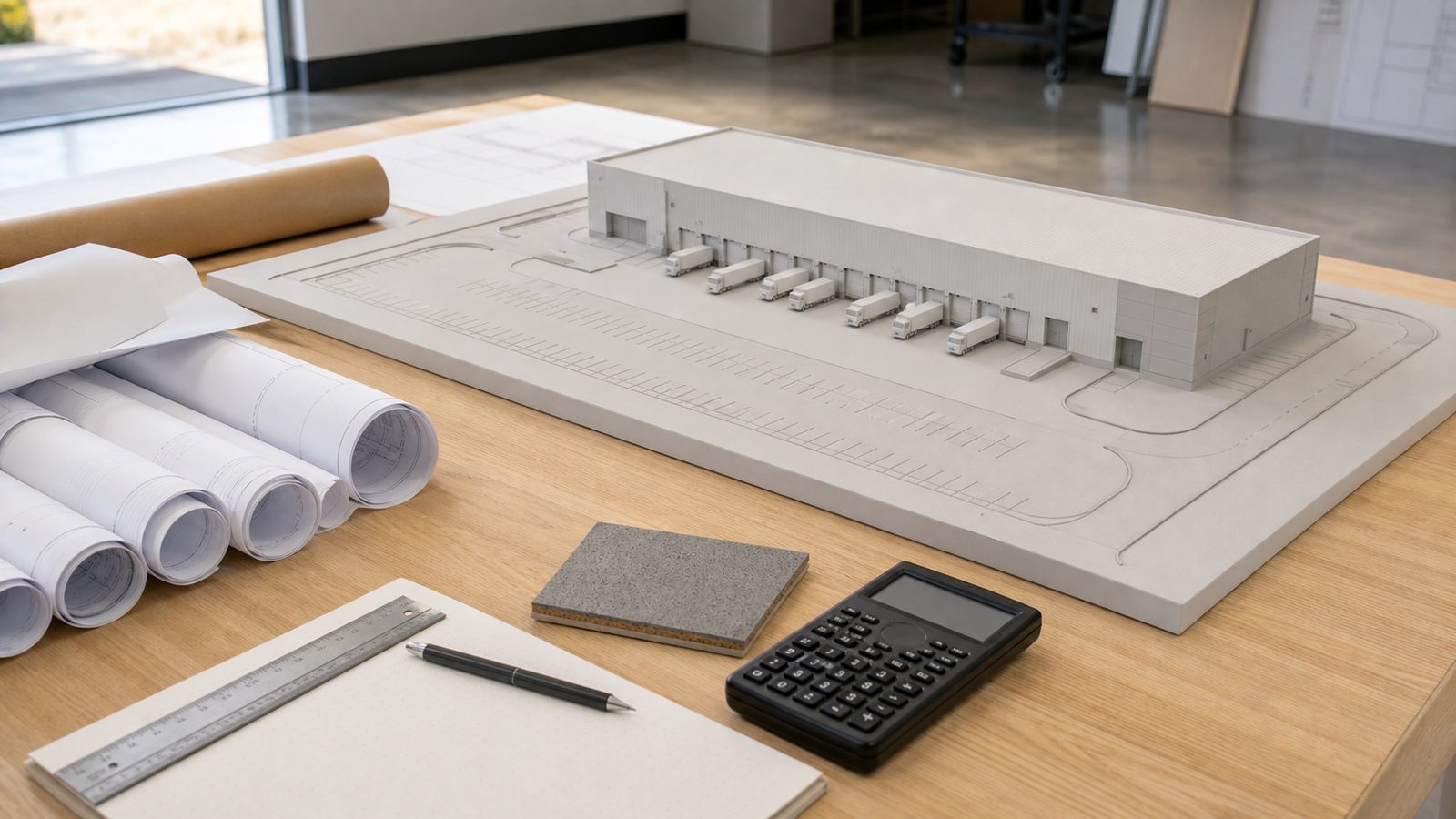
Section 1: Project Information and Site Data
Every RFP must open with the complete factual context for the project. A GC cannot accurately estimate or schedule without this information.
Site address and legal description: Full street address, parcel ID, and county. GCs need this to pull zoning, verify code jurisdiction, and identify local permitting authority (Duval County, Nassau County, St. Johns County, etc.).
Survey and geotechnical data: Provide the most recent boundary survey, topographic survey, and geotechnical report (borings, soil bearing values, and recommendations for slab and foundation design). If these are not available, state so clearly — qualified GCs will include site investigation costs in their response.
Utilities: Document available utilities at the site boundary: water, sewer, power (utility provider and available capacity), natural gas if applicable, and stormwater tie-in point. A GC who discovers that utility extension adds 1,000 feet and 8 weeks to the schedule needs to know that before bidding, not after.
Environmental: Identify any known contamination, wetlands delineation, or environmental permits already obtained. Florida's wetland permitting through the St. Johns River Water Management District or Army Corps of Engineers adds months to a schedule if not initiated early.
Section 2: Programmatic Requirements
This section specifies what the building must do. Do not leave these as ranges or options — commit to specific numbers. Ambiguous program requirements produce non-comparable bids.
The programmatic requirements section must include:
- Clear height: Specify the required clear height at the lowest point inside the building (under the joist or beam, not at the ridge). 28 ft, 32 ft, 36 ft clear — be specific.
- Bay spacing: Column grid dimensions (e.g., 50 ft × 50 ft, 40 ft × 50 ft). If column-free interior is required, state it.
- Dock count: Number of dock-high doors, their dimensions (typically 9 ft × 10 ft or 10 ft × 10 ft), and whether levelers, seals, and bumpers are in scope.
- Truck court depth: Required truck court depth from dock face to nearest obstruction.
- Office square footage: If office is included, state gross area, desired floor level, and any MEP or finish requirements for office space.
- Trailer parking stalls: Number of trailer storage positions required.
- Power requirements: Three-phase power requirement, service size, and any significant electrical loads (EV charging, compressed air, refrigeration).
- ESFR sprinkler: Whether ESFR (Early Suppression, Fast Response) sprinkler system is required, and at what commodity classification storage height.
Section 3: Delivery Model
State the contract type you intend to execute. Each model allocates risk differently, and GCs need to know which applies before they structure their response.
Fixed-price (lump sum): The GC bears the risk of cost overruns for anything within the defined scope. Requires a fully defined scope and locked program before bidding. Appropriate when the owner wants cost certainty and is willing to invest in a thorough preconstruction scope document.
Guaranteed Maximum Price (GMP): The GC provides an open-book cost breakdown with a maximum that will not be exceeded. Savings below the GMP are shared under an agreed formula. Appropriate for projects where scope will be refined during design development and the owner wants visibility into actual costs.
Design-build: A single entity (GC with in-house or contracted design professionals) delivers both design and construction under one contract. Faster than design-bid-build. Requires the owner to define performance requirements and outcomes rather than prescriptive drawings. JK Prestige offers design-build delivery on warehouse projects.
State in the RFP which model is required. If you are open to proposals under multiple models, say so — but require GCs to respond under a single model with a narrative explaining their recommendation.

Section 4: Certification and Insurance Requirements
Licensing: Florida requires a state-licensed general contractor (CGC or CBC license) for commercial projects. Verify this yourself — do not accept a GC's representation without confirming on the Florida DBPR license lookup. The RFP should state: "Florida licensed GC (CGC or CBC) required; provide license number in response."
OSHA 30: State that all on-site supervisory personnel must hold current OSHA 30 certification in construction. Require GCs to certify this in their response and provide evidence on request. This is not universal in the Florida market — it separates GCs who maintain a safety culture from those who do not.
Insurance minimums: Specify minimum coverage limits. For a warehouse project, typical minimums:
- General Liability: $2,000,000 per occurrence / $4,000,000 aggregate
- Workers' Compensation: statutory limits
- Umbrella/Excess: $5,000,000
- Builders Risk: project value (may be owner-furnished)
Require a certificate of insurance naming the owner as additional insured. Review actual policy language, not just the certificate — certificates are not guarantees of coverage.
NAHB/AGC/ABC membership: Optional but meaningful. Membership in the National Association of Home Builders (NAHB), Associated General Contractors (AGC), or Associated Builders and Contractors (ABC) indicates engagement with professional standards and continuing education. State it as preferred, not required.
Section 5: Schedule Requirements
The RFP must state:
- Required CO date: The date the facility must be operational. This is the constraint the GC schedules backward from.
- Required construction start date: When the owner needs boots on the ground. This determines whether the permit timeline is realistic given the required CO.
- Preconstruction timeline: How much time is available between contract award and permit submission.
If the required dates are aggressive, say so. A GC who identifies that the schedule requires steel to be ordered before permit issuance will tell you — if you've told them the constraints. A GC who doesn't flag it is a GC who will miss the date.
Section 6: Reference Requirements
References are not optional on a warehouse project. The RFP should require:
- Three warehouse references from Florida projects completed in the last four years
- Project size must be comparable to your project (within 50% of sqft or contract value)
- References must be from the owner or owner's representative — not the GC's own project team
- References must be contactable (name, title, direct phone — not a general company number)
When you call references, ask three questions that matter: (1) Did the project finish on time? (2) Were change orders within scope? (3) Would you use this GC again?
Section 7: Bond Requirements
For projects over $1,000,000, requiring performance and payment bonds is standard risk management.
- Performance bond: Guarantees that the GC will complete the project according to the contract. If the GC defaults, the surety completes the work or compensates the owner up to the bond amount.
- Payment bond: Guarantees that subcontractors and material suppliers will be paid. Protects the owner from mechanic's lien exposure.
Standard bond cost is approximately 1–1.5% of the contract value for a financially stable GC. A GC who cannot obtain bonds at market rates is a credit risk. State in the RFP: "Performance and payment bonds in the amount of 100% of the contract value required at contract execution."
Section 8: Required GC Submittals
Define exactly what the GC must submit for the bid to be evaluable:
- GMP or fixed-price breakdown: Line-item cost by CSI division or major work category. A single lump number is not evaluable.
- Preliminary schedule: CPM (Critical Path Method) schedule showing major milestones, permit timeline, long-lead items, and critical path.
- Project organization chart: Who will be on site (superintendent, project manager, project executive), their names and qualifications, and their availability for this project.
- Safety plan outline: How the GC manages OSHA compliance, incident reporting, and toolbox talks. OSHA 30 certification list for on-site supervision.
- Florida references: Per Section 6 above.
- License and insurance certificates: Florida contractor license number, current certificates of insurance.
Bids missing any required submittal item should be disqualified. Non-comparable submittals waste evaluation time.
Learn more about how JK Prestige structures warehouse bids and preconstruction, and review the JK Way delivery process before issuing your RFP.
No call center. No coordinator. A JK principal reviews every inquiry and replies with a real number, not a range, not a follow-up form.
Request Free Estimate →