Safety incidents don't happen randomly. They happen when a crew does an unfamiliar task, skips a step, and hits a hazard nobody thought through in advance. The Job Safety Analysis (JSA) exists to interrupt that sequence before it produces an incident.
A JSA is a written document that breaks a specific non-routine task into its component steps, identifies the hazard present at each step, and specifies the control measure that eliminates or reduces that hazard. It is completed by the crew — not by a safety officer sitting in an office — before the work begins.
This post explains what a JSA looks like in practice, why it prevents incidents, and why requiring a written JSA for every non-routine task is a meaningful indicator of a GC's safety culture.
What a JSA Looks Like in Practice
The simplest JSA format is a three-column table: task step, hazard, control measure. For a simple task, the table might have four rows. For a complex multi-trade operation, it might have 20.
Example: Cutting a Roof Opening for an HVAC Curb
A roofing crew is tasked with cutting an opening in a completed roof deck to install an HVAC curb and unit. This is a non-routine task with multiple hazard points. A properly written JSA breaks it down as follows:
Step 1 — Mark the opening location Hazard: Inaccurate marking causes cut in wrong location, requires rework, may damage existing structure. Control: Field verify dimensions against mechanical drawings before marking. Superintendent reviews marks before cutting begins.
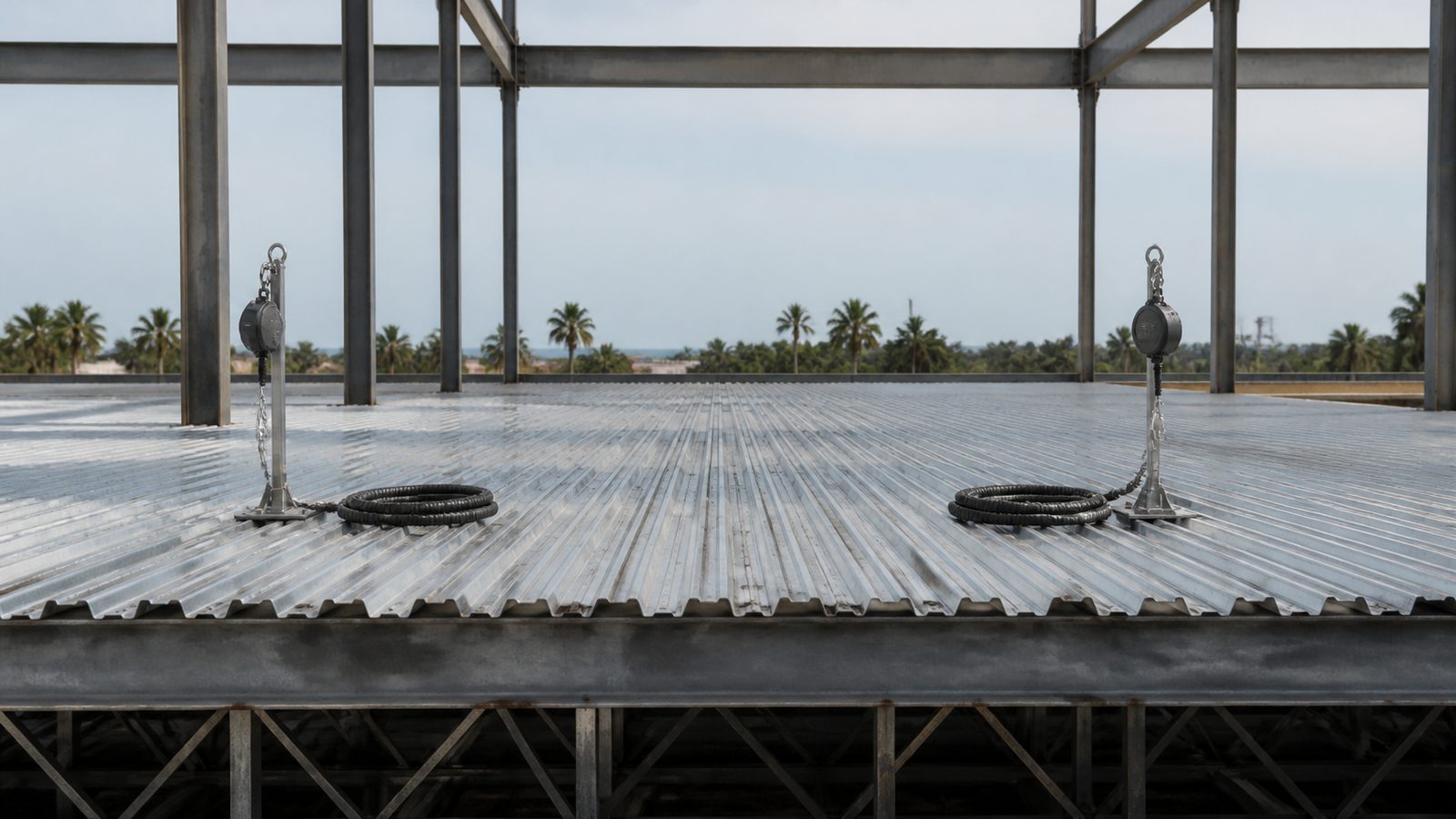
Step 2 — Set fall protection anchor and install safety harness Hazard: Unprotected roof edge; fall to lower level. Control: Install OSHA-compliant anchor rated for fall arrest load. Each crew member dons full-body harness, inspected that morning, with lanyard attached to anchor before approaching roof edge or opening area.
Step 3 — Make first cut with circular saw Hazard: Saw kickback; blade contact; flying debris. Control: Operator uses two-handed grip on saw. Blade guard in place and functional before starting. Personal protective equipment (PPE) — eye protection, cut-resistant gloves, hearing protection — worn by operator and all crew within 10 feet.
Step 4 — Remove cut section of roof deck Hazard: Cut section falls through to interior; personnel below at risk. Control: Establish exclusion zone below opening before cutting begins. Spotter at opening controls cut section descent. Cut section lowered by rope, not dropped.
This is not a theoretical exercise. This is what a crew talks through before they pick up a saw. The act of writing and reviewing the JSA is the intervention — it forces the crew to think about what can go wrong at each step before touching the task.
Why JSAs Prevent Incidents — and Schedule Delays
They Make Hazards Explicit Before Work Starts
Most construction incidents are preceded by a recognized hazard that nobody addressed. Post-incident investigations almost always find that the crew "knew" about the risk but didn't have a plan for it. A JSA makes that recognition and planning step mandatory before work begins.
Research from OSHA consistently shows that the majority of construction fatalities involve falls, struck-by events, caught-in/between incidents, and electrocution. All four of these hazard categories are identifiable in advance. A JSA that doesn't identify a fall hazard for a task performed above six feet is an incomplete JSA.
They Drive Supervisor Accountability
A JSA requires a supervisor signature before work begins. That signature creates accountability: the supervisor has reviewed the task, confirmed the hazards, and verified that controls are in place. If an incident occurs and the JSA was not completed, the supervisor failed to perform a required duty. That accountability structure changes behavior.
At JK Prestige Constructor, every supervisor holds an OSHA 30 certification — the 30-hour supervisor-level OSHA training course. OSHA 30 trains supervisors to identify hazards and implement controls, which is the same framework a JSA applies at the task level.
They Protect the Critical Path
This is the piece that surprises some owners: safety incidents are also schedule events. When a crew member is injured, the following happens simultaneously — work in that area stops, the incident must be investigated and documented, OSHA may conduct an inspection, the crew's focus shifts, and the GC's Total Recordable Incident Rate (TRIR) takes a hit that affects future bonding and insurance rates.
A single serious incident on a critical-path activity can cost two to five days of schedule. On a project with a hard delivery date — a hospital with a licensing deadline, a warehouse with a tenant lease start, a school with a first-day-of-school requirement — that schedule loss is a real cost, often measured in thousands of dollars per day.
JSAs are not just a safety tool. They are a schedule protection tool.
When a JSA Is Required vs. Routine Toolbox Talks
Not every task requires a JSA. Standard repetitive tasks — hanging drywall, installing interior framing, running conduit in a standard configuration — are covered by routine safety training and daily toolbox talks. Toolbox talks are brief (10 to 15 minutes) pre-shift safety conversations that cover the day's scope and any site-specific conditions. They are documented but not task-specific.
A JSA is required for non-routine tasks — work that is performed infrequently, work that involves an unusual combination of hazards, or work in a confined space, at significant elevation, or near energized equipment.
Examples of tasks that should trigger a JSA:
- Cutting openings in completed structural elements
- Work in confined spaces (tanks, crawl spaces, vaults)
- Rigging and crane lifts above occupied spaces
- Hot work (welding, cutting) near combustible materials or in occupied buildings
- Energized electrical work where de-energizing is not feasible
- Demolition of load-bearing elements in a renovation
At JK Prestige, a written JSA is required for every non-routine task on every project. This is not discretionary based on the supervisor's judgment — it is a standing operating requirement. See how our safety culture integrates with project delivery in The JK Way.

What Owners Should Ask About JSA Practices
When evaluating a general contractor for any project — ground-up construction, hospital renovation, warehouse build-out, or residential gut-reno — these are the safety questions that separate systems from claims:
- Do you require written JSAs for non-routine tasks? (The answer should be yes, always, not "when it seems necessary.")
- Who signs off on the JSA? (The supervisor, not the worker performing the task.)
- Can I see a sample JSA from a recent project? (A GC who runs the system will have these on file and be comfortable sharing them.)
- What is your TRIR? (Total Recordable Incident Rate — should be below the commercial GC industry average. JK Prestige's TRIR is below one-third of the industry average.)
- Do your supervisors hold OSHA 30 certifications? (All JK Prestige supervisory employees hold OSHA 30.)
A GC who can answer all five of these questions with specifics has a functioning safety system. A GC who gives vague answers about "prioritizing safety" does not.
If you're hiring a general contractor in Jacksonville or anywhere in Florida for a project where safety record and schedule protection matter, contact JK Prestige Constructor for a free estimate. Call (904) 944-0278. A principal answers.
No call center. No coordinator. A JK principal reviews every inquiry and replies with a real number, not a range, not a follow-up form.
Request Free Estimate →